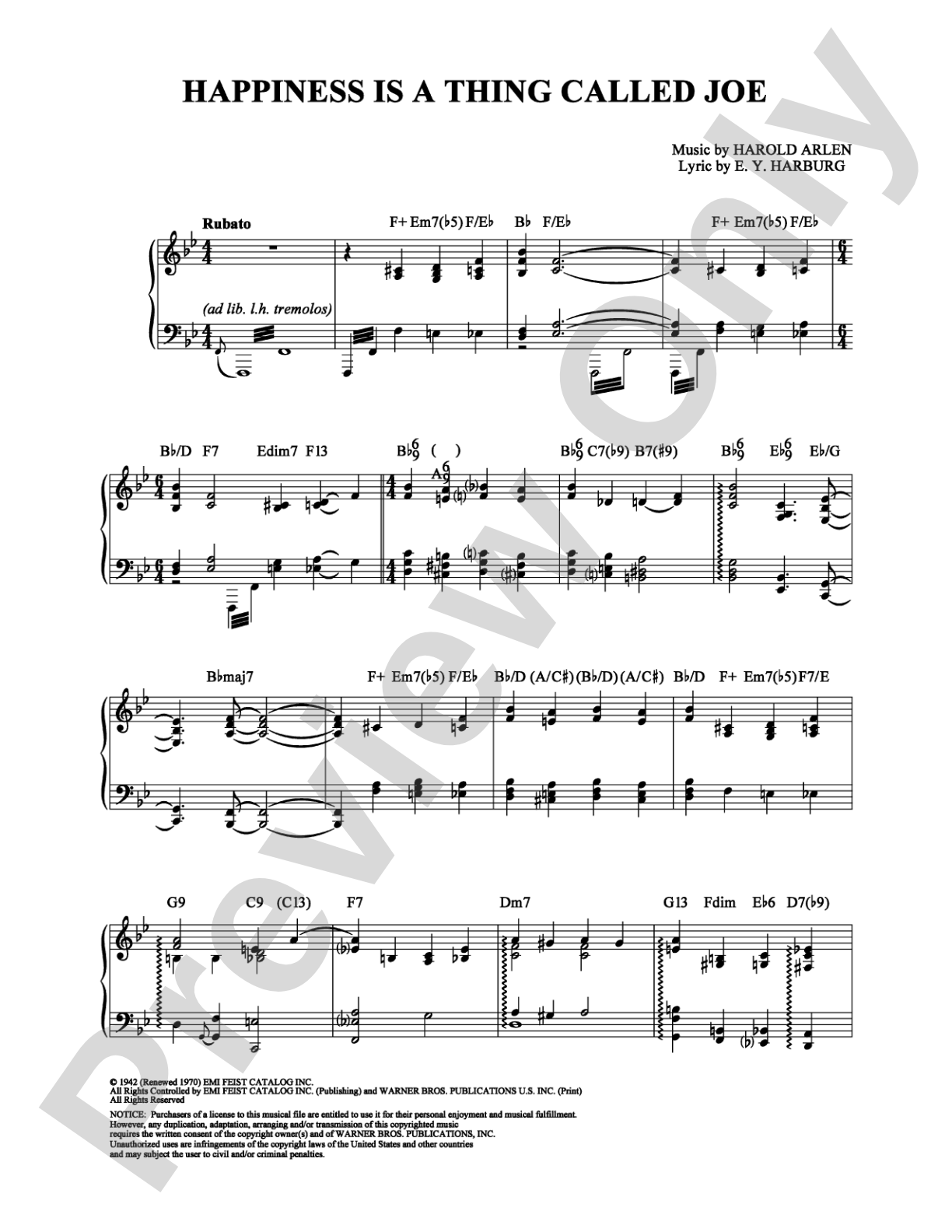
Happiness is a Thing Called Joe: Piano Digital Sheet Music

Happiness is a Thing Called Joe: Piano Digital Sheet Music

Harold Arlen, George Shearing

Item: 00-PS-0000533

Digital Download
$3.99
Description

Happiness is a Thing Called Joe: Piano Digital Sheet Music isn't in MakeMusic Cloud just yet...but it could be. Let us know you'd like to see it, and you'll help shape what comes next. In the meantime, start a free trial and dive into thousands of interactive titles your students can play along with today.

Sample Audio
No sample audio found.
Sample Video
Additional Details
SKU: 00-PS-0000533

More about this title

About the Artist: George Shearing

George Shearing (1919-2011) was a British jazz pianist and composer whose sophisticated harmonic approach and lush voicings defined the sound of 1940s and 1950s jazz. Blind from birth, Shearing developed an instantly recognizable style built on block chord technique and melodic clarity, leading the George Shearing Quintet to international fame. His arrangements and original compositions remain central to jazz pedagogy and performance.

Why we love this

Shearing's interpretation of this standard showcases exactly why his approach to jazz piano became a teaching standard. The voicings are sophisticated without being impenetrable, the harmonic movement is logical enough to analyze, and the swing feel sits right at the intersection of accessibility and artistry. Students hear a master balancing clarity and elegance.

What to expect

Warm, sophisticated, and conversational. The piece has an easy elegance that sounds effortless but requires thoughtful voicing choices and relaxed swing timing. There's a friendliness here, a sense that the pianist is inviting you into the music rather than showing off technical prowess.

Who it's for

This arrangement suits intermediate to advanced jazz pianists working on standard interpretation and harmonic application. It's also valuable for jazz theory students studying block chord voicing and for ensemble pianists who need a polished jazz credibility piece for recitals or informal settings.

How to get the most out of it

  • Anchor the bass line with a steady, walking pulse; let the block chords float slightly ahead of or settle into that foundation rather than racing ahead.
  • Voice the melody so it sits naturally on top of the harmony; Shearing's trademark is clarity, not density, so resist the urge to overload the middle voices.
  • Listen for the rubato in the phrasing and allow yourself space to breathe at phrase endings without losing the swing feel underneath.
  • Balance touch between the accompaniment and melody; the comping should support without competing for attention.

How to use it

Program this as a jazz interlude at a recital featuring multiple styles, or as an example piece during a jazz history or theory unit on standards and jazz piano traditions. It also works well in a casual setting where musicians and audiences share a moment of pure musical enjoyment without high stakes.

Skills your students will build

  • Block chord voicing and voice leading
  • Jazz swing articulation and phrasing
  • Harmonic analysis and reharmonization strategies
  • Reading and interpreting jazz notation and feel
  • Balancing melody, harmony, and accompaniment texture

You May Also Like