
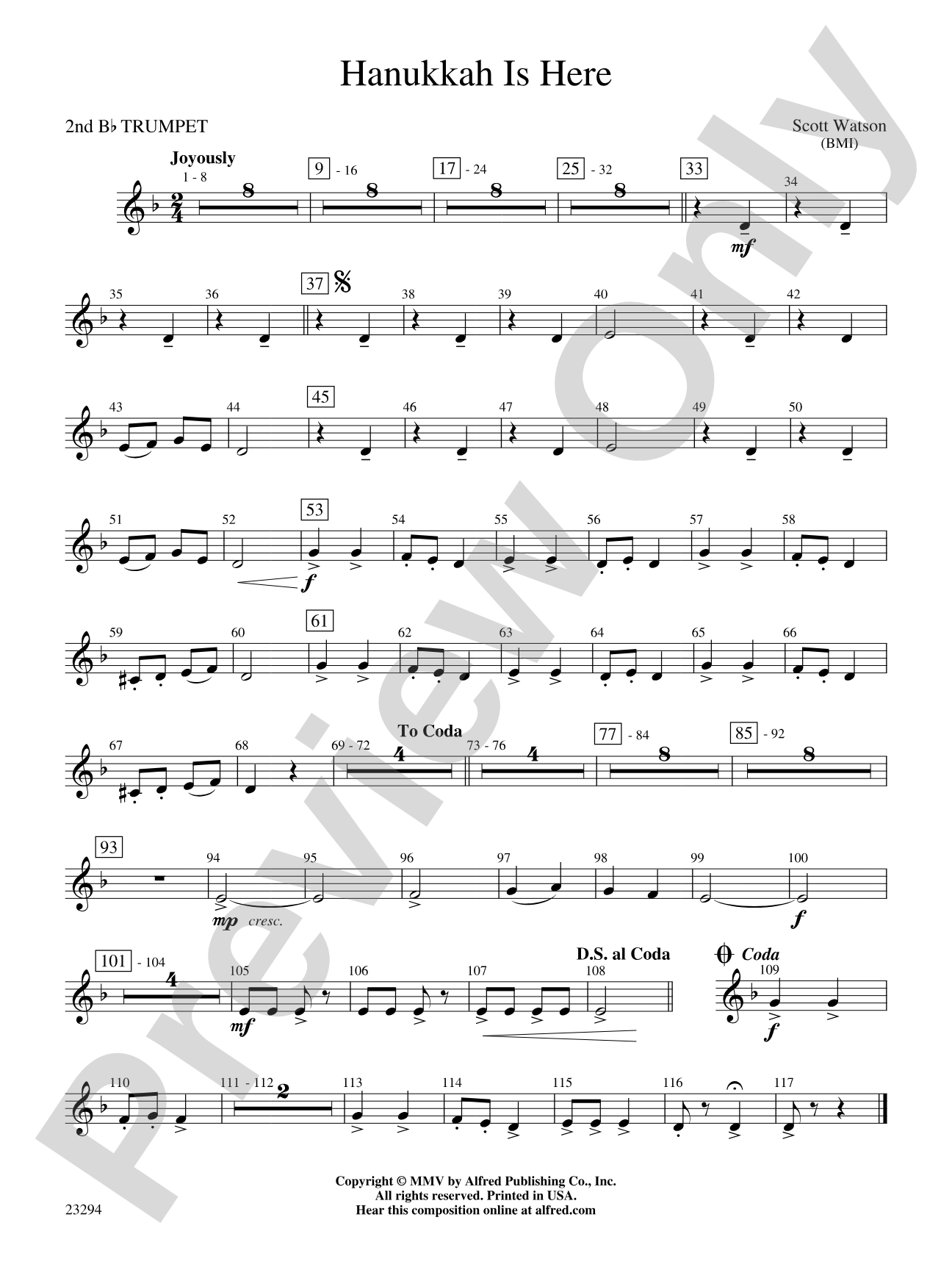

Hanukkah Is Here: 2nd B-flat Trumpet
By Scott Watson
Grade: 1 (Very Easy)
Item: 00-PC-0000644_T2
$3.00
Pickup currently not available
Description
For children, Hanukkah brings thoughts of a miracle from long, long ago and excitement each holiday season about what awaits. This work musically conveys both reflection and joy with colorful scoring and expressive writing. Add wonder to your holiday performance this year with "Hanukah Is Here."


Don't just read it, hear it, play along with it, and watch your students grow with it. In MakeMusic Cloud, Hanukkah Is Here: 2nd B-flat Trumpet comes alive with professional accompaniment, adjustable tempo, and built-in practice tools that turn solo practice into real progress.
Open in the Player
Jump straight in and assign it today.
Start Your Free Trial
Open this title and explore the full library in minutes.
Sample Audio
1
Audio File
--:--
0:00
0:00
Sample Video
Additional Details
Series:
Alfred Debut Series
Publisher:
Alfred Music
Page Count:
114
SKU:
00-PC-0000644_T2
More about this title
About the Composer: Scott Watson

Scott Watson brings three and a half decades of classroom experience to his work as a composer and educator. After leading instrumental programs in the Parkland School District (Allentown, PA), where he directed high school bands and built the elementary band and strings program across multiple buildings, Watson joined the faculty at Cairn University as Associate Professor of Music. His catalog includes more than 120 published works for concert band, string orchestra, and chamber ensembles spanning all difficulty levels.
Watson's compositions draw equally from his immersion in contemporary concert music and his deep understanding of the school band world. His pieces have been performed at venues including the Academy of Music in Philadelphia, the Midwest Clinic in Chicago, and the White House. Beyond composing, he serves as an exclusive composer and clinician for Alfred Publications, contributes to their Sound Innovations series, conducts honor and festival bands, and authored the textbook Using Technology to Unlock Musical Creativity (Oxford University Press, 2011). More information is available at www.scottwatsonmusic.com.
Why we love this
Watson captures the dual emotional core of the holiday—reverent memory and genuine celebration—without resorting to obvious musical clichés. The colorful orchestration and expressive phrasing make this accessible for young players while giving ensemble directors meaningful musical content to rehearse. At Grade 1, it fits perfectly into holiday programming when rehearsal time is tight but your students deserve something with real artistic substance.
What to expect
The piece opens with quiet wonder, inviting reflection on the historical meaning of the holiday before moving toward warmer, more celebratory passages. Colorful instrumental combinations create a sense of gathering and joy without losing the contemplative quality that makes the music memorable. Young players experience genuine expressive writing that rewards their effort and engagement.
Who it's for
Band directors building winter concert programs for Grade 1 ensembles, whether in schools with beginning players or community bands serving younger musicians. This works well for any director seeking holiday material that respects the musical intelligence of emerging musicians while remaining technically approachable.
How to get the most out of it
- Balance the melodic material across sections; at this level, clarity of line matters more than volume, so ensure inner voices support the main theme without overwhelming it.
- Let the expressive writing breathe naturally rather than over-conducting. Young players respond well to a conversational approach that emphasizes where the music should sing.
- Use the variety in texture and orchestration to maintain ensemble focus and keep rehearsals engaging. Point out the moments where different sections share the spotlight.
How to use it
Program this as a centerpiece for your winter concert's Hanukkah segment, positioning it between a rousing opener and closing piece to give the ensemble a chance to demonstrate both musical sensitivity and control. The 114 pages accommodate the full conductor score and parts, so you'll have everything needed for rehearsal and performance. Consider pairing it with other winter/holiday selections to create a thematic concert arc.
Skills your students will build
- Expressive phrasing and dynamic control in Grade 1 repertoire
- Balancing melody and accompaniment across mixed ensemble textures
- Sustaining focus during sectional changes and solo passages
- Connecting musical content to historical and cultural context