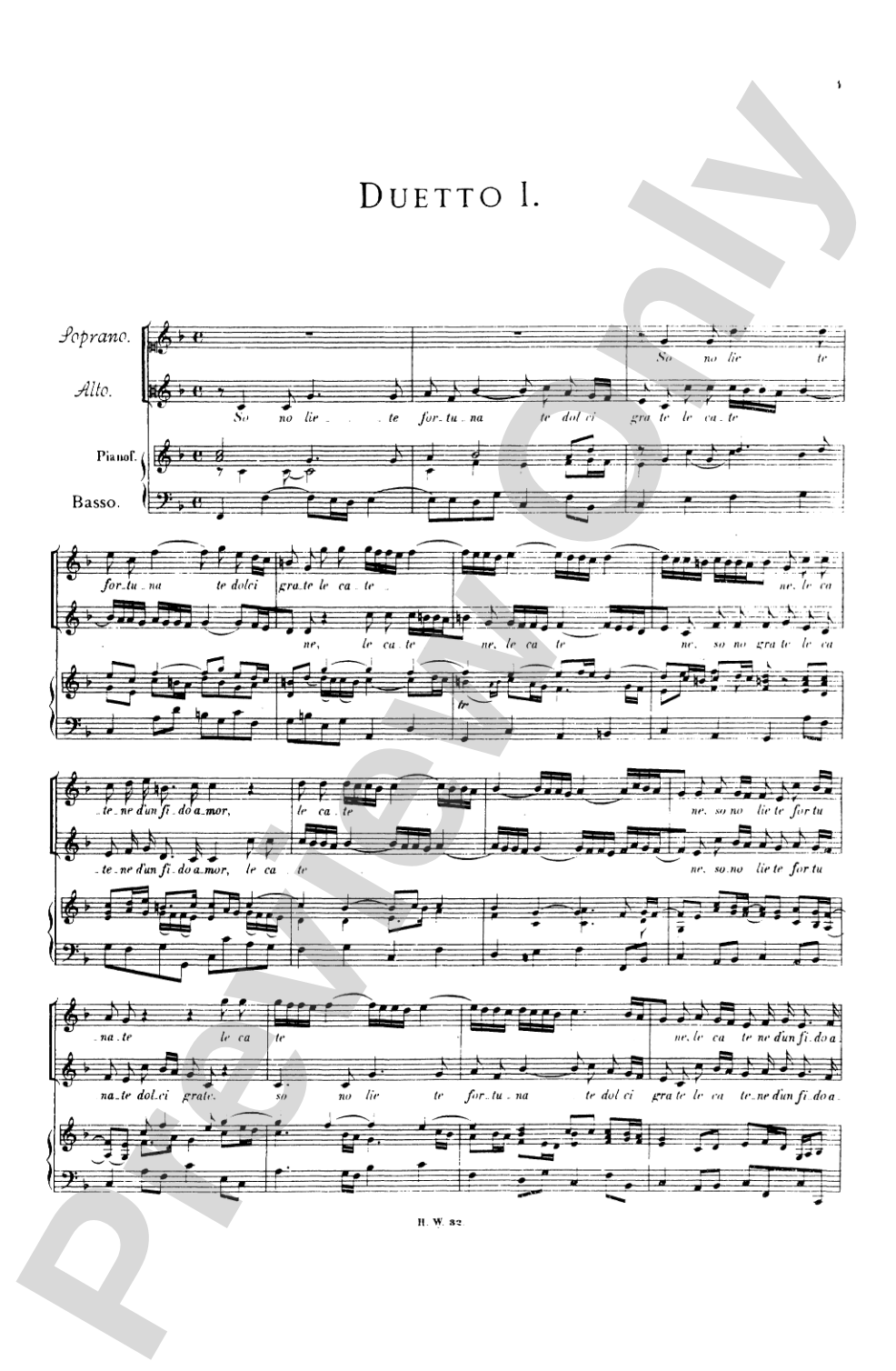
Handel: Italian Duets and Trios, Volume I (Italian) Sheet Music Preview

Handel: Italian Duets and Trios, Volume I (Italian)

By George Frideric Handel

Item: 00-PC-0002740

Digital Download
$0.99
Description
A collection of duets and trios for Voice, composed by George Frideric Handel.

Don't just read it, hear it, play along with it, and watch your students grow with it. In MakeMusic Cloud, Handel: Italian Duets and Trios, Volume I (Italian) comes alive with professional accompaniment, adjustable tempo, and built-in practice tools that turn solo practice into real progress.

Sample Audio
No sample audio found.
Sample Video
Additional Details
Series: Kalmus Edition
Publisher: Alfred Music
Page Count: 116
SKU: 00-PC-0002740

More about this title

About the Composer: George Frideric Handel

George Frideric Handel (1685-1759) was a German-born composer who spent much of his career in England, where he became a dominant figure in Baroque music. He mastered every major vocal and instrumental genre of his time, from operas and oratorios to keyboard works and concerti grossi. His gift for melody and dramatic expression made him one of the most performed composers of his era, a status his music has maintained for over 250 years.

Handel's vocal writing reveals his deep understanding of the human voice. Whether composing for the stage or the chamber, he crafted lines that sit naturally for singers while maintaining the harmonic sophistication and rhetorical power that defined his style. His duets and trios showcase this balance perfectly, allowing singers to experience authentic Baroque counterpoint without the scale or complexity of his larger works.

Why we love this

Handel's duets and trios are windows into the chamber music that filled aristocratic salons across 18th-century Europe. This collection preserves works that demand real artistry from singers: carefully balanced voice parts, ornamentation that rewards stylistic awareness, and harmonic language that deepens with repeated study. For a director building a recital program or a studio teacher seeking repertoire that bridges technique and musicianship, these pieces offer immediate rewards and unlimited depth.

What to expect

Handel's duets and trios breathe with the elegance of conversation between friends. The interplay of voices creates intimate moments despite their formal structure; a somber duet can shift suddenly to playful dialogue, and a reflective trio unfolds with the unhurried confidence of someone telling a story worth savoring. The harmonic language feels both orderly and emotional, grounding listeners in the rational beauty of the Baroque while the melodic lines lift and soar with genuine feeling.

Who it's for

This collection serves singers preparing for voice recitals, vocal chamber music ensembles, and advanced choral singers seeking solo repertoire that deepens their understanding of Baroque style. Studio teachers will find it invaluable for students ready to move beyond contemporary art songs into the technically and stylistically demanding world of classical vocal literature.

How to get the most out of it

  • Shape phrases with the long lines Handel favored in his vocal writing; allow singers to breathe naturally but avoid fragmenting the melodic arc with too many pauses.
  • Attend closely to the text underlay, which guides both rhythmic clarity and vocal phrasing; clarity of diction becomes especially important when two or three voices sing simultaneously.
  • Balance the voices according to the function of each line in the texture; a soprano singing the primary melody should not be swallowed by accompanying parts, even when all three voices carry equal musical weight.
  • Research period-appropriate ornamentation before rehearsing; Baroque singers added embellishments to repeats and cadences, and understanding these conventions transforms a restrained performance into an expressive one.

How to use it

These works pair naturally with other Baroque vocal works or a mixed program of Italian and English art songs; a duet or trio from this collection can anchor the second half of a recital or provide a moment of textural variety in an otherwise solo-dominated program. They also work beautifully as concert openers or closing pieces, their clarity and elegance setting a refined tone for the entire evening.

Skills your students will build

  • Stylistic awareness of Baroque vocal ornamentation and period conventions
  • Voice leading and balance in multi-voice textures
  • Italian diction and musical phrasing in an unfamiliar language
  • Reading and interpreting figured bass notation
  • Ensemble listening and intonation across independent melodic lines

You May Also Like