
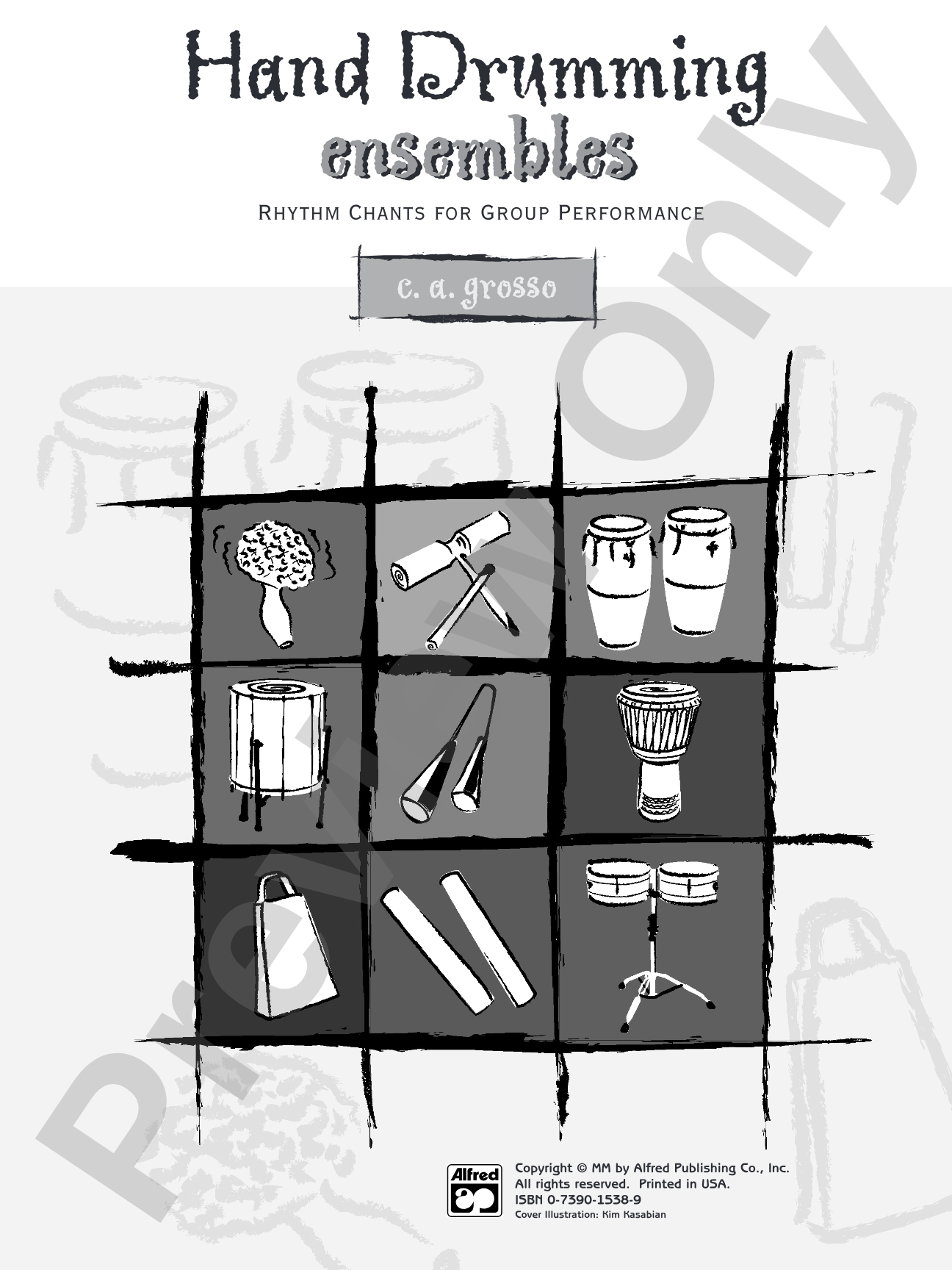

Hand Drumming Ensembles: Rhythm Charts for Group Performance
Rhythm Charts for Group Performance
By C. A. Grosso
Item: 00-PB-0002116
$8.50
Pickup currently not available
Related Items
Hand Drumming Ensembles: Drum Book |
$8.50
|
View |
Description
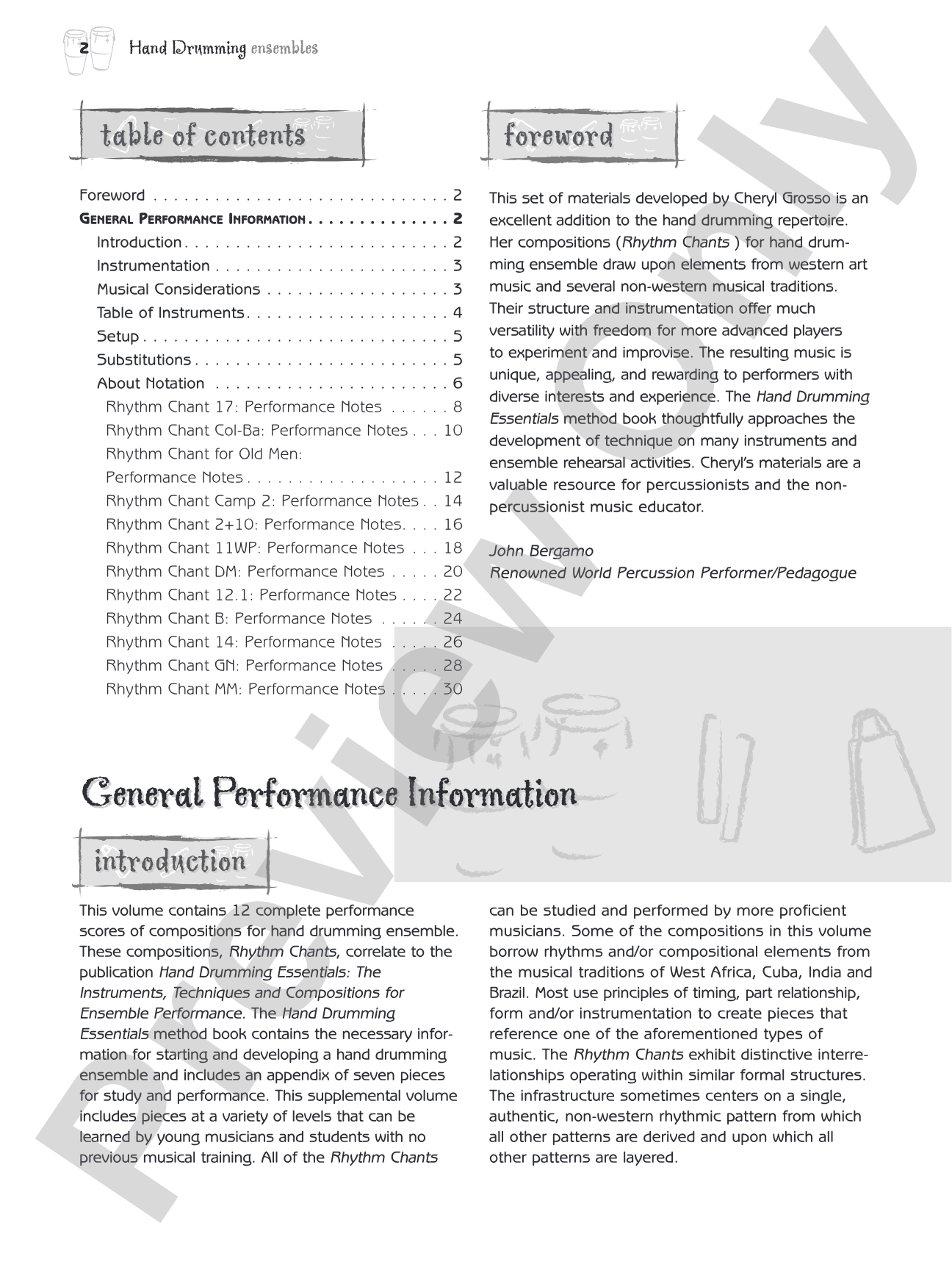
Hand Drumming Ensembles is the companion to the method book Hand Drumming Essentials: The Instruments, Techniques and Compositions for Ensemble Performance. This supplemental volume contains 12 complete performance scores of compositions for hand drumming ensemble. These compositions (Rhythm Chants) are written at a variety of levels and can be learned by young musicians and students with no previous musical training. All of the Rhythm Chants can be studied and performed by more proficient musicians.


Hand Drumming Ensembles: Rhythm Charts for Group Performance isn't in MakeMusic Cloud just yet...but it could be. Let us know you'd like to see it, and you'll help shape what comes next. In the meantime, start a free trial and dive into thousands of interactive titles your students can play along with today.
Request This Title
Tell us you want it.
Start Your Free Trial
Explore everything that's ready to play right now.
Sample Audio
No sample audio found.
Sample Video
No sample videos found.
Additional Details
Publisher:
Alfred Music
Page Count:
32
SKU:
00-PB-0002116
More about this title
About the Composer: C. A. Grosso

C. A. Grosso joined the University of Wisconsin-Green Bay music faculty in 1985 and has built a distinguished career bridging Western and non-Western percussion traditions. She holds a Doctor of Musical Arts in Percussion Performance and Pedagogy from the University of Iowa and a Master of Fine Arts in Percussion Performance from the California Institute of the Arts.
Her training spans continents and masters. In the Western tradition, she studied with prominent pedagogues including John Bergamo, Thomas L. Davis, and Karen Ervin Pershing. Equally important to her artistry is her deep engagement with non-Western percussion systems, having studied extensively with Pandit Taranath Rao, Alfred and Kobla Ladzekpo, Sowah Mensah, and K. R. T. Wasitodiningrat. This dual expertise informs her approach to ensemble writing and pedagogy.
Why we love this
These rhythm charts arrive ready to teach, grounded in years of ensemble pedagogy rather than generic patterns. Grosso's sequencing from foundational to more sophisticated rhythmic content respects what beginning students actually need, while the flexibility to perform across skill levels means you won't outgrow this collection as your ensemble matures.
What to expect
These rhythm chants pulse with the kind of accessible energy that lets newer musicians experience immediate success while remaining musically engaging. The interplay of layered rhythms creates cohesion and forward motion that keep performers and listeners anchored in the groove.
Who it's for
This collection serves hand drum programs at any stage, from teachers introducing students to ensemble concepts for the first time to experienced percussionists seeking varied repertoire that works for mixed ability groups. The graded difficulty means a single ensemble can perform pieces that challenge everyone proportionally.
How to get the most out of it
- Establish the pulse before layering parts. Have the group tap the foundation rhythm in unison first, then gradually add individual parts so each student feels their role within the larger structure.
- Record your ensemble's performance early in the learning process. Playing it back reveals rhythmic alignment issues and gives students a concrete reference for what precision sounds like.
- Rotate students between parts across rehearsals. This builds flexibility, deepens their understanding of how parts interlock, and prevents anyone from getting locked into a single rhythm.
- Direct with clear visual markers for section changes rather than relying solely on verbal cues. A raised hand or shift in your conducting position helps ensemble members anticipate transitions without losing focus on their own part.
How to use it
Open a concert with one of the foundational pieces to welcome your audience into the world of hand drumming, then progress through the collection to demonstrate your ensemble's developing sophistication. These chants also work well as warm-up material at the start of rehearsals or as stand-alone performances at school assemblies and cultural events.
Skills your students will build
- Reading rhythm notation in single-line and multi-part scores
- Maintaining steady pulse while executing individual rhythmic patterns
- Listening for alignment with ensemble members playing different parts
- Recognizing how ostinatos and call-and-response patterns create musical structure
- Performing music from non-Western percussion traditions with appropriate technique
- Executing hand drumming strokes with control and tonal clarity