
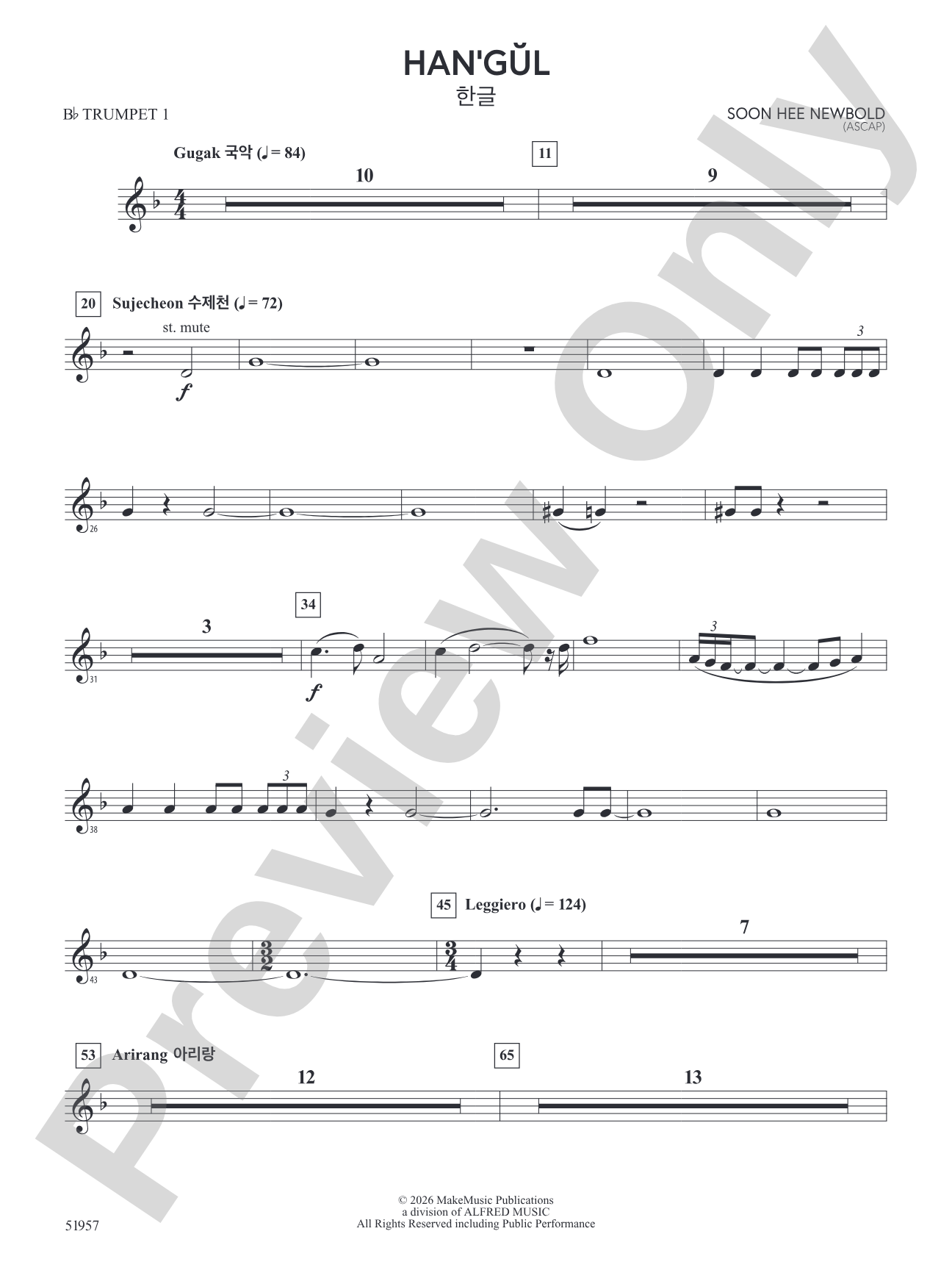

Han'gul: 1st B-flat Trumpet
한글
By Soon Hee Newbold
Grade: 5
Item: 00-PC-0019844_T1
$3.00
Pickup currently not available
Description
Commissioned by the LA Philharmonic Association under artistic director Gustavo Dudamel, Han'gul is a powerhouse work for symphony orchestra by Soon Hee Newbold, who drew inspiration from the rich history and culture of Korea. Several traditional Korean songs combine with original music as Newbold explores a unique blend between traditional Korean instruments and contemporary Western music. Stunning! (8:15)


Don't just read it, hear it, play along with it, and watch your students grow with it. In MakeMusic Cloud, Han'gul: 1st B-flat Trumpet comes alive with professional accompaniment, adjustable tempo, and built-in practice tools that turn solo practice into real progress.
Open in the Player
Jump straight in and assign it today.
Start Your Free Trial
Open this title and explore the full library in minutes.
Sample Audio
1
Audio File
--:--
0:00
0:00
Sample Video
Additional Details
Series:
MakeMusic Symphony Orchestra
Publisher:
MakeMusic Publications
SKU:
00-PC-0019844_T1
More about this title
About the Composer: Soon Hee Newbold

Soon Hee Newbold brings a distinctive compositional voice shaped by deep engagement with music across cultures and continents. Starting formal training at five on piano and seven on violin, she developed into a concert artist and eventually a composer whose works span from professional orchestras to beginning ensembles, performed at venues including Carnegie Hall, Kennedy Center, Lincoln Center, and Disney Hall.
Newbold's career reflects constant creative cross-pollination. She has conducted orchestras and bands throughout the United States, Europe, Australia, and Asia, drawing on these experiences to infuse her compositions with authentic cultural elements. Her work in Hollywood film and recording projects complements an active schedule as a keynote speaker and guest clinician, positioning her as both a working composer and advocate for music education at all levels.
Why we love this
Han'gul demonstrates how contemporary orchestration can honor traditional musical voices without diluting either world. A Grade 5 commission from the LA Philharmonic Association signals serious ambition, and Newbold's integration of actual Korean songs with original material creates structural coherence rather than patchwork exoticism. Your orchestra gets to inhabit genuinely blended musical spaces, not just borrow surface details.
What to expect
Han'gul unfolds as a conversation between two musical worlds, one rooted in centuries of Korean tradition and the other in contemporary Western symphonic practice. The piece builds cumulative power through this dialogue, creating moments of luminous beauty when cultures meet and moments of driving intensity as they interweave. At 8:15, it sustains interest through genuine musical substance rather than novelty.
Who it's for
Conductors leading high school or college orchestras ready to program beyond the standard European repertoire, and ensembles whose audiences deserve exposure to living composers and cross-cultural musical dialogue. This work serves orchestras seeking Grade 5 challenge pieces that also broaden musical horizons without sacrificing technical rigor.
How to get the most out of it
- Balance the traditional Korean instrumental colors against your Western orchestral palette by rehearsing sections separately before combining them, ensuring the unique timbral qualities read clearly in performance.
- Study the historical context and melodic shapes of the traditional Korean songs woven throughout; this knowledge helps your musicians understand the musical logic behind phrase shapes and ornamentation that may feel unfamiliar.
- Mark cues for the traditional Korean instruments carefully with your section leaders, as these often enter in counterpoint with Western orchestral lines and need secure independence to avoid getting lost in the mix.
- Record a run-through and listen for moments where the two musical languages might need dynamic adjustment; sometimes what balances in the room needs tweaking for clarity in live performance.
How to use it
Program Han'gul as a concert centerpiece rather than an opening, where its full cultural and musical scope can anchor a program exploring global perspectives. It pairs naturally with other contemporary works or following traditional standard repertoire as a statement about where orchestral music lives today. The substantial length and Grade 5 demands make it ideal for a spring concert where rehearsal time has built musician confidence and maturity.
Skills your students will build
- Balancing contrasting timbral colors in contemporary orchestration
- Executing unfamiliar melodic and rhythmic shapes derived from traditional Korean music
- Maintaining rhythmic precision across complex layering of multiple musical languages
- Interpreting ornamentation and articulation that reflects non-Western musical practice
- Ensemble independence when playing counterpoint between traditional and contemporary musical material