
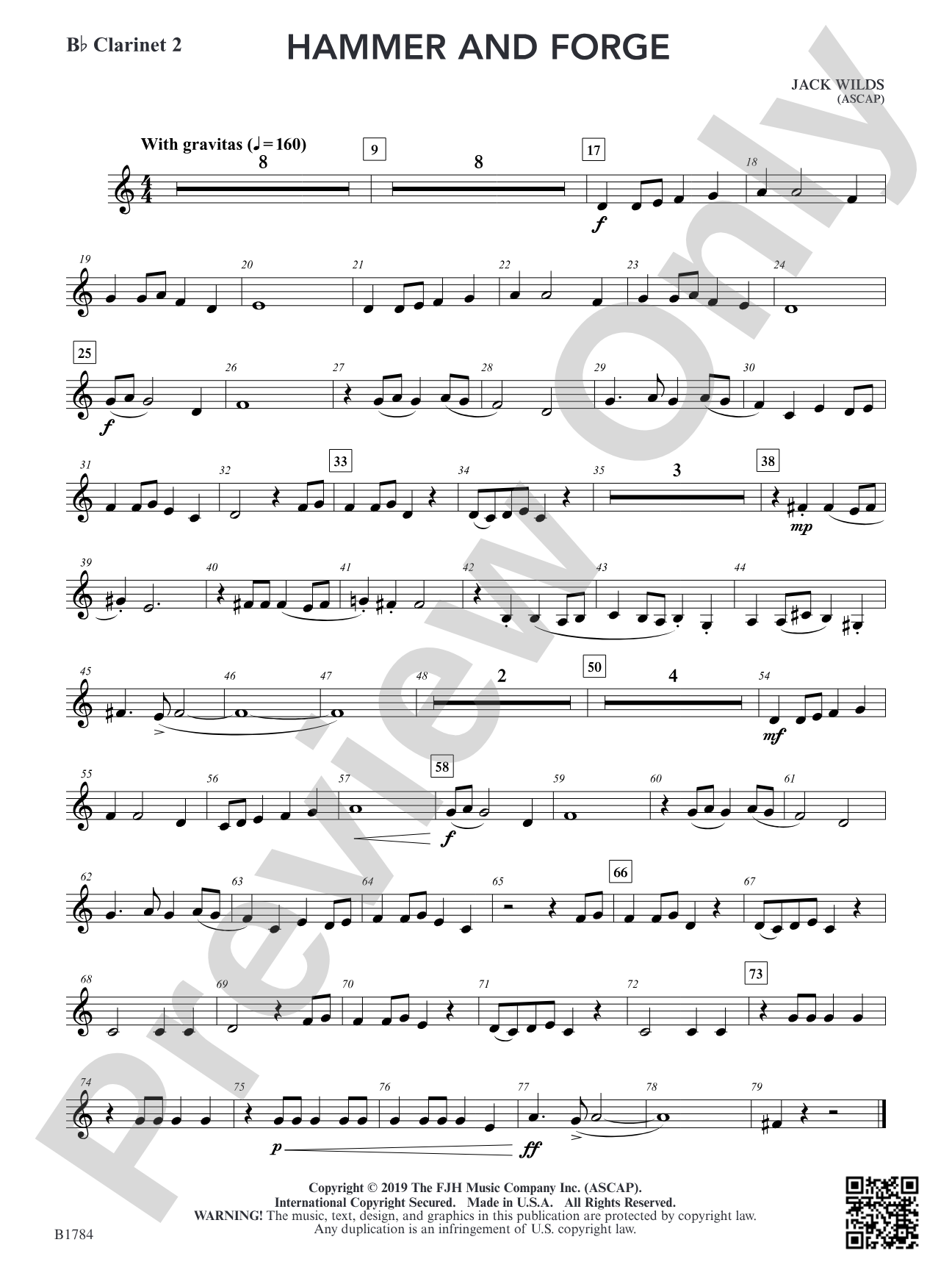

Hammer and Forge: B-flat Clarinet 2
By Jack Wilds
Grade: 1.5
Item: 98-PC-DB1784_C2
$7.00
Pickup currently not available
Description
Inspired by the art of blacksmithing, this powerful work combines sturdy, jovial melodies with hammer blows and sparkling cymbals to vividly portray the process of someone bending metal to their will. Also consider this as an exciting alternative to a traditional concert march!


Hammer and Forge: B-flat Clarinet 2 isn't in MakeMusic Cloud just yet...but it could be. Let us know you'd like to see it, and you'll help shape what comes next. In the meantime, start a free trial and dive into thousands of interactive titles your students can play along with today.
Request This Title
Tell us you want it.
Start Your Free Trial
Explore everything that's ready to play right now.
Sample Audio
1
Audio File
--:--
0:00
0:00
Sample Video
Additional Details
Series:
FJH Developing Band
Publisher:
The FJH Music Company, Inc.
SKU:
98-PC-DB1784_C2
More about this title
About the Composer: Jack Wilds

Jack Wilds composes music for ensembles spanning from children's choirs through professional orchestras, drawing inspiration from visual art, literature, and philosophical texts alongside purely musical sources. His work as a former public school band director informs his compositions for developing musicians; over 40 of his wind ensemble and choral pieces are published and regularly appear on festival required repertoire lists across multiple continents.
Wilds teaches composition, music theory, ear training, and music technology at Texas State University and serves as Co-Director of Music at First Presbyterian Church in San Marcos. His chamber works have been performed by the Attacca Quartet, members of the New York Philharmonic and Atlanta Symphony, and at major festivals including the International Trombone Festival and the Midwest Clinic. He studied composition with Michael Ippolito, Chris Trapani, and Donald Grantham.
Why we love this
Wilds captures the kinetic energy of blacksmithing without resorting to thin programmatic gimmickry. The writing is genuinely inventive: sturdy melodies sit naturally across the band, the percussion writing propels rather than decorates, and the whole piece swings with understated confidence. This sits perfectly at Grade 1.5, offering developing bands an exciting alternative to the standard march repertoire without inflating difficulty.
What to expect
The piece unfolds like a visit to a working forge: rhythmic, purposeful, and alive with the energy of creation. Sturdy melodies build momentum across bright brass and woodwind writing, punctuated by the ring and strike of percussion that underscores the physical craft. There's joy in the labor here, not struggle.
Who it's for
Concert bands working at Grade 1.5 seeking repertoire that combines accessibility with genuine artistry. Directors will appreciate material that challenges students musically without requiring advanced technical facility, and students will connect to a piece that tells a vivid story through sound.
How to get the most out of it
- Shape the melodic lines with clear phrase endings; the jovial character thrives on confident, singing statements from your first chair players across all sections.
- Balance the cymbal and percussion hits so they punctuate the action without overwhelming the melody. These are hammer strikes, not afterthoughts.
- Maintain consistent energy through scalar passages and repeated figures. The craftsmanship of the work depends on steady, purposeful execution rather than dramatic tempo changes.
- Let the rhythm section drive the forward momentum. Steady quarter-note pulse from the low instruments gives the piece its sense of purposeful labor.
How to use it
Program this as an opening or closing number for a concert featuring American musical narratives and character pieces. Its patriotic idiom and accessible Grade 1.5 level make it an excellent fit alongside folk-inspired works or other pieces celebrating craft and American themes. The piece also serves well as a festival selection, offering the excitement of a march without requiring standard march repertoire.
Skills your students will build
- Sustained, lyrical phrasing across multiple phrase lengths
- Balance and blend in ensemble scoring with clear melodic hierarchy
- Steady rhythmic foundation and pulse maintenance
- Coordination between melodic and percussive elements
- Musical storytelling through character and articulation