
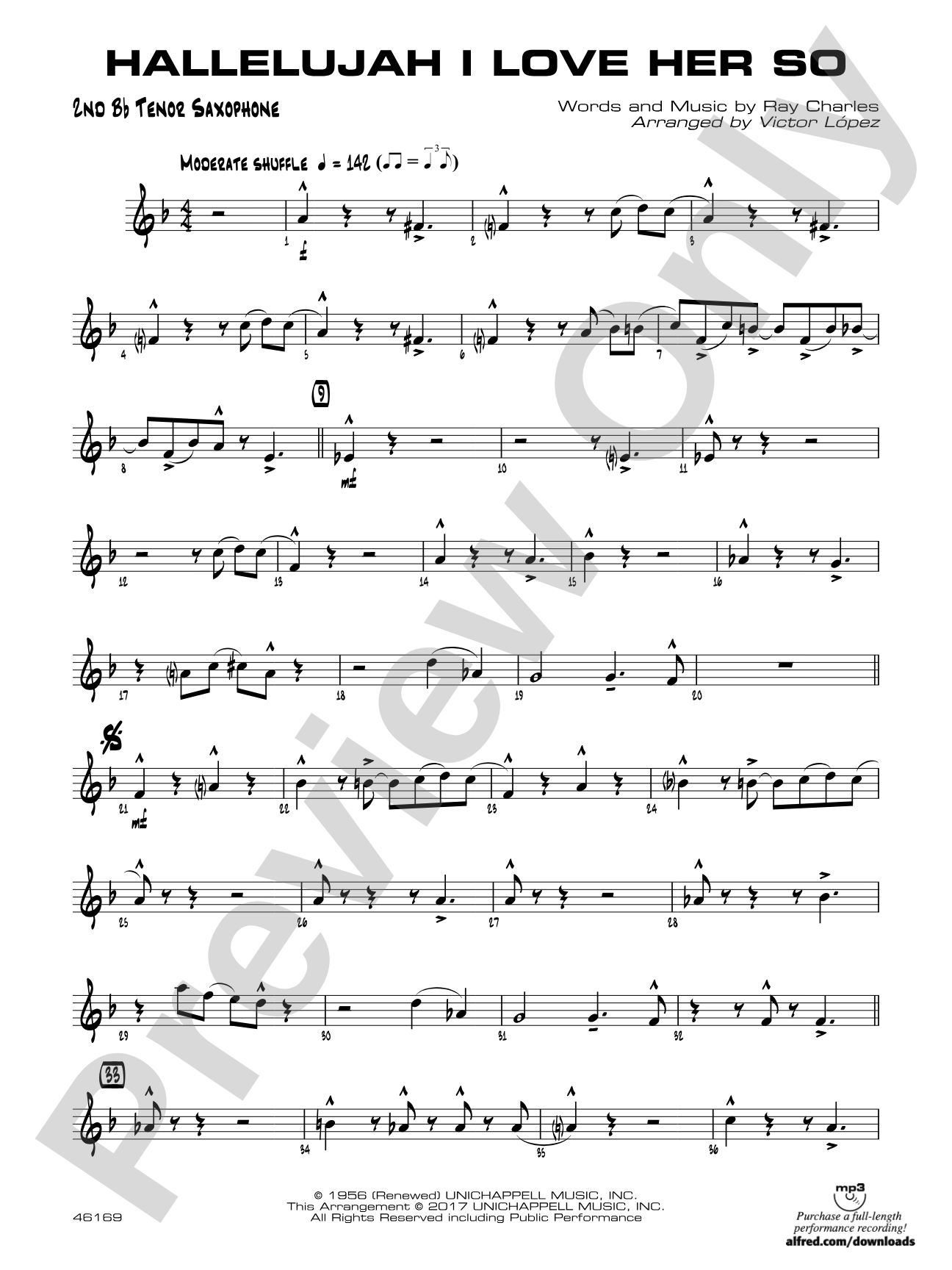

Hallelujah I Love Her So: 2nd B-flat Tenor Saxophone
Words and music by Ray Charles / arr. Victor López
Grade: 3 (Medium)
Item: 00-PC-0017759_TX2
$3.00
Pickup currently not available
Description
A shuffle swing vocal chart on an upbeat song with lyrics provided to accommodate female or male vocalists. The tempo is around 142 BPM, with a few stop time sections, no horn solos, just swingin' vocals and ensemble. The vocal range is from B-flat below middle C to third space B-flat. Optional parts to substitute for the vocal are provided for C, B-flat, E-flat, and trombone. (3:05) This title is available in MakeMusic Cloud.


Don't just read it, hear it, play along with it, and watch your students grow with it. In MakeMusic Cloud, Hallelujah I Love Her So: 2nd B-flat Tenor Saxophone comes alive with professional accompaniment, adjustable tempo, and built-in practice tools that turn solo practice into real progress.
Open in the Player
Jump straight in and assign it today.
Start Your Free Trial
Open this title and explore the full library in minutes.
Sample Audio
1
Audio File
--:--
0:00
0:00
Sample Video
Additional Details
Series:
Jazz Vocal Series
Publisher:
Alfred Music
Page Count:
90
SKU:
00-PC-0017759_TX2
More about this title
About the Composer: Ray Charles
Ray Charles (1930-2004) revolutionized popular music by fusing gospel, blues, country, and jazz into a deeply personal sound. His influence on American music education extends far beyond his recordings; his fearless approach to genre-blending and his commitment to emotional authenticity continue to inspire musicians across all styles and ensembles.
Charles's compositional legacy provides jazz educators with accessible yet sophisticated models for vocal phrasing, rhythm section interaction, and the integration of blues tonality into swing contexts. His work demonstrates how vernacular American music can serve as serious repertoire for student ensembles.
Why we love this
This Victor López arrangement captures the infectious joy of Ray Charles's original without sacrificing the shuffle swing groove that makes the piece swing. The straightforward vocal line paired with an engaging ensemble section creates a performance that sounds polished while remaining within reach of intermediate jazz ensembles, and the optional instrumental substitutions give you flexibility whether your vocalist is a soprano or a baritone.
What to expect
Upbeat and joyful, with a classic shuffle swing bounce that feels effortless and celebratory. The stop time sections create moments of surprise and intimacy, inviting the audience into a conversation between vocalist and ensemble that never loses its forward momentum.
Who it's for
Jazz ensemble directors seeking repertoire that engages student singers and builds swing ensemble literacy at an intermediate level. This works for mixed-voice jazz groups, small jazz combos with vocal capability, or as a feature piece for a vocalist within a larger jazz band setting.
How to get the most out of it
- Shape the vocal line with swing eighth notes and lyrical phrasing rather than mechanical rhythmic precision; the groove comes from the ensemble, not the vocalist.
- Use the stop time sections to build dramatic tension. Have the rhythm section lock in tightly during these moments so the vocalist can stretch and breathe musically without losing the pulse.
- Balance the vocal against the ensemble throughout. The vocalist should sit above the texture, but the accompaniment's energy and swing must remain clear and propulsive.
- If using an optional instrumental solo instead of vocals, maintain the same character and energy; the piece works equally well as a feature for trumpet, alto sax, tenor sax, or trombone.
How to use it
Program this as a show-stopping second-set opener or as a midpoint energizer in a jazz concert where you need to lift the room and showcase vocal talent. The 3-minute length fits comfortably into mixed-repertoire concerts and pairs naturally with other medium-difficulty jazz vocal or ensemble pieces.
Skills your students will build
- Swing eighth-note articulation and phrasing in a vocal context
- Listening for and locking into the ensemble groove while singing
- Navigating stop time sections without losing rhythmic security
- Reading jazz vocal lines with chord changes and stylistic inflection
- Balancing and blending as an ensemble while supporting a featured soloist