Hallelujah Chorus: Percussion 2 Sheet Music Preview

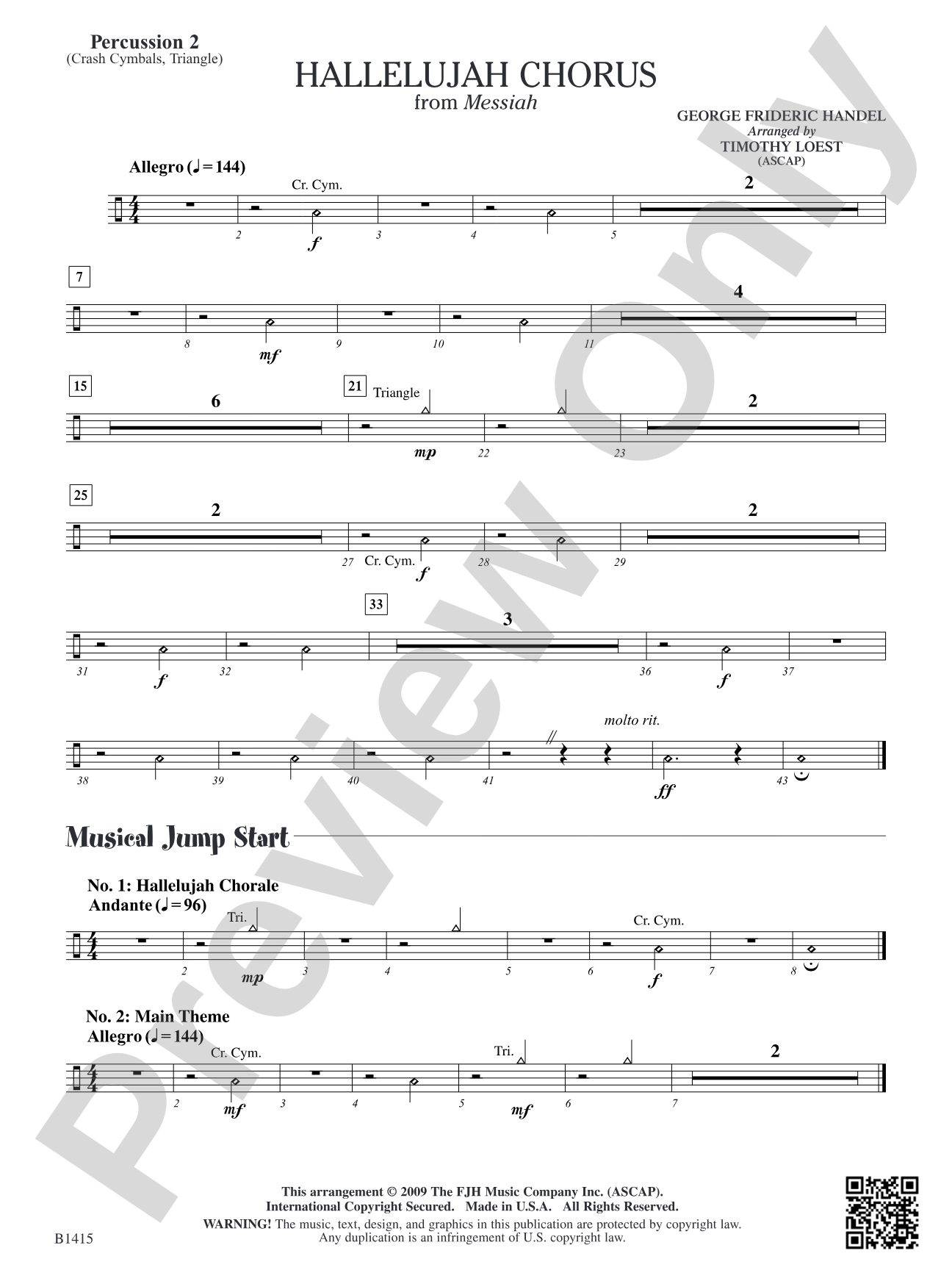
Hallelujah Chorus: Percussion 2

By George Frideric Handel / arr. Timothy Loest

Level:.5

Item: 98-PC-DB1415_PC2

Digital Download
$7.00
Description
This exceptional arrangement may well be the first of its kind ever to capture the spirit of Handel’s masterpiece using just six notes! Weaving through the various themes of the original, Loest is able to maintain a surprising sense of authenticity while making this the most accessible version of the Hallelujah Chorus one is likely to ever find. Outstanding!

Don't just read it, hear it, play along with it, and watch your students grow with it. In MakeMusic Cloud, Hallelujah Chorus: Percussion 2 comes alive with professional accompaniment, adjustable tempo, and built-in practice tools that turn solo practice into real progress.

Sample Audio
0:00
0:00
Sample Video
Additional Details
Series: FJH Starter Series
Publisher: The FJH Music Company, Inc.
SKU: 98-PC-DB1415_PC2

More about this title

About the Composer: George Frideric Handel

George Frideric Handel (1685-1759) was a German-born composer who spent most of his career in England, where he became a central figure in Baroque music. His dramatic works, instrumental compositions, and sacred music established him as one of the most performed and influential composers of his era. The Hallelujah Chorus, from his 1741 oratorio Messiah, remains one of the most recognizable pieces in the classical canon.

Handel's gift for memorable melody and structural clarity made his music immediately accessible to both court audiences and the general public. His approach to composition—direct, emotionally resonant, and brilliantly orchestrated—continues to inspire educators and performers seeking music that communicates across skill levels and generations.

Why we love this

Timothy Loest has performed something genuinely rare: he has distilled Handel's iconic chorus into its essence using a palette of just six pitches, yet the arrangement retains the harmonic sophistication and structural logic of the original. Your band will experience authentic masterwork arranging at an entry-level difficulty, making this ideal for programs introducing students to Handel without sacrificing musical integrity.

What to expect

The familiar proclamatory grandeur of the original emerges through an unexpected lens of restraint. Within the six-note framework, Handel's harmonic language and structural genius remain audible, creating a sense of discovery for both performers and listeners who encounter this streamlined yet authentic version.

Who it's for

This arrangement opens the Hallelujah Chorus to beginning and developing concert bands while serving as a model of faithful, creative arranging. Directors working with younger or less experienced ensembles who want to program a masterwork without oversimplifying will find this invaluable.

How to get the most out of it

  • Build the character gradually from the opening announcements through the fugal sections, letting the six-note constraint create natural points of textural contrast rather than limiting expression.
  • Maintain the integrity of Handel's phrasing by treating the score as a conductor's score first; shape lines across parts rather than emphasizing individual section boundaries.
  • Balance the homophonic and fugal sections clearly; the fugal passages will emerge more powerfully if the early statements are grounded and unhurried.

How to use it

This works beautifully as a holiday concert centerpiece or as part of a pops program exploring masterwork arrangements at accessible levels. Consider pairing it with other Level 0.5-1 pieces to demonstrate how great music can be made available across the full range of student bands without compromise.

Skills your students will build

  • reading and executing clean attacks and releases in homophonic textures
  • maintaining linear independence in fugal passages despite limited pitch material
  • understanding how arrangers preserve compositional intent through constraint
  • responding to large-scale phrase architecture and structural pacing

You May Also Like