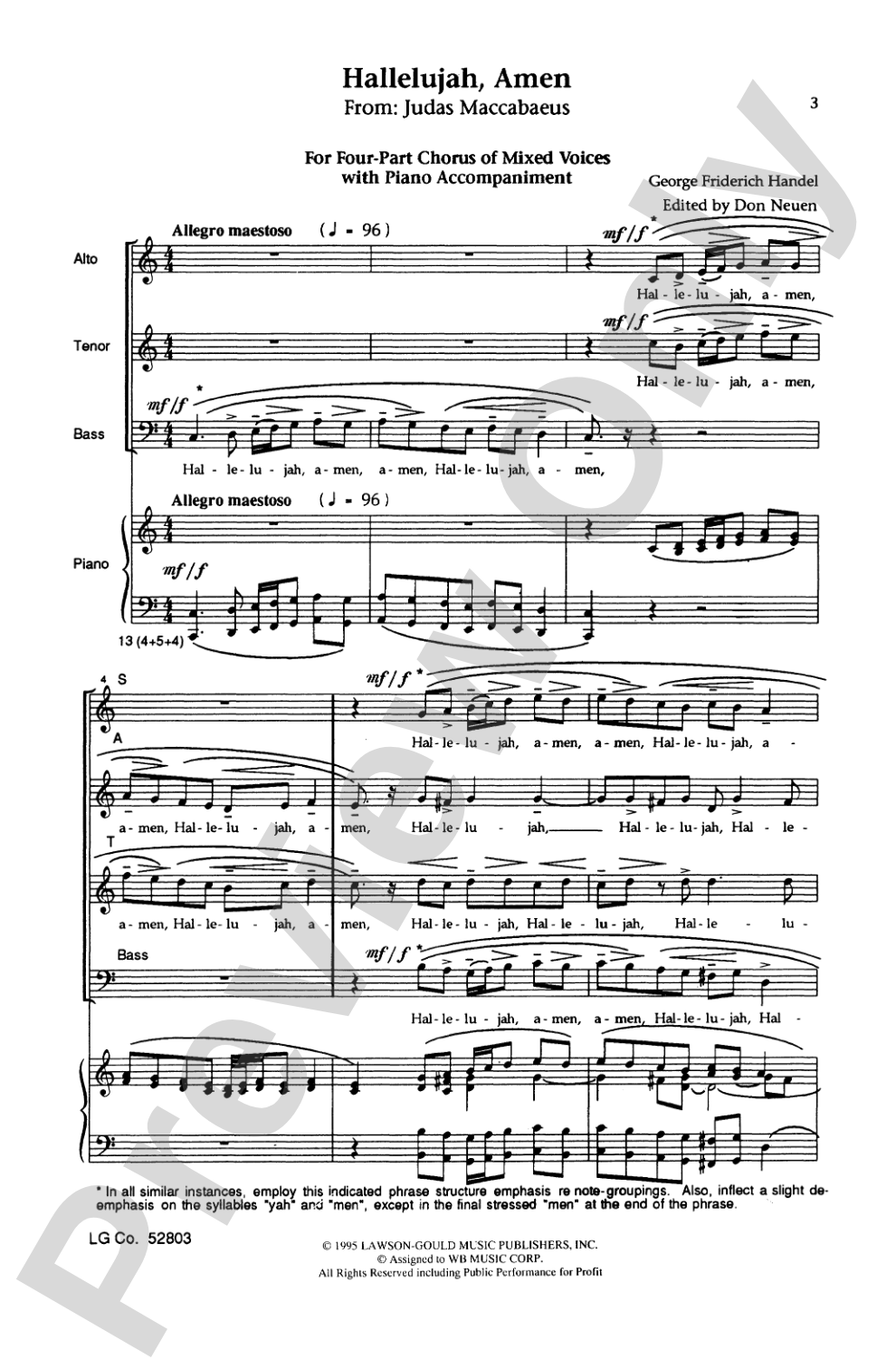
Hallelujah, Amen (from <I>Judas Maccabaeus</I>) Sheet Music Preview

Hallelujah, Amen (from Judas Maccabaeus): SATB Choral Octavo

From Judas Maccabaeus

By George Frideric Handel / ed. Donald Neuen

Item: 00-PO-0005096

Digital Download
$2.25

Minimum order quantity: 20 copies

Description

Hallelujah, Amen (from Judas Maccabaeus): SATB Choral Octavo isn't in MakeMusic Cloud just yet...but it could be. Let us know you'd like to see it, and you'll help shape what comes next. In the meantime, start a free trial and dive into thousands of interactive titles your students can play along with today.

Sample Audio
No sample audio found.
Sample Video
Additional Details
Series: Alfred Archive Edition: Lawson-Gould Music Publishers
Publisher: Alfred Music
Page Count: 8
SKU: 00-PO-0005096

More about this title

About the Composer: George Frideric Handel

George Frideric Handel (1685-1759) dominated the musical life of London for over fifty years, establishing himself as a master of both opera and oratorio. His dramatic gift for melody and his architectural command of large forms made him one of the most performed composers of his era and beyond. In the English-speaking world especially, his oratorios remain central to the choral repertoire, performed in concert halls, churches, and festivals worldwide.

Handel's approach to choral writing combines theatrical grandeur with accessibility. His choruses drive narrative forward while remaining singable by ensembles of varied skill levels. This balance between artistic substance and practical musicianship explains why his works endure in education and professional contexts alike.

Why we love this

This movement from Judas Maccabaeus brings exactly what festival adjudicators reward: clear harmonic architecture, rhythmic precision, and text that demands unanimous commitment from all four voice parts. The piece teaches ensemble discipline without sacrificing the joy of Baroque counterpoint, and its celebratory character energizes both singers and listeners.

What to expect

Joyful affirmation with classical proportion. The music radiates confidence through clear harmonic motion and rhythmic decisiveness, without bombast. Each voice contributes equally to a unified celebration that feels both intellectually satisfying and emotionally direct.

Who it's for

Intermediate to advanced SATB choirs preparing for festival competition or concert programming. This arrangement suits both student ensembles with secure fundamentals and adult community choirs seeking Baroque repertoire with immediate impact.

How to get the most out of it

  • Emphasize the rhythmic vitality of the "Amen" sections. These statements work best when sung with spring and forward momentum rather than processed as purely devotional moments.
  • Balance the inner voices in the homophonic passages. Handel wrote for four independent parts, and the alto and tenor lines deserve clarity alongside the soprano melody.
  • Shape the longer phrases with attention to Baroque breathing practice. Singers should plan breath points that honor the harmonic rhythm rather than text fragments.
  • Approach the dynamic architecture as written without adding unnecessary crescendos. Handel's contrasts between sections create sufficient architectural interest.

How to use it

Program this as a festival entry or as a concert conclusion where you want to send the audience out with undeniable musical substance. It also works effectively paired with other Baroque sacred works or as a contrast to Romantic-era choral repertoire.

Skills your students will build

  • Reading and executing Baroque text underlay conventions
  • Balancing homophonic writing across four voices
  • Understanding harmonic function and cadential structure in Baroque contexts
  • Rhythmic precision in dotted figures and syncopated passages
  • Managing breath points in relation to harmonic phrasing

You May Also Like