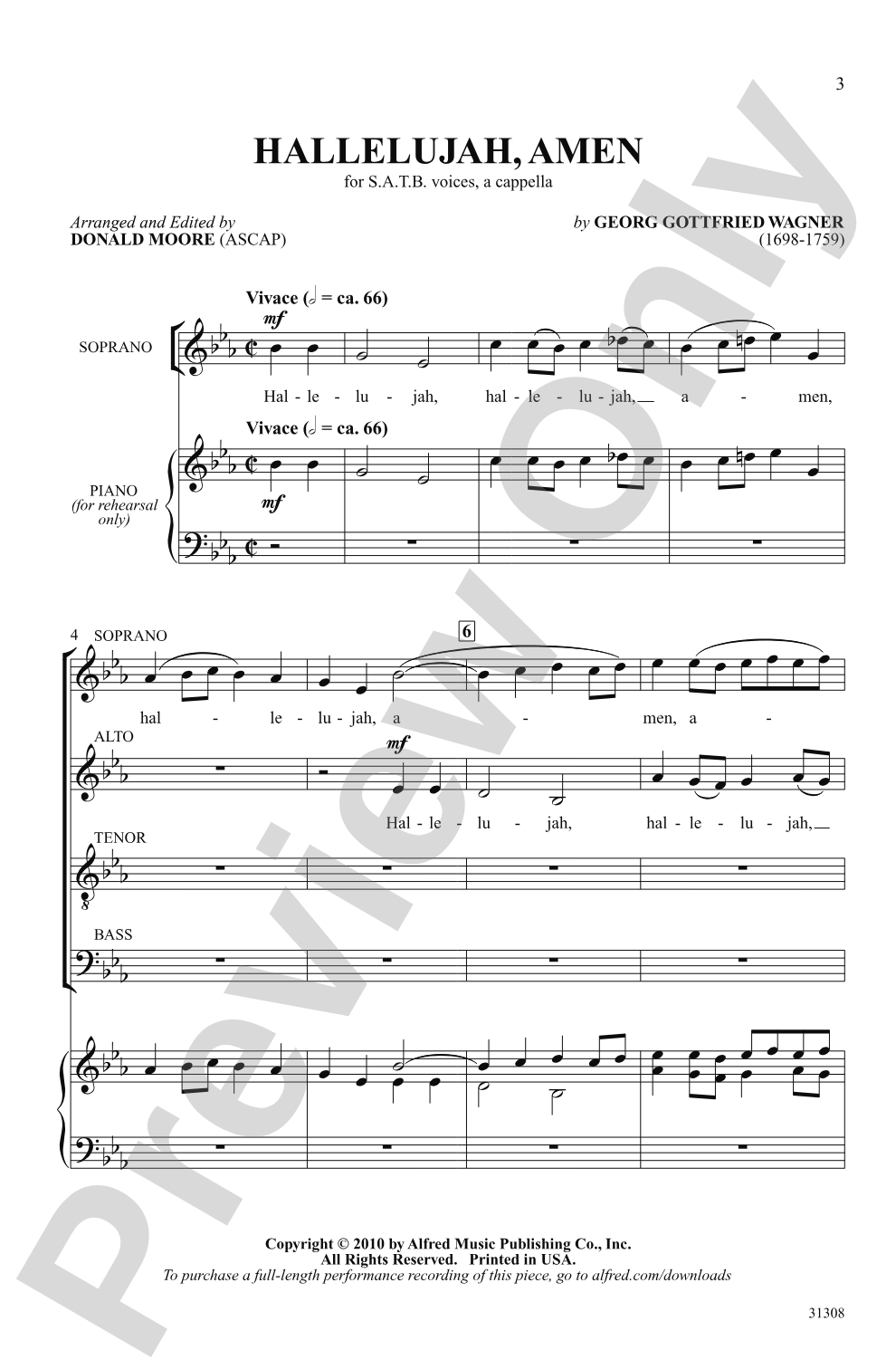
Hallelujah, Amen Sheet Music Preview

Hallelujah, Amen: SATB Choral Octavo

By Georg Gottfried Wagner / arr. and ed. Donald Moore

Item: 00-PO-0000826

Digital Download
$1.75

Minimum order quantity: 20 copies

Description
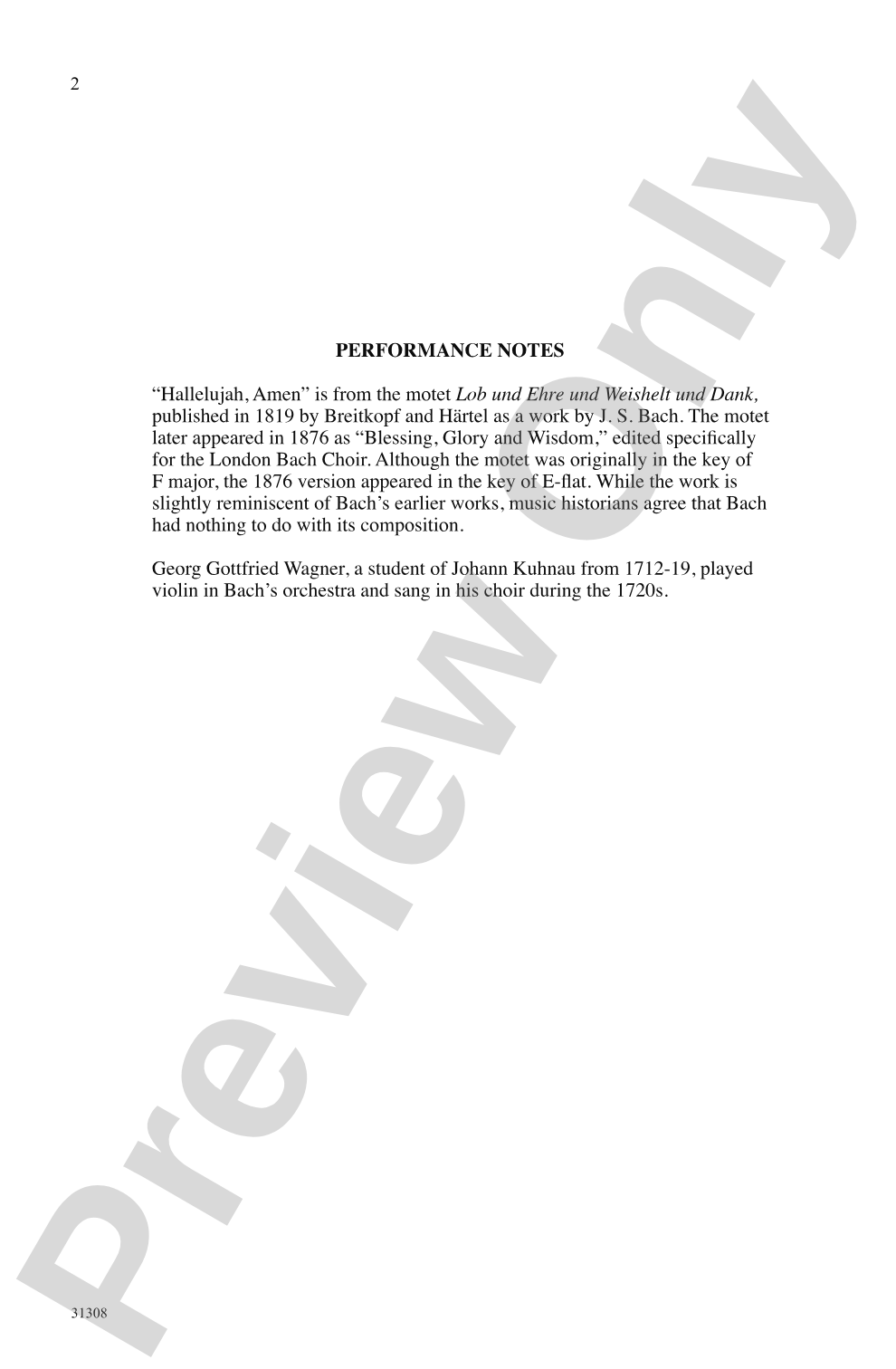
This contrapuntal chorus comes from a 19th century motet composed by a performer in J. S. Bach's choir and orchestra. The piece, first published in 1819, was mistakenly attributed to Bach himself.

Hallelujah, Amen: SATB Choral Octavo isn't in MakeMusic Cloud just yet...but it could be. Let us know you'd like to see it, and you'll help shape what comes next. In the meantime, start a free trial and dive into thousands of interactive titles your students can play along with today.

Sample Audio
0:00
0:00
Sample Video
Additional Details
Series: Alfred Choral Designs
Publisher: Alfred Music
Page Count: 8
SKU: 00-PO-0000826

More about this title

About the Composer: Georg Gottfried Wagner

Georg Gottfried Wagner (1698-1756) was a German composer and performer who worked in the Leipzig Collegium Musicum and sang in J. S. Bach's choir. His sacred vocal works reflect the contrapuntal mastery of the Bach era, though his individual compositions remained largely overshadowed by his more famous contemporaries.

Wagner's output demonstrates solid craft in the motet tradition. This piece, long attributed to Bach himself after its 1819 publication, speaks to the respect his writing earned from subsequent generations of musicians. The confusion over attribution only underscores how well he absorbed the musical language of his time and place.

Why we love this

This arrangement gives singers authentic Baroque counterpoint without the pedagogical demands of a full Bach motet. The contrapuntal writing is genuinely challenging but lies in a manageable range for high school and college choirs, making it ideal when you want serious musical substance with accessibility.

What to expect

The piece radiates the orderliness and mathematical precision of Baroque counterpoint, yet the sacred text lifts it beyond academic exercise into genuine devotional expression. Four independent voice lines weave and intersect with clarity and purpose, creating an architecture that feels both inevitable and uplifting.

Who it's for

High school and college choirs with intermediate to advanced sight-reading skills will find this octavo rewarding. Directors seeking substantial Baroque repertoire that avoids overexposure to Bach himself will appreciate having this alternative in rotation.

How to get the most out of it

  • Shape each voice line as a distinct melody. Wagner wrote every part to sing; resist blending voices into homophonic blocks. Test each section by singing parts solo during rehearsal.
  • Address the text painting in the word "Hallelujah" with careful attention to phrase shape. These moments deserve room to breathe rather than hurried delivery.
  • Balance the soprano and alto entries carefully in imitative passages. The lower voices often carry foundational material; ensure tenors and basses anchor the harmonic progressions so upper voices can spin out their lines.

How to use it

Schedule this for a concert exploring the Bach era and its contemporaries, pairing it with works by other composers in the Leipzig circle. Its moderate length and digital format make it practical for adding depth to a spring sacred music program without requiring extensive rehearsal time.

Skills your students will build

  • Reading and performing imitative counterpoint
  • Sustaining independent melodic lines within ensemble texture
  • Balancing multiple simultaneous voice entries
  • Phrasing in Baroque sacred music idiom
  • Text declamation in contrapuntal writing

You May Also Like