
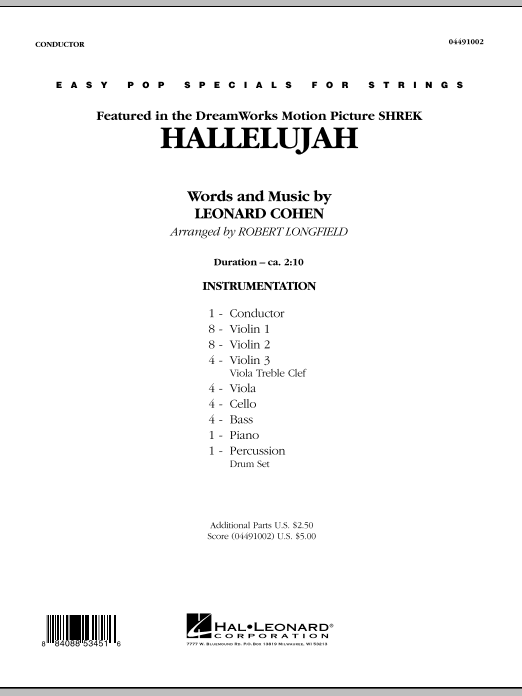

Hallelujah: String Orchestra Conductor Score & Parts
By Leonard Cohen / Arranged by Robert Longfield
Grade: 2
Item: 35-PK00157525
$45.00
Pickup currently not available
Buy Extra Parts (Digital PDF Download)
| Product | Price | Quantity |
|---|---|---|
| Hallelujah - Full Score | $7.50 | |
| Hallelujah - Violin 1 | $7.00 | |
| Hallelujah - Violin 2 | $7.00 | |
| Hallelujah - Violin 3 (Viola Treble Clef) | $7.00 | |
| Hallelujah - Viola | $7.00 | |
| Hallelujah - Cello | $7.00 | |
| Hallelujah - Bass | $7.00 | |
| Hallelujah - Piano | $7.00 | |
| Hallelujah - Percussion | $7.00 |
Parts Added to Cart!
Description
Recorded by such diverse artists as Bob Dylan, Bon Jovi and Justin Timberlake, "Hallelujah" was also heard in the movie "Shrek" and during the 2010 Winter Olympics opening ceremony in Vancouver. Robert's setting is just right for string groups who want to perform popular songs from artists they love. Dur: 2:10


Hallelujah: String Orchestra Conductor Score & Parts isn't in MakeMusic Cloud just yet...but it could be. Let us know you'd like to see it, and you'll help shape what comes next. In the meantime, start a free trial and dive into thousands of interactive titles your students can play along with today.
Request This Title
Tell us you want it.
Start Your Free Trial
Explore everything that's ready to play right now.
Sample Audio
No sample audio found.
Sample Video
No sample videos found.
Additional Details
Publisher:
Hal Leonard
SKU:
35-PK00157525
More about this title
About the Composer: Leonard Cohen
Leonard Cohen (1934-2016) was a Canadian singer, poet, and songwriter whose work bridged literary sophistication with popular music. His compositions are marked by introspective lyrics, spiritual depth, and melancholic beauty that have earned him a devoted following across generations. Cohen's willingness to explore sacred and profane themes made his music enduringly relevant to students and performers seeking material with genuine emotional substance.
Why we love this
This arrangement captures what makes the original so magnetic: a melody that feels both contemplative and soaring, paired with harmonic depth that works beautifully on strings. Your students will recognize it immediately, which means they'll invest in the performance from day one rather than spending weeks building familiarity with an unfamiliar work. Robert Longfield's setting respects the song's integrity while giving string orchestras a chance to own a genuinely meaningful piece of contemporary music.
What to expect
Hushed and searching at first, then gradually illuminated. The piece holds a quiet reverence even as it swells, never losing the intimate quality that made the original resonate across such different interpretations. There's something both vulnerable and transcendent about it.
Who it's for
String orchestras at the intermediate level who want to program contemporary music that feels substantial rather than novelty. This works for directors building ensembles that connect to student culture without compromising musical integrity.
How to get the most out of it
- Treat the vocal line (likely on first violins) with the same care a singer would give it. The tune needs breathing room and clarity even as the texture builds around it.
- Balance the harmony carefully in the middle voices so the arrangement supports rather than obscures the melody. In a Grade 2 setting, this often means reminding cellists and violas to voice chords underneath rather than in unison with the violins.
- Shape phrases across the full duration rather than beat-by-beat. This song lives in its long emotional arcs, not quick gestures.
How to use it
This pairs well on a concert that explores how popular songs can be reimagined through different instrumental lenses, or as a moment of introspection in a program otherwise filled with classical standards. The two-minute duration makes it an excellent palate cleanser or closing piece for an all-strings concert.
Skills your students will build
- sustaining long melodic lines with consistent tone and expression
- balancing multiple harmonic layers while maintaining clarity
- responding to rubato and flexible phrasing beyond metronomic precision
- performing contemporary arranged music with the same care given to classical repertoire