
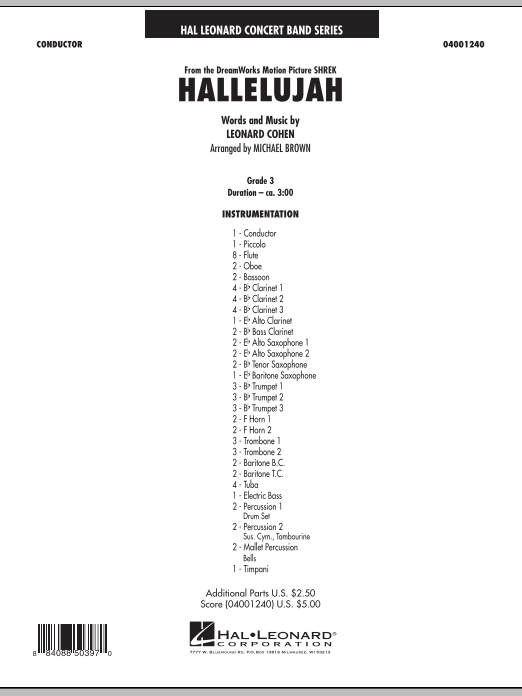

Hallelujah: Concert Band Conductor Score & Parts
By Leonard Cohen / Arranged by Michael Brown
Grade: 3
Item: 35-PK00155724
$60.00
Pickup currently not available
Buy Extra Parts (Digital PDF Download)
| Product | Price | Quantity |
|---|---|---|
| Hallelujah - Conductor Score (Full Score) | $6.00 | |
| Hallelujah - Piccolo | $6.00 | |
| Hallelujah - Flute | $6.00 | |
| Hallelujah - Oboe | $6.00 | |
| Hallelujah - Bassoon | $6.00 | |
| Hallelujah - Bb Clarinet 1 | $6.00 | |
| Hallelujah - Bb Clarinet 2 | $6.00 | |
| Hallelujah - Bb Clarinet 3 | $6.00 | |
| Hallelujah - Eb Alto Clarinet | $6.00 | |
| Hallelujah - Bb Bass Clarinet | $6.00 | |
| Hallelujah - Eb Alto Saxophone 1 | $6.00 | |
| Hallelujah - Eb Alto Saxophone 2 | $6.00 | |
| Hallelujah - Bb Tenor Saxophone | $6.00 | |
| Hallelujah - Eb Baritone Saxophone | $6.00 | |
| Hallelujah - Bb Trumpet 1 | $6.00 | |
| Hallelujah - Bb Trumpet 2 | $6.00 | |
| Hallelujah - Bb Trumpet 3 | $6.00 | |
| Hallelujah - F Horn 1 | $6.00 | |
| Hallelujah - F Horn 2 | $6.00 | |
| Hallelujah - Trombone 1 | $6.00 | |
| Hallelujah - Trombone 2 | $6.00 | |
| Hallelujah - Baritone B.C. | $6.00 | |
| Hallelujah - Baritone T.C. | $6.00 | |
| Hallelujah - Tuba | $6.00 | |
| Hallelujah - Electric Bass | $6.00 | |
| Hallelujah - Percussion 1 | $6.00 | |
| Hallelujah - Percussion 2 | $6.00 | |
| Hallelujah - Mallet Percussion | $6.00 | |
| Hallelujah - Timpani | $6.00 |
Parts Added to Cart!
Description
Written by Canadian singer-songwriter Leonard Cohen back in the '80s, this powerful song has reached almost legendary status with its frequent usage in TV and movies. Recorded by such diverse artists as Bob Dylan, Bon Jovi and Justin Timberlake, it was also used in the first "Shrek" movie and most recently during the 2010 Winter Olympics opening ceremony in Vancouver. Here is a terrific setting for band by Michael Brown. Dur: 3:00


Hallelujah: Concert Band Conductor Score & Parts isn't in MakeMusic Cloud just yet...but it could be. Let us know you'd like to see it, and you'll help shape what comes next. In the meantime, start a free trial and dive into thousands of interactive titles your students can play along with today.
Request This Title
Tell us you want it.
Start Your Free Trial
Explore everything that's ready to play right now.
Sample Audio
No sample audio found.
Sample Video
No sample videos found.
Additional Details
Publisher:
Hal Leonard
SKU:
35-PK00155724
More about this title
About the Composer: Leonard Cohen
Leonard Cohen (1934-2016) was a Canadian poet, novelist, and singer-songwriter whose work bridged literary sophistication with accessible melody. His compositions often explored themes of spirituality, love, and human struggle with a distinctive baritone voice and sparse, intentional arrangements. Cohen's influence on contemporary music extends far beyond his original recordings; his songs have become standards covered by artists across genres, demonstrating the timeless quality of his songwriting.
Why we love this
Michael Brown's arrangement captures the emotional depth of Cohen's masterpiece while making it accessible for Grade 3 musicians. The setting respects the song's reverent character and spiritual weight, giving your band a chance to work on phrasing and dynamic control with material that genuinely moves audiences. Programming this alongside more traditional concert fare creates a meaningful contrast that reminds students why they're making music in the first place.
What to expect
The arrangement preserves Cohen's introspective, almost liturgical quality while giving it the warmth and weight of full band texture. There's a quiet dignity here, punctuated by moments of building intensity that feel earned rather than imposed. Students will feel the difference between playing notes and conveying meaning.
Who it's for
Concert bands working at the Grade 3 level who want to program something with real artistic substance. This works equally well for school ensembles seeking material that engages audiences and student musicians alike, and for groups looking to build interpretive skills on repertoire with immediate cultural resonance.
How to get the most out of it
- Honor the tempo marking and resist the urge to rush. This arrangement breathes, and that space is essential to the song's power.
- Blend the melodic voices carefully, particularly in the early sections. Every line matters, and clarity of texture will shape how listeners receive the arrangement.
- Pay attention to dynamics beyond what's marked on the page. Subtle crescendos and decrescendos into sustained passages will enhance the emotional arc considerably.
- Treat the accompaniment parts as active music, not padding. The foundation voices set the harmonic color that makes the melody resonate.
How to use it
Consider this a centerpiece for a concert exploring contemporary songwriting or spiritual themes in music. The three-minute duration makes it a strong closing number for a program section, or it can anchor a set alongside folk-influenced arrangements. This piece also works beautifully as a communal experience at festival or assembly settings where the audience carries emotional connection to the material.
Skills your students will build
- Sustaining tone quality through long phrases
- Responding to subtle dynamic shaping and expressive nuance
- Balancing melody and accompaniment within ensemble texture
- Interpreting a song arrangement with emotional authenticity rather than technical perfection
- Intonation control in slower tempos with sustained harmonies