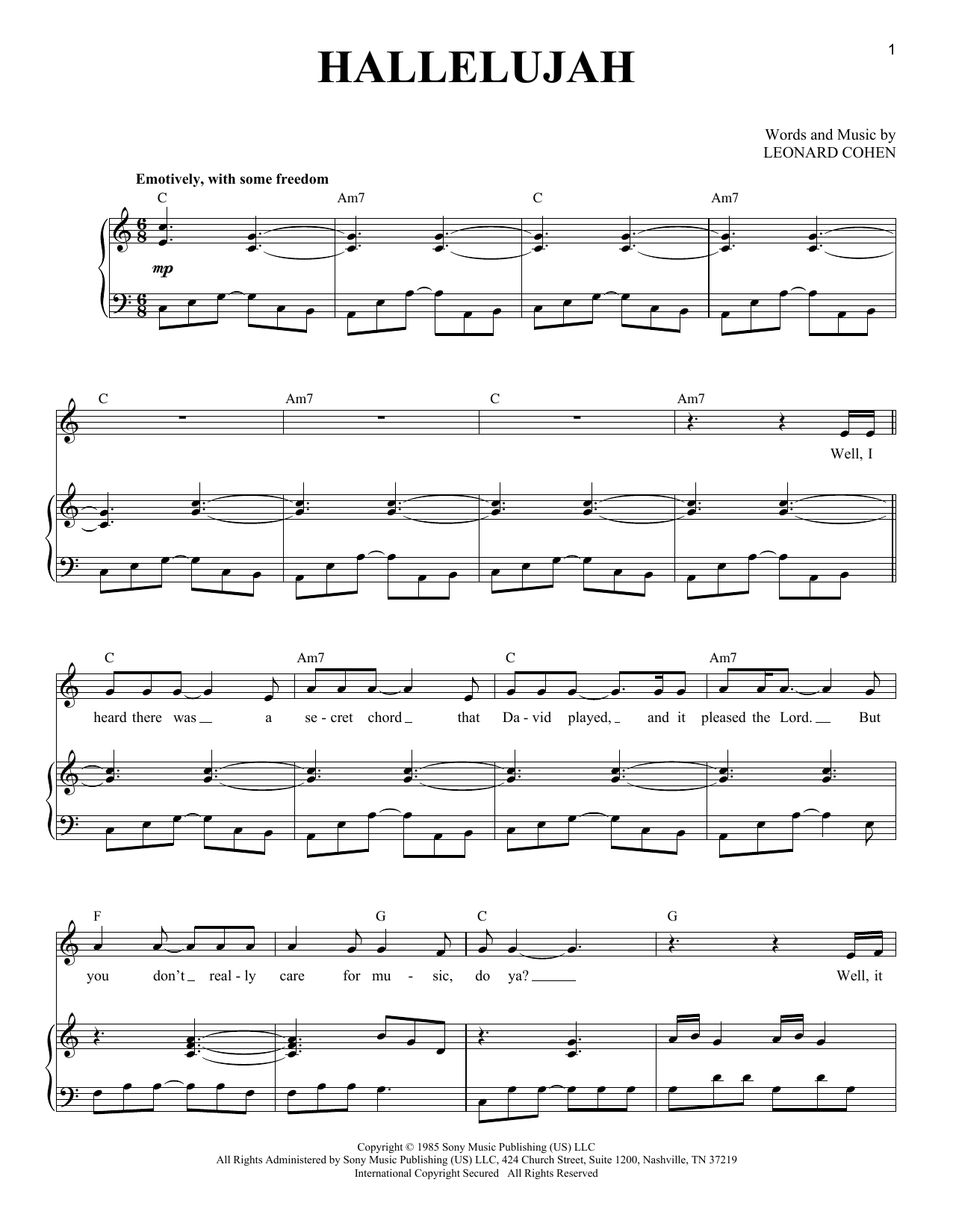
Jeff Buckley's 1994 rendition of Leonard Cohen's 'Hallelujah' became a landmark interpretation that introduced the song to a generation of listeners who might never have encountered Cohen's original. Buckley's sparse, emotionally direct arrangement and his soaring vocal performance transformed the piece into something simultaneously vulnerable and transcendent, establishing it as a standard for contemporary vocalists across genres.
Why we love this
This arrangement captures the song's essential emotional architecture without oversimplifying it. The piano part provides harmonic support that lets the vocal line breathe, while the 12 pages of music give singers room to explore the text's spiritual and romantic tension. It's a piece that teaches young singers about restraint and the power of a single, sustained emotional truth.
What to expect
Quiet devotion tinged with doubt. The piano grounds you in minor key harmony while the vocal line reaches toward something transcendent, creating a conversation between earthbound struggle and spiritual longing. There's an ache here, but also an invitation to celebrate despite it.
Who it's for
Intermediate to advanced vocalists with a mature sound and emotional range. This works well for soloists preparing for jazz or contemporary music programs, or for voice students studying how modern interpretations of standards can coexist with the original composer's vision.
How to get the most out of it
Resist the urge to overdecorate. The strength of this arrangement lives in its clarity. Every note should feel intentional.
Attend carefully to the lyrical phrasing rather than forcing the melody into predictable bar divisions. Some lines ask to breathe mid-measure.
Shape the dynamic arc across the full 12 pages; this is not a song that stays at one emotional temperature throughout.
How to use it
Consider this for a contemporary music recital, a winter or spring concert exploring spiritual themes, or as a showcase for a senior voice student. It also pairs thoughtfully with art songs or other modern arrangements of traditional material, bridging classical technique with accessible repertoire.
Skills your students will build
Navigating minor key tonality and its emotional implications
Sustaining long vowels and tone across a wide range
Interpreting text with maturity and restraint
Coordinating vocal phrasing with piano accompaniment across varying bar lengths
Building and releasing tension across an extended song form
You May Also Like
Scan to Complete Your Purchase
Use your phone's camera to scan the code below
You'll log in on your phone and the order will be added to your account