
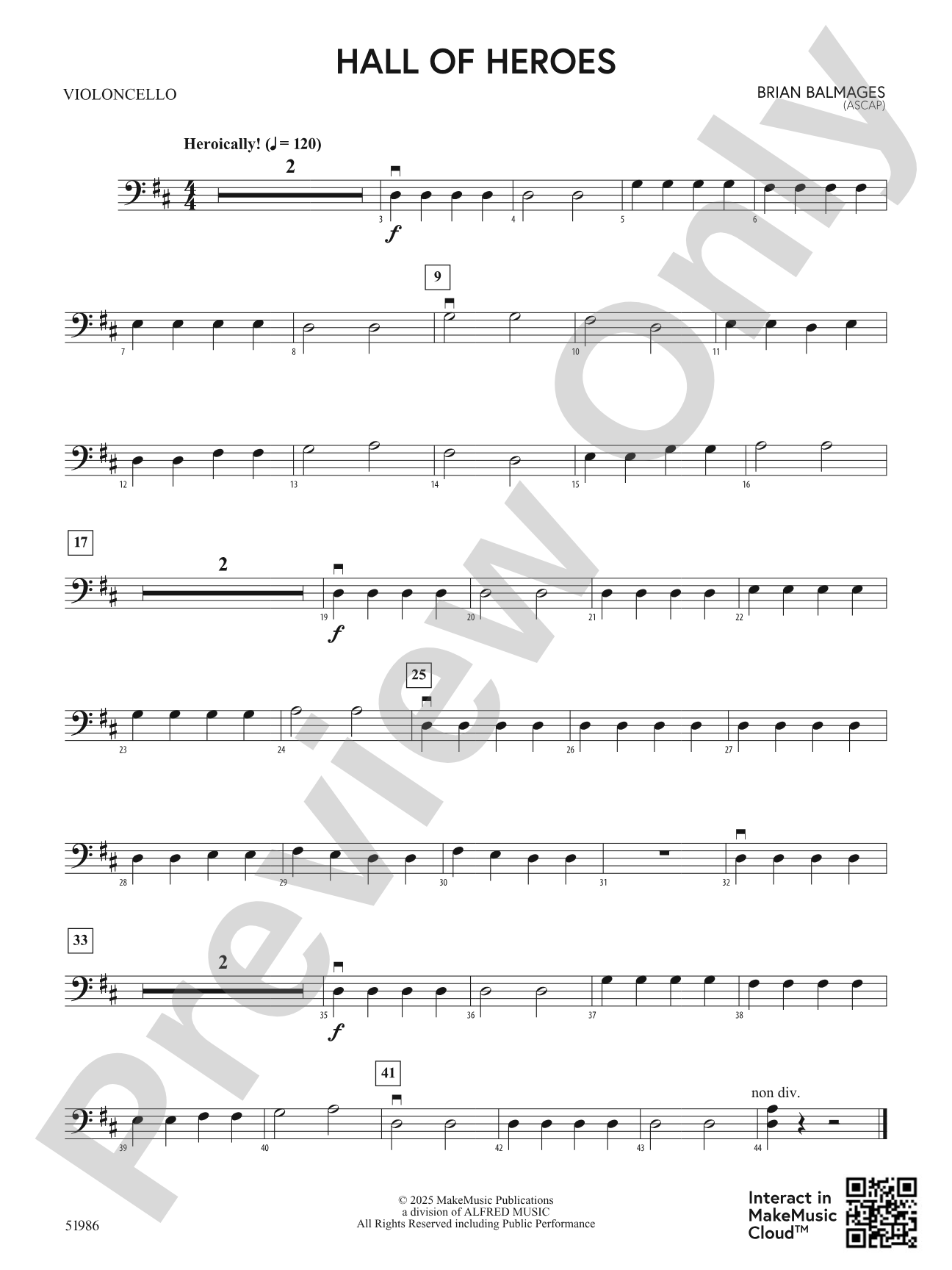

Hall of Heroes: Cello
By Brian Balmages
Level:.5
Item: 00-PC-0019462_VC1
$3.00
Pickup currently not available
Description
This stunning fanfare by Brian Balmages uses only quarter notes and half notes. All instruments use just five notes (D to A) with the exception of Violin 1, which uses the full D major scale; yet all string crossings involve open strings. Despite its playability, Hall of Heroes is powerful, harmonically sophisticated, and highly compelling! (1:30)


Don't just read it, hear it, play along with it, and watch your students grow with it. In MakeMusic Cloud, Hall of Heroes: Cello comes alive with professional accompaniment, adjustable tempo, and built-in practice tools that turn solo practice into real progress.
Open in the Player
Jump straight in and assign it today.
Start Your Free Trial
Open this title and explore the full library in minutes.
Sample Audio
1
Audio File
--:--
0:00
0:00
Sample Video
Additional Details
Series:
MakeMusic Developing Strings
Publisher:
MakeMusic Publications
SKU:
00-PC-0019462_VC1
More about this title
About the Composer: Brian Balmages

Brian Balmages has built a career bridging orchestral, band, and chamber music composition while maintaining an active conducting schedule with ensembles ranging from professional orchestras to school groups. His works have been heard at Carnegie Hall, the Kennedy Center, Sydney Opera House, and the Toronto Centre for the Arts, earning him the A. Austin Harding Award from the American School Band Directors Association and a 2020 NBA William D. Revelli Composition Contest win for Love and Light.
As an elected member of the American Bandmasters Association, Balmages has guest conducted at the Midwest Clinic, Western International Band Clinic, College Band Directors Conference, and state ASTA conferences worldwide. He received the inaugural James Madison University Distinguished Alumni Award and was commissioned by the University of Miami to compose music for the inauguration of the institution's president. Currently, he serves as Director of MakeMusic Publications and Digital Education for Alfred and MakeMusic.
Why we love this
Balmages achieves remarkable impact with minimal materials here. The constraint of five notes per instrument (except Violin 1) and a rhythm vocabulary limited to quarters and halves would seem limiting on paper, but the result is anything but simplistic. The piece announces itself like a real fanfare and builds genuine excitement, making it ideal for opening concerts or festival performances where first impressions matter. Your students will discover that technical accessibility and musical sophistication are not mutually exclusive.
What to expect
A brilliant call to attention. The piece sparkles with the open resonance of early-position string work while projecting the ceremonial weight of a real fanfare. Despite its elementary vocabulary, the harmonic motion and orchestration create a sense of occasion and grandeur, leaving listeners with the impression they've witnessed something important.
Who it's for
This piece belongs in the hands of early-level string orchestra conductors and their students. Grade 0.5 ensembles will find the technical demands manageable while the musical payoff makes the effort genuinely worthwhile, making Hall of Heroes an excellent choice for programs building confidence and pride in young string players.
How to get the most out of it
- Shape the opening with rhythmic precision and clear articulation; the quarter note and half note foundation means every attack and sustain carries weight, so unison attacks matter tremendously.
- Balance Violin 1's D major scale passages against the homophonic backdrop of the other instruments so the melodic line sings without overwhelming the harmonic foundation.
- Exploit the open string crossings for resonance and brightness; this is a piece that gains its power partly through the natural shimmer of open strings, so resist the urge to dampen the tone.
- Maintain steady, confident tempo throughout the 1:30 duration; the fanfare character depends on forward momentum and unflinching delivery.
How to use it
Open a concert with this piece to establish energy and ensemble confidence from the first measures. Its contest/festival designation makes it equally at home on a festival program or adjudication platform, and at just 1:30 it pairs beautifully as an opener before a longer work that showcases your ensemble's developing technical range.
Skills your students will build
- Open string crossings while maintaining consistent tone and intonation
- Rhythmic precision with quarter notes and half notes in ensemble context
- Unison attacks and synchronized articulation across multiple voices
- Balance and blend when one voice carries melodic material against harmonic accompaniment
- Reading and executing fanfare-style phrasing and character