
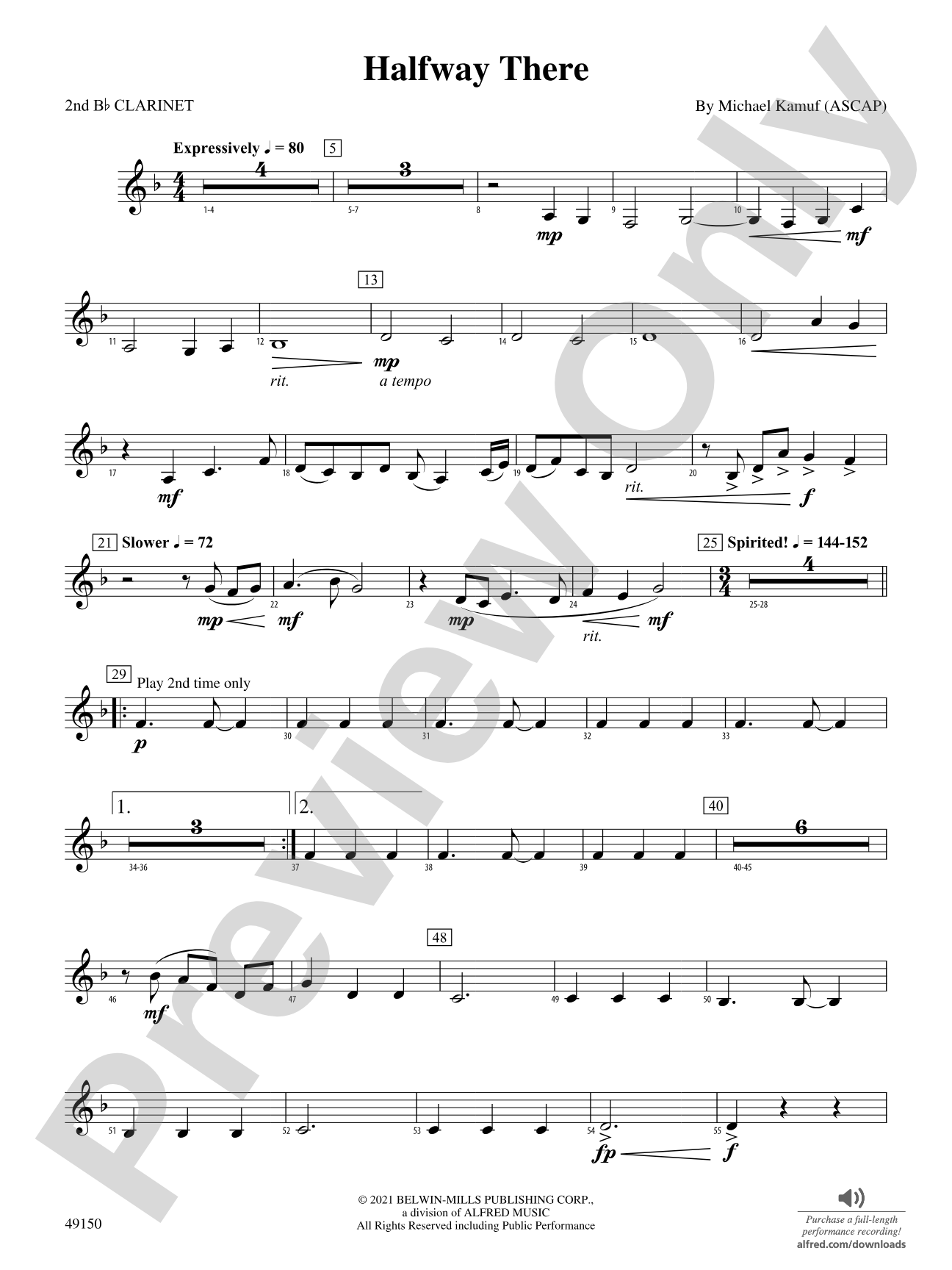

Halfway There: 2nd B-flat Clarinet
By Michael Kamuf
Grade: 2 (Easy)
Item: 00-PC-0018702_C2
$3.00
Pickup currently not available
Description
This optimistic yet driving work was inspired by the President Theodore Roosevelt quote, "believe you can and you're halfway there." The beginning lyrical section introduces contrasting themes that are developed further in a heroic and energetic fast section. Varying textures, bold harmonies, and fun percussion writing propel this piece---Halfway There by Michael Kamuf is a perfect choice for concerts and festivals! (3:10) This title is available in MakeMusic Cloud.


Don't just read it, hear it, play along with it, and watch your students grow with it. In MakeMusic Cloud, Halfway There: 2nd B-flat Clarinet comes alive with professional accompaniment, adjustable tempo, and built-in practice tools that turn solo practice into real progress.
Open in the Player
Jump straight in and assign it today.
Start Your Free Trial
Open this title and explore the full library in minutes.
Sample Audio
1
Audio File
--:--
0:00
0:00
Sample Video
Additional Details
Series:
Belwin Young Band
Publisher:
Alfred Music
Page Count:
159
SKU:
00-PC-0018702_C2
More about this title
About the Composer: Michael Kamuf

Michael Kamuf earned Bachelor of Music degrees in Jazz Performance and Music Education from Youngstown State University's Dana School of Music, followed by a Master of Arts in Instrumental Conducting from George Mason University. His compositions and arrangements have been performed by the Woody Herman and Glenn Miller Orchestras, the USAF Airmen of Note, the US Navy Commodores, and acclaimed soloists including James Moody, Eddie Daniels, and Sean Jones. As an exclusive writer for the Belwin Division of Alfred Music Publishing, Kamuf has published over 100 works across jazz, orchestra, and concert band repertoire, with many becoming standard literature for young ensembles.
Kamuf taught instrumental music for Montgomery County Public Schools in Maryland for thirty years, serving as Director of Bands and Orchestras and Music Department Chairperson at John T. Baker Middle School in Damascus. Under his leadership, Baker ensembles earned consistent high ratings at festivals and commissioned numerous works for young concert bands. He currently leads the Mike Kamuf Little Big Band, a jazz octet based in the Baltimore and Washington, DC region.
Why we love this
Kamuf structures this piece with architectural clarity: a lyrical opening that sets the inspirational foundation, followed by a fast section that builds energy without losing focus. The varying textures and bold harmonies keep the band engaged throughout, while the percussion writing is genuinely fun to execute rather than merely functional. At Grade 2, it delivers the sophistication of a larger programmatic work without demanding impossible technical demands.
What to expect
The opening invites reflection and hope, with lyrical lines that allow the band to settle into ensemble blend and phrasing. When the fast section arrives, the energy shifts from contemplative to propulsive, driven by driving harmonies and sharp, purposeful rhythms that feel triumphant without being bombastic.
Who it's for
This piece works for young concert bands seeking repertoire that balances musical sophistication with technical accessibility. It's ideal for groups preparing for contest or festival performance, especially those looking to program something with an inspirational message that still delivers musical substance.
How to get the most out of it
- Balance the contrasting themes in the opening section by having the lead voices sing through their lines with purpose; the lyrical quality depends on phrasing and projection, not slow tempos.
- Articulation across the band should match the character shift when the fast section arrives. Crisper attacks in the ensemble parts will reinforce the heroic energy without requiring extremes in dynamics.
- Let the percussion writing breathe. Kamuf wrote these parts to propel the piece forward, so avoid overplaying them; they work best when they support rather than dominate the wind sections.
- Use the three-minute-ten-second duration to your advantage in rehearsal: record sections of the fast material and listen back as a group. Students hear their parts in context quickly and understand pacing immediately.
How to use it
Program this as a concert centerpiece for an inspirational or motivational theme, or pair it with other Grade 2 works of contrasting character to showcase your band's range. Its three-minute length makes it efficient for festivals while leaving time for additional selections, and the patriotic undertones work particularly well for spring or commemorative concerts.
Skills your students will build
- Balancing lyrical phrasing with contrasting fast material
- Executing bold harmonic changes cleanly across the full ensemble
- Coordinating rhythmic drive in fast sections without losing clarity
- Listening to and supporting multiple melodic lines simultaneously
- Interpreting programmatic content (Roosevelt quote) through musical expression