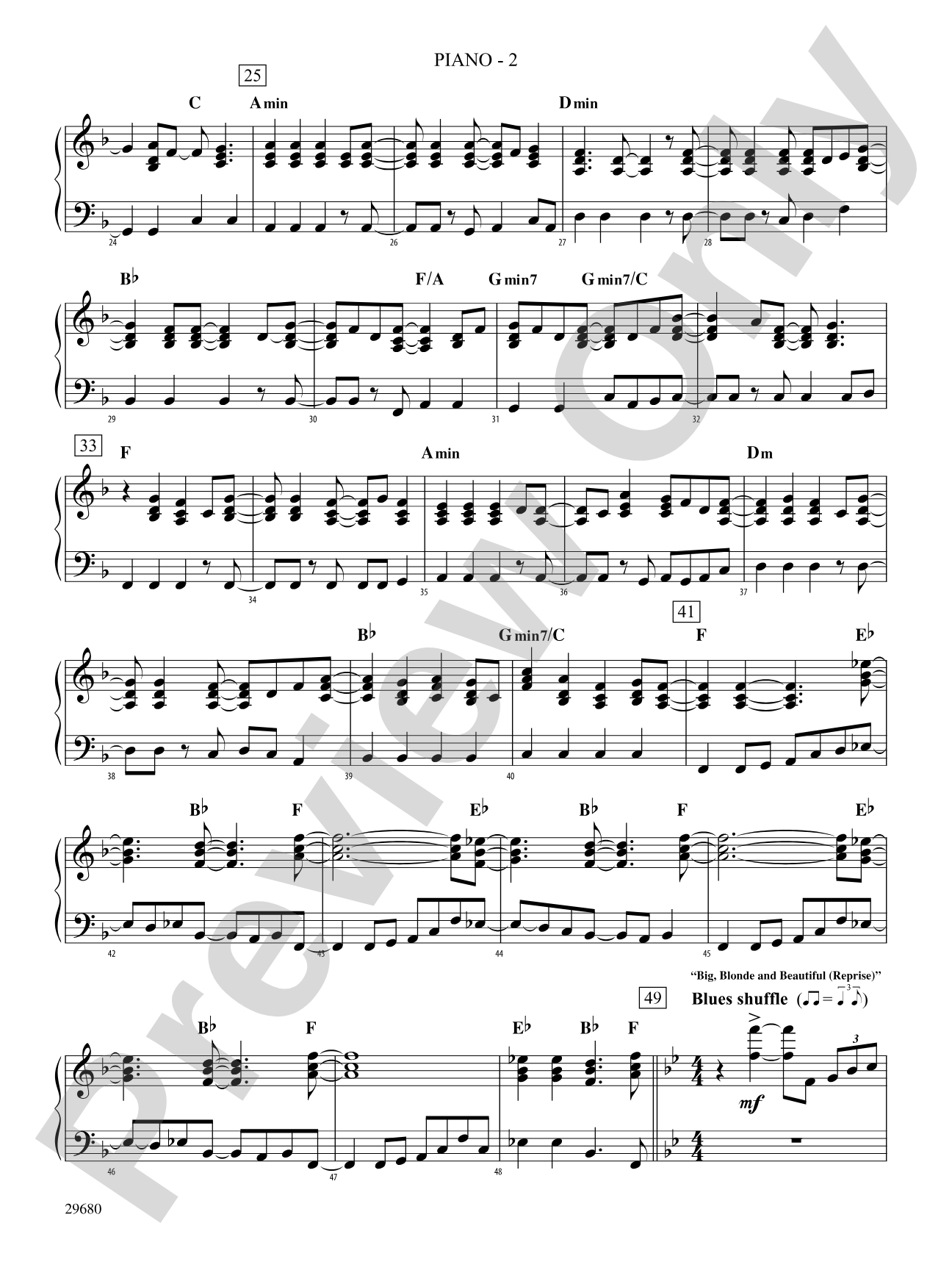
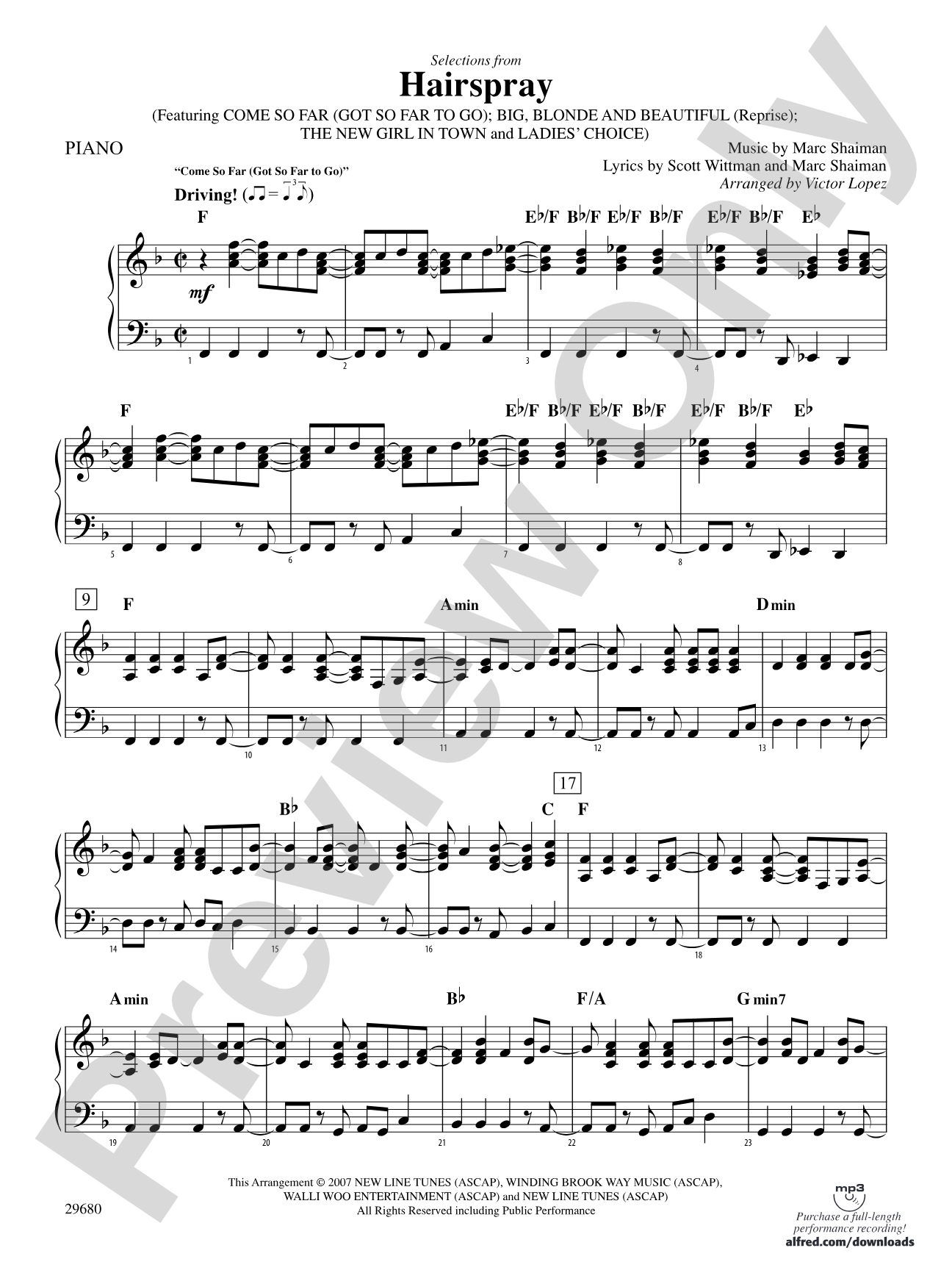
Hairspray, Selections from: Piano Accompaniment Sheet Music Preview

Hairspray, Selections from: Piano Accompaniment

Featuring: Come So Far (Got So Far to Go) / Big, Blonde and Beautiful (Reprise) / The New Girl in Town / Ladies' Choice

Music by Marc Shaiman, lyrics by Scott Wittman and Marc Shaiman / arr. Victor López

Grade: 3

Item: 00-PC-0015709_K

Digital Download
$3.00
Description
Relive the excitement and pure joy of the blockbuster movie with this superb medley including "Come So Far," "Big, Blonde and Beautiful (Reprise)," "The New Girl in Town" and "Ladies' Choice." A totally versatile arrangement that will sound great with strings alone or with the addition of any combination of winds! (5:00)

Don't just read it, hear it, play along with it, and watch your students grow with it. In MakeMusic Cloud, Hairspray, Selections from: Piano Accompaniment comes alive with professional accompaniment, adjustable tempo, and built-in practice tools that turn solo practice into real progress.

Sample Audio
0:00
0:00
Sample Video
Additional Details
Series: Pop Intermediate String/Full Orchestra
Publisher: Alfred Music
Page Count: 244
SKU: 00-PC-0015709_K

More about this title

About the Composer: Marc Shaiman

Marc Shaiman has established himself as one of contemporary musical theater's most versatile and prolific composers. His gift for melody and orchestration spans Broadway, film, and television, where he crafts music that connects instantly with audiences while maintaining sophisticated harmonic language. His work on Hairspray exemplifies his ability to write infectious, character-driven songs that serve narrative while remaining genuinely enjoyable to perform and hear.

Why we love this

Victor Lopez's orchestration gives student musicians genuine substance to play while keeping the arrangement accessible at Grade 3. The medley strips away the theatrical production's spectacle and focuses on pure musicality, letting the orchestra shine without depending on soloists or vocal parts. Directors who want contemporary concert repertoire that engages audiences and doesn't oversimplify the source material will find this arrangement delivers both.

What to expect

Bright, joyful, and propulsive. The medley captures Hairspray's unbridled optimism without sentimentality, moving fluidly between moments of pure fun and genuine musical warmth. There's an infectious energy throughout that feels modern and accessible yet grounded in strong melodic writing.

Who it's for

Orchestras at the intermediate level seeking contemporary concert repertoire that audiences recognize and enjoy. This works equally well for groups building full orchestra experience and those expanding beyond a string foundation with selective wind doublings.

How to get the most out of it

  • Treat the string foundation as your anchor. Even when winds enter, the strings carry the harmonic core, so lock that intonation first before layering any additional color.
  • Balance the familiar melodies against the accompanimental figures. These songs land best when the tune feels effortless, not buried beneath orchestral texture.
  • Let the full orchestra sections breathe. The arrangement gains character from moments of varied instrumentation, so resist the urge to push all voices equally in every measure.
  • Articulation matters. Shaiman's melodies thrive on clarity and rhythmic precision, particularly in the rhythmic passages that define the Hairspray sound.

How to use it

Consider this for a pops concert or as a stylistic contrast in a mixed program of classical and contemporary works. The five-minute runtime makes it valuable as a closing piece that leaves audiences smiling, or as a bridge between a heavier classical selection and a lighter concert finale.

Skills your students will build

  • Balancing melody against harmonic accompaniment in full orchestral texture
  • Executing rhythmic precision in contemporary pop-influenced idioms
  • Adapting orchestration choices based on available instrumentation (strings alone vs. full ensemble)
  • Reading flexible part assignments and understanding sectional independence within an ensemble

You May Also Like