

Habari Nzuri (Good News-Swahili): 3-Part Choral Octavo
(Good News -- Swahili)
Music by Sally K. Albrecht and Jay Althouse
Item: 00-PO-0004292
$2.25
Minimum order quantity: 20 copies
Pickup currently not available
Description
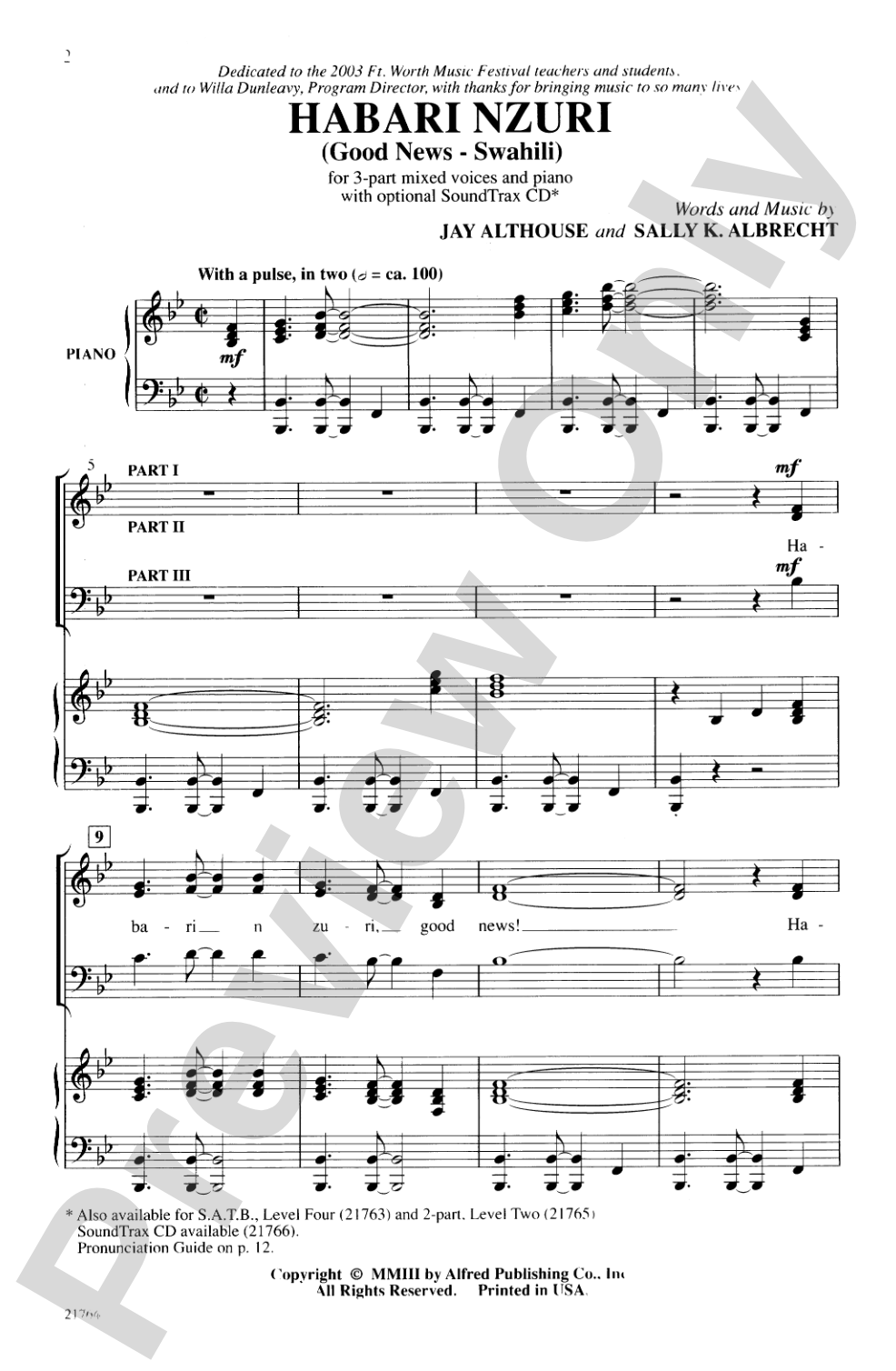
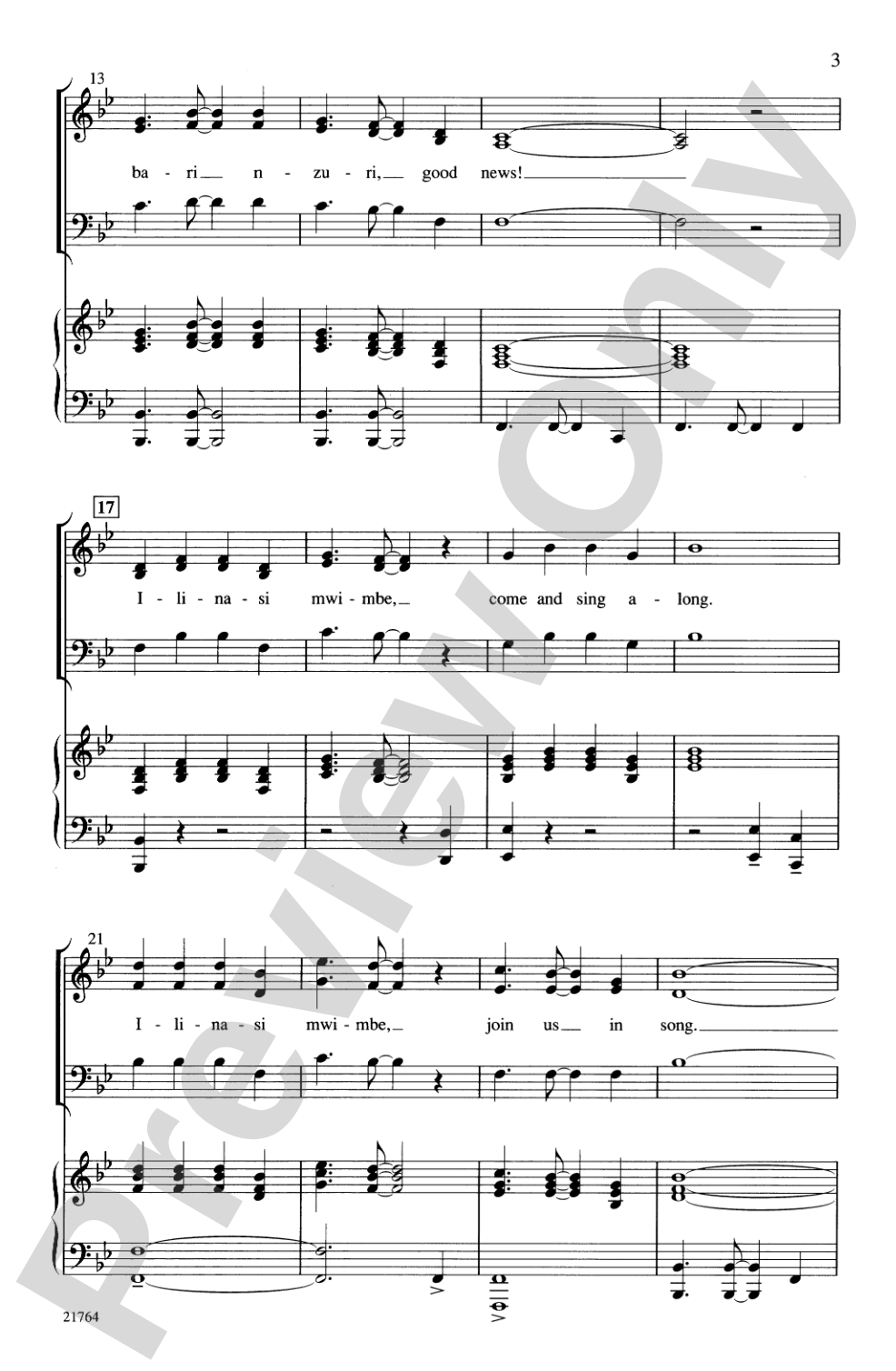
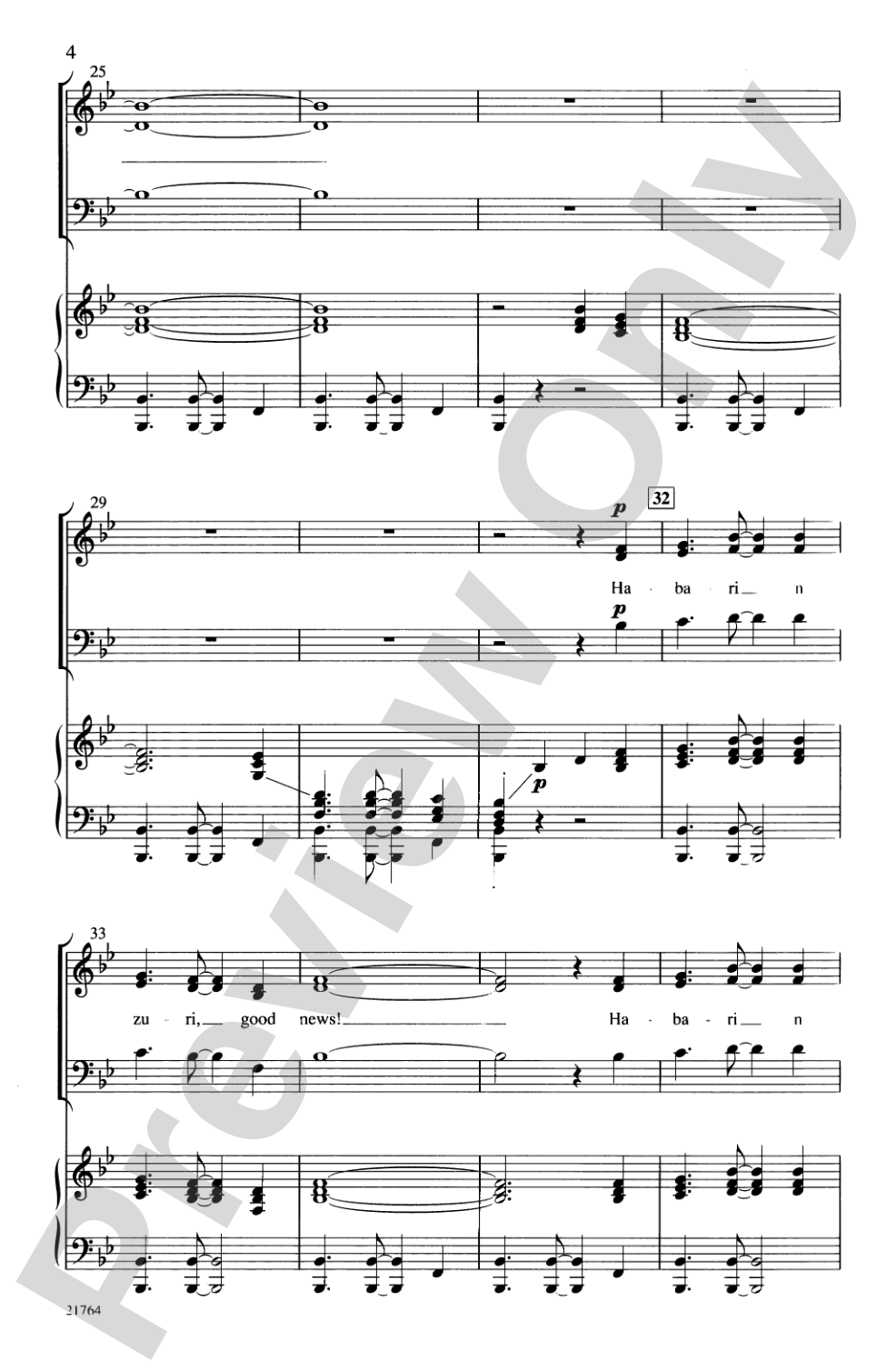
Sally and Jay have done it again with this energized English/Swahili combination. Three simple Swahili phrases, appropriate for general or seasonal use, are sung back and forth with their English equivalents and repeated over the pulsating African accompaniment. An add-on section in the middle climaxes into a restatement of the original chorus with a treble trio added for an unforgettable finish! The optional SoundTrax is authentically African, or add your own rhythm instruments. It's one of those "just-can't-stand-still" songs. Featured on "On with the Show!" video, #21799.


Habari Nzuri (Good News-Swahili): 3-Part Choral Octavo isn't in MakeMusic Cloud just yet...but it could be. Let us know you'd like to see it, and you'll help shape what comes next. In the meantime, start a free trial and dive into thousands of interactive titles your students can play along with today.
Request This Title
Tell us you want it.
Start Your Free Trial
Explore everything that's ready to play right now.
Sample Audio
1
Audio File
--:--
0:00
0:00
Sample Video
No sample videos found.
Additional Details
Series:
Alfred Archive Edition: Alfred Choral Designs
Publisher:
Alfred Music
Page Count:
12
SKU:
00-PO-0004292
More about this title
About the Composer: Sally K. Albrecht

Sally K. Albrecht has shaped American choral music for over four decades as a composer, conductor, and advocate for movement-centered choral experiences. Her catalog spans more than 600 published pieces, numerous songbooks, and full-length musicals; she has received the ASCAP Special Music Award annually since 1987. Her work conducting honor choirs at venues including Lincoln Center, Carnegie Hall, and The Kennedy Center reflects her commitment to elevating choral performance across the country.
For more than 30 years, Albrecht directed choral, vocal, and elementary music publications at major educational publishers, most recently at Alfred Music, where her influence shaped repertoire selections for thousands of schools. She holds degrees from Rollins College (B.A. in Music and Theater, 1976) and the University of Miami (M.A. in Drama, 1977; M.M. in Accompanying, 1979). A former faculty member at Oakland University, Jersey City State College, and Meredith College, she has been recognized with the Distinguished Alumna Award from both the University of Miami Frost School of Music and Rollins College, and serves as a Board of Trustees member at Rollins.
Why we love this
Habari Nzuri captures that rare quality of being musically sophisticated while remaining irresistibly joyful. The back-and-forth structure between Swahili and English phrases gives singers multiple entry points while building antiphonal energy, and the addition of a treble trio in the final section creates a dynamic texture shift that feels earned rather than tacked on. The pulsating African accompaniment does the rhythmic heavy lifting, allowing your singers to focus on ensemble blend and the genuine cultural content rather than fighting through complex rhythms.
What to expect
Habari Nzuri pulses with celebratory energy from the first phrase. The alternating English and Swahili text creates a call-and-response conversation that mirrors the joy of sharing good news, while the African-inspired accompaniment invites movement and lifts the ensemble into an infectious groove that builds naturally toward the trio finale.
Who it's for
This piece works beautifully for any mixed or SAB choir seeking accessible multicultural repertoire with genuine rhythmic drive. It's equally at home in a general music concert, a winter program, or a Kwanzaa celebration, making it practical for directors managing diverse scheduling and programming needs.
How to get the most out of it
- Establish a steady pulse with the rhythm section or accompaniment before adding voices; the infectious groove only works when the foundation is locked in.
- Work the Swahili pronunciation separately, even just 10 minutes before rehearsal, so singers own the authenticity of the language rather than approximating it.
- Shape the treble trio entrance in the final chorus as a genuine textural peak, not a surprise; let the rest of the choir feel the build approaching so the moment lands with impact.
- Consider adding hand percussion (shakers, djembes, or frame drums) on top of the recorded accompaniment to deepen the African character and give students a kinesthetic connection to the material.
How to use it
Program this as an energizing moment in a winter or seasonal concert where you need a tonal and emotional shift. It pairs well alongside more contemplative pieces and serves as a natural crowd-pleaser that demonstrates your choir's rhythmic vitality and cultural awareness without requiring extensive rehearsal time.
Skills your students will build
- Singing in a non-English language with stylistically informed pronunciation
- Maintaining rhythmic independence while supporting an African-based accompaniment pattern
- Executing antiphonal (call-and-response) singing with clear ensemble entrances
- Building dynamic contrast through textural layering (trio addition in the final section)
- Blending voices within a three-part voicing while respecting cultural musical traditions