Habanera (from the opera Carmen): Piano/Vocal
By Georges Bizet / arr. Edwin McLean
Item: 98-DPV3003
Pickup currently not available
Related Items
Habanera (from the opera Carmen): Piano Sheet |
$6.95
|
View |
Description
Habanera (from the opera Carmen): Piano/Vocal isn't in MakeMusic Cloud just yet...but it could be. Let us know you'd like to see it, and you'll help shape what comes next. In the meantime, start a free trial and dive into thousands of interactive titles your students can play along with today.
Tell us you want it.
Explore everything that's ready to play right now.
Sample Audio
Sample Video
Additional Details
More about this title
About the Composer: Georges Bizet
Georges Bizet (1838-1875) was a French composer whose gift for melody and theatrical drama shaped opera across Europe. Born in Paris and trained at the Conservatoire, he composed with extraordinary fluency, yet his career was marked by frustration; most of his operas received only modest runs during his lifetime. Carmen, premiered in 1875 just months before his death, was initially dismissed by critics as vulgar and scandalous. Today it stands as one of the most performed operas worldwide, and the Habanera remains one of opera's most iconic arias, performed by singers across every voice type and in countless contexts beyond the stage.
Bizet's genius lay in his ability to blend European sophistication with Spanish and Latin American rhythmic color. The Habanera exemplifies this: he captures the sultry, unhurried pulse of the Cuban dance form while crafting a melody so memorable that it has transcended opera to become part of popular culture. For music educators, Bizet's work demonstrates how strong melodic writing and cultural specificity can create pieces that endure for generations.
Why we love this
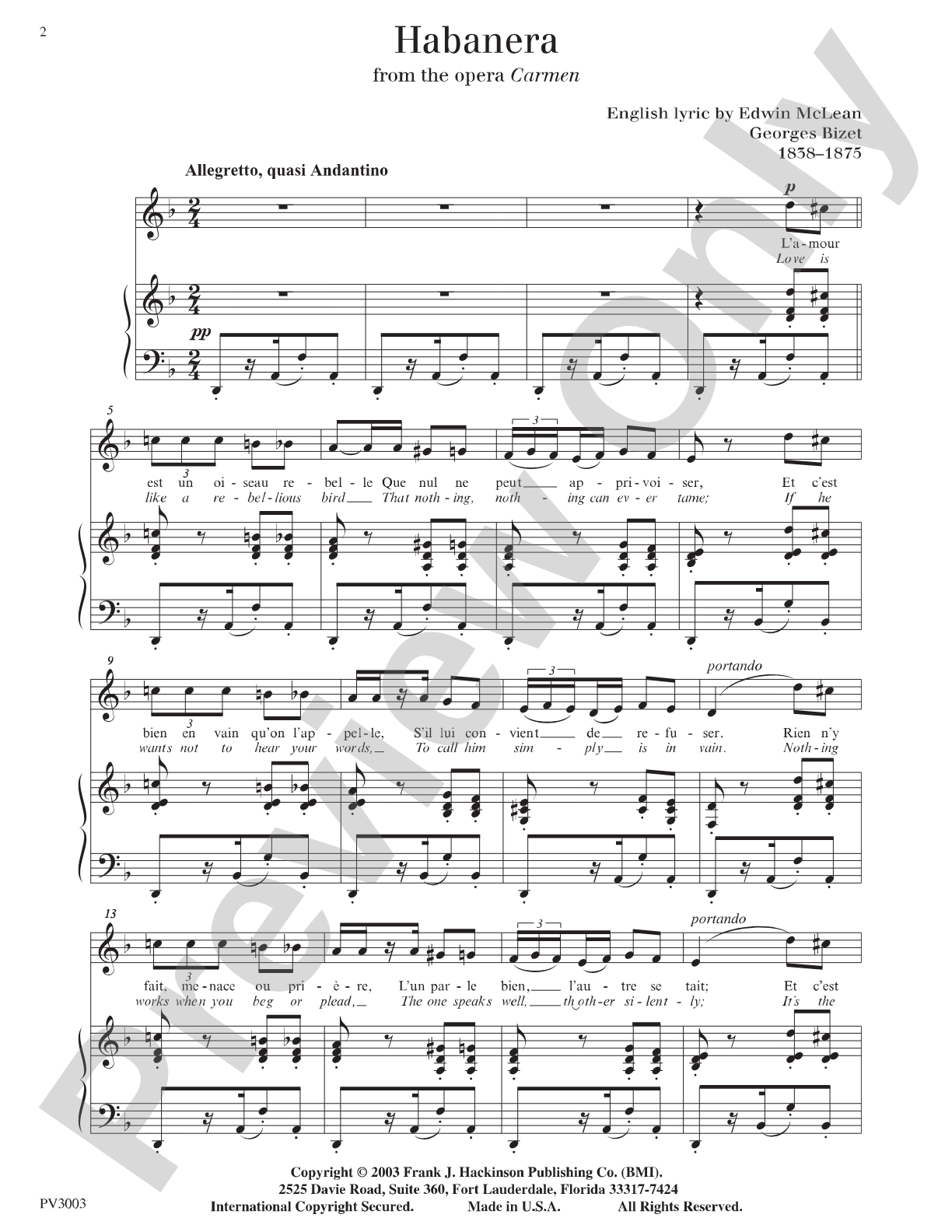
This edition gives singers access to one of opera's greatest vocal lines in a straightforward, singable format. The dual French and English text opens the piece to diverse performance contexts, from recital to crossover programming, without requiring translators or second editions. The expert editing and engraving make learning and performance seamless, so singers can focus on capturing the character rather than wrestling with unclear notation.
What to expect
The Habanera unfolds with theatrical confidence and understated sensuality. The famous opening melody floats over a steady, hypnotic rhythmic foundation, creating a sense of inevitability and charm. The piece captures a moment of intimate persuasion, where directness and mystery coexist in every phrase.
Who it's for
Any vocalist comfortable with art song repertoire who wants to perform one of opera's most celebrated numbers outside the full operatic context. This edition suits soprano, mezzo-soprano, or tenor recitalists, as well as singers exploring crossover programming or looking for a staple encore.
How to get the most out of it
- Maintain the habanera rhythm's unhurried forward motion in the accompaniment; resist the impulse to rush, as the style depends entirely on that distinctive lilting pulse.
- Sing the opening phrase with a warm, slightly detached tone that suggests ease and seduction rather than urgency. Let the rhythm do the work.
- Balance the vocal line prominently against the piano so every curve of the melody registers clearly, especially through the repetitions where familiarity might flatten the phrasing.
- Work closely with your pianist on the orchestral color of the accompaniment; the original harmony supports a rich, almost impressionistic sound that lifts the vocal line rather than competing with it.
How to use it
Include this in a recital built around opera highlights or iconic vocal moments. It pairs naturally with other song literature in French, or as a bridge between classical art song and musical theater contexts. The piece also works as an effective encore when programming draws primarily from standard vocal repertoire.
Skills your students will build
- Singing over a repeating rhythmic pattern without losing phrase shape
- Balancing legit vocal technique with theatrical character and style
- Interpreting a melody with cultural specificity (Cuban habanera rhythm and Spanish musical language)
- Sight-reading piano/vocal scores with dual-language text
- Sustaining character consistency across multiple melodic repetitions