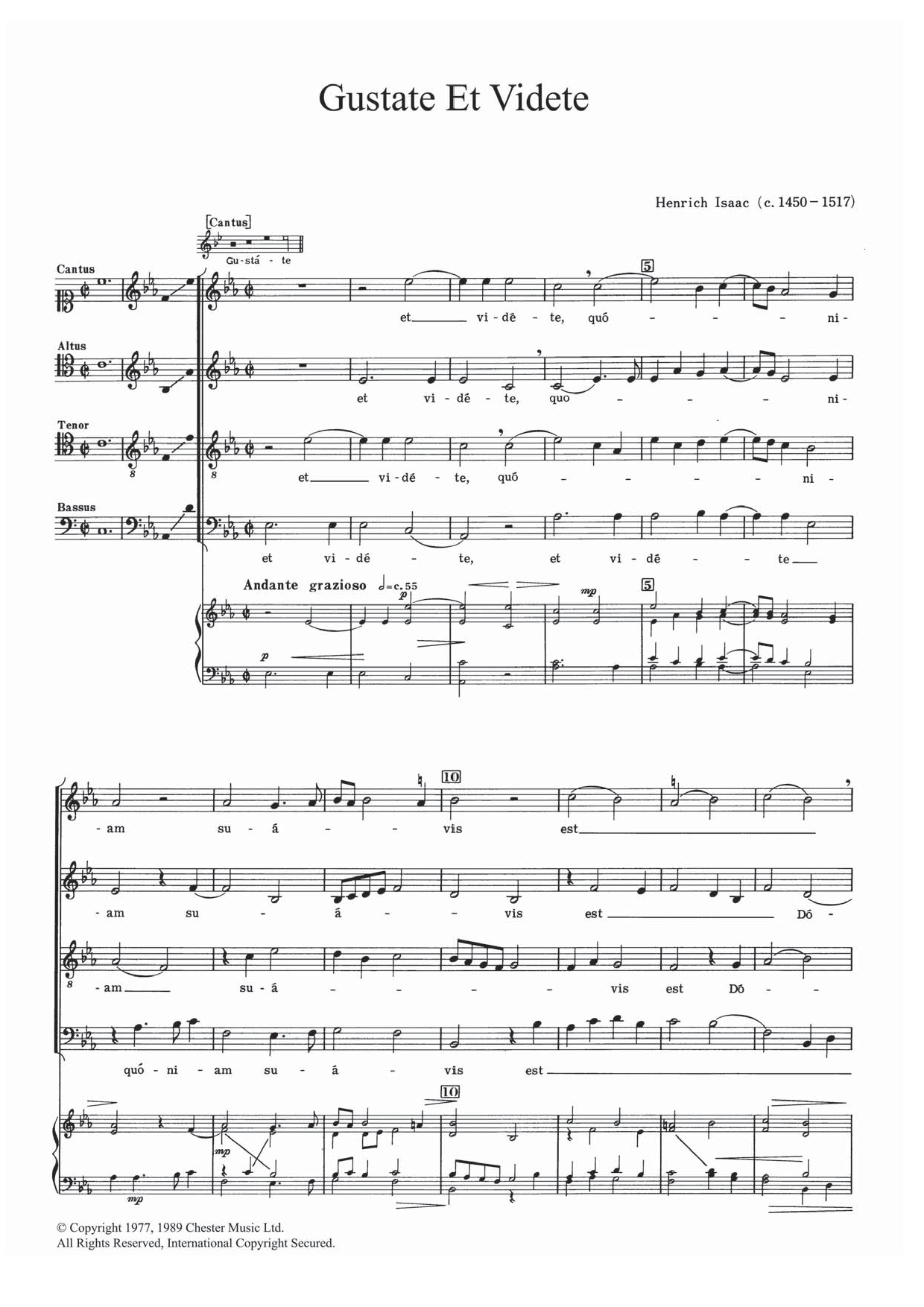
Gustate Et Videte Sheet Music Preview

Gustate Et Videte: SATB Choral Octavo

As performed by Heinrich Isaac

Item: 35-DS00366727

Digital Download
$2.99
Description

Gustate Et Videte: SATB Choral Octavo isn't in MakeMusic Cloud just yet...but it could be. Let us know you'd like to see it, and you'll help shape what comes next. In the meantime, start a free trial and dive into thousands of interactive titles your students can play along with today.

Sample Audio
No sample audio found.
Sample Video
Additional Details
Publisher: Hal Leonard
Page Count: 2
SKU: 35-DS00366727

More about this title

About the Artist: Heinrich Isaac

Heinrich Isaac (c. 1450-1517) was among the most prolific composers of the Renaissance, working across Europe from Flanders to Italy to the German-speaking lands. His output encompassed sacred motets, masses, and secular songs that shaped the polyphonic style of his era. Isaac's ability to craft singable, expressive lines within complex harmonic structures made his work foundational to Renaissance choral pedagogy, and his motets remain vital resources for understanding how composers approached text expression before the Baroque.

Why we love this

Isaac writes for the voice with genuine understanding of breath and phrasing, letting each line breathe while maintaining intricate polyphonic texture. The Latin text pairs with music that never feels didactic, making this a piece that engages singers intellectually while remaining musical and rewarding to perform. For directors building a Renaissance program, this octavo offers authentic sixteenth-century writing without the extreme technical demands of some contemporaries.

What to expect

Contemplative and luminous, with the kind of serene clarity that comes from balanced four-part writing. The text (Psalm 34, 'O taste and see') pairs with music that unfolds gradually, inviting listeners into intimate harmonic spaces rather than overwhelming them. There's a quiet confidence to Isaac's voice leading, a sense that each note belongs exactly where it sits.

Who it's for

This piece suits intermediate to advanced SATB choirs with exposure to Renaissance repertoire. It works equally well in academic settings exploring polyphonic history and in liturgical contexts where it can serve as an introit or motet. Singers benefit from some familiarity with Latin pronunciation and the aesthetic of Renaissance phrasing.

How to get the most out of it

  • Clarify the text underlay early in rehearsal; Renaissance notation leaves room for interpretation, and settling this prevents confusion during polishing.
  • Balance the voices so that the Soprano and Alto lines remain distinct rather than blending into a undifferentiated top; Isaac frequently trades motivic material between upper voices.
  • Approach phrasing by phrase rather than by line, letting the natural cadential points in the harmony dictate breath placement rather than text syntax alone.
  • Shape the harmonic rhythm subtly; longer note values often carry the structural weight, so avoid rushing through them even when surrounding voices move.

How to use it

Place this as a reflective moment in a concert mixing Renaissance and early Baroque works, or use it to open a program devoted to liturgical texts across centuries. It pairs naturally with other Isaac motets or with music by Josquin and Palestrina, creating a coherent historical narrative. Consider performing it during a service or ceremony where the meaning of the text adds spiritual weight to the musical experience.

Skills your students will build

  • Renaissance text underlay and its relationship to melodic phrasing
  • Balance and blend in four-part polyphony with equal voice independence
  • Harmonic analysis of diatonic Renaissance voice leading
  • Pronunciation and expressive delivery of Latin text
  • Sustained tone production and breath management across longer phrases

You May Also Like