
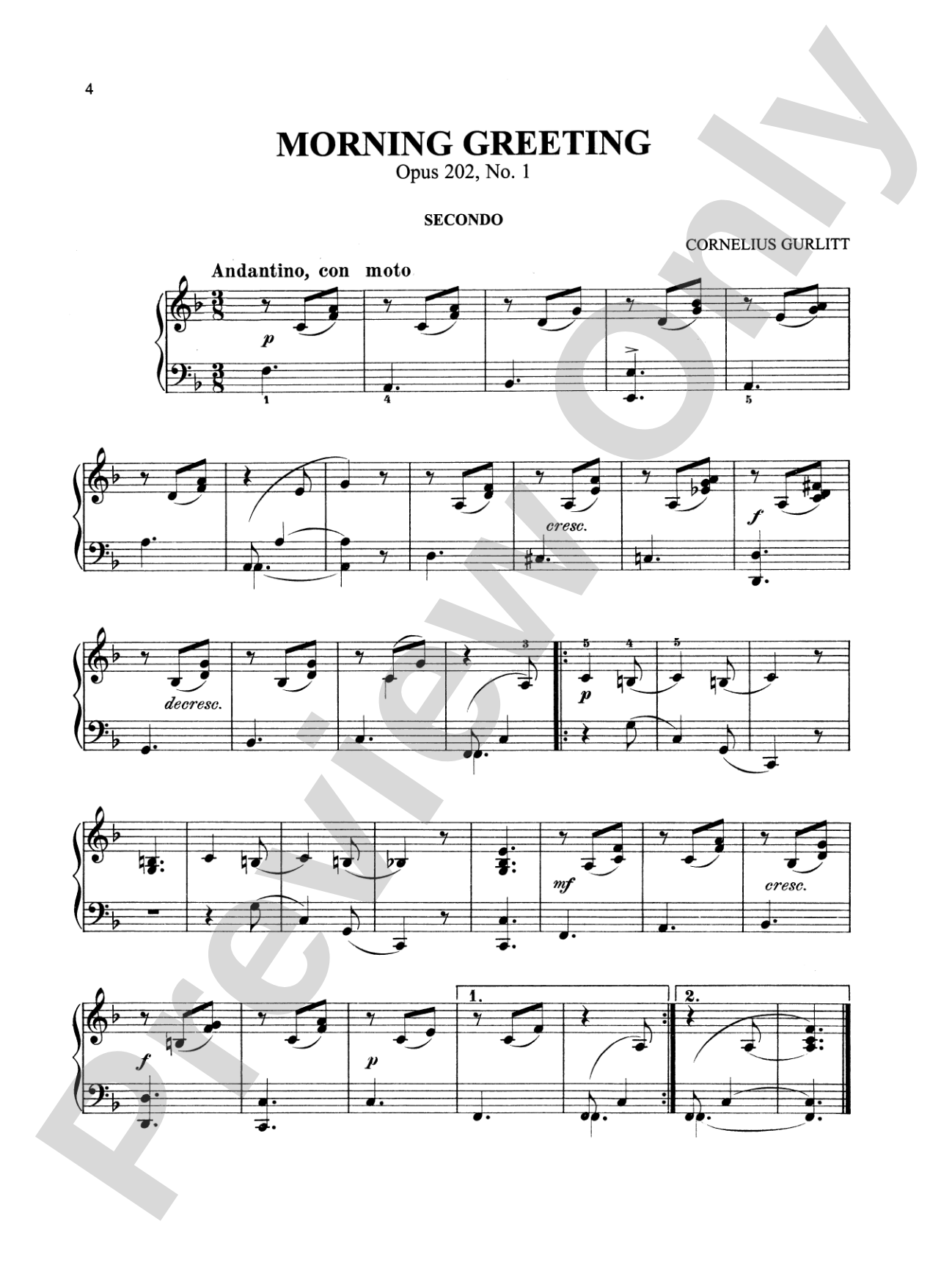
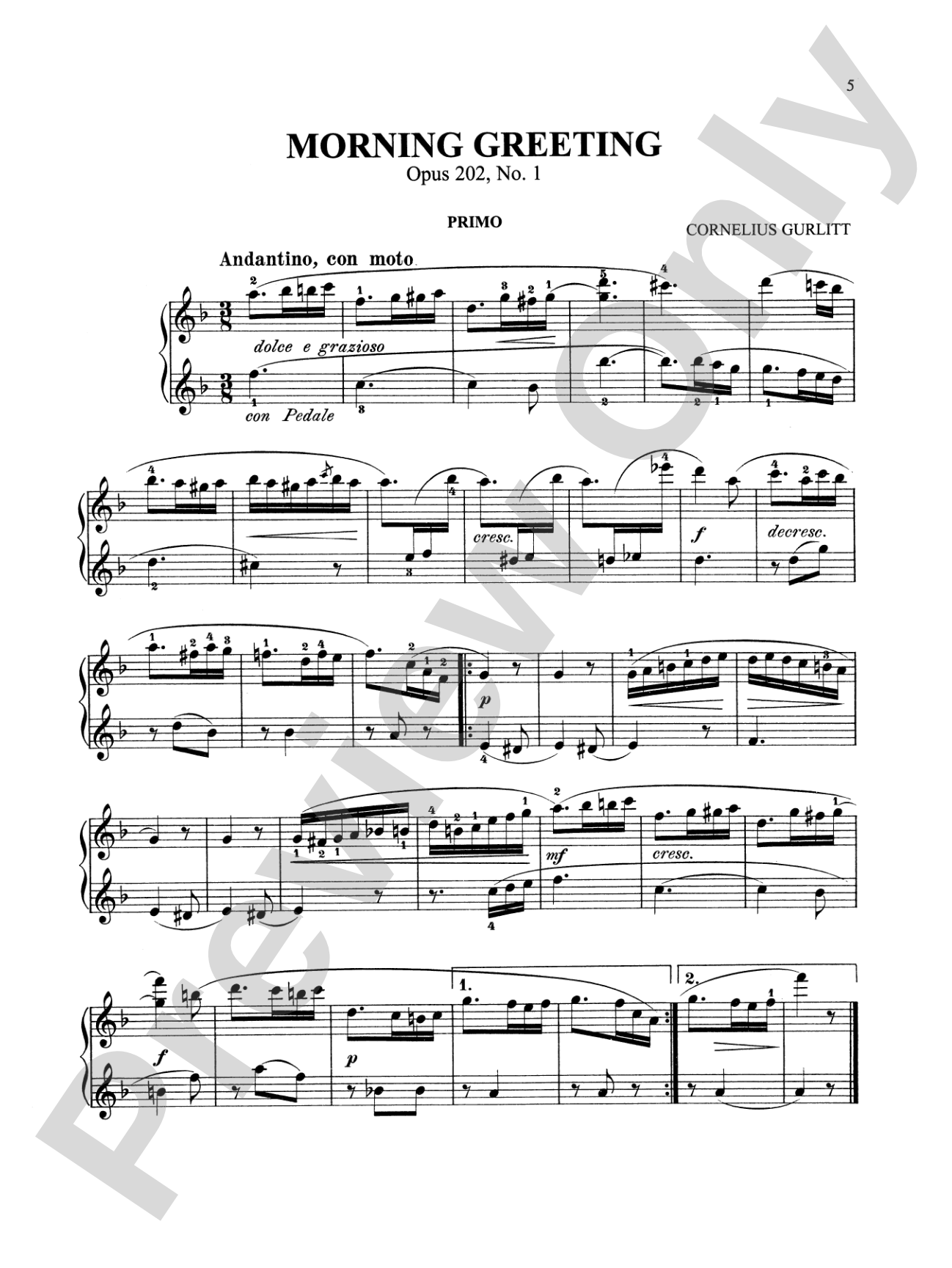

Gurlitt: Stray Leaves, Op. 202: Piano Duet (1 Piano, 4 Hands) Book
By Cornelius Gurlitt
Item: 00-PK-0002755

$6.99
Pickup currently not available
Buy Extra Parts (Digital PDF Download)
| Product | Price | Quantity |
|---|---|---|
| Gurlitt: Stray Leaves, Op. 202 | $0.99 | |
| Gurlitt: Stray Leaves, Op. 202 | $0.99 | |
| Gurlitt: Stray Leaves, Op. 202 | $0.99 | |
| Gurlitt: Stray Leaves, Op. 202 | $0.99 | |
| Gurlitt: Stray Leaves, Op. 202 | $0.99 | |
| Gurlitt: Stray Leaves, Op. 202 | $0.99 |
Parts Added to Cart!
Related Items
Stray Leaves, Opus 202: Piano Duet (1 Piano, 4 Hands) Book |
$6.99
|
View |
Description
Six delightful piano duets at the intermediate to late-intermediate level. Cleanly printed from an original Litolff edition.


Don't just read it, hear it, play along with it, and watch your students grow with it. In MakeMusic Cloud, Gurlitt: Stray Leaves, Op. 202: Piano Duet (1 Piano, 4 Hands) Book comes alive with professional accompaniment, adjustable tempo, and built-in practice tools that turn solo practice into real progress.
Open in the Player
Jump straight in and assign it today.
Start Your Free Trial
Open this title and explore the full library in minutes.
Sample Audio
No sample audio found.
Sample Video
No sample videos found.
Additional Details
Series:
Kalmus Edition
Publisher:
Alfred Music
Page Count:
24
SKU:
00-PK-0002755
More about this title
About the Composer: Cornelius Gurlitt
Cornelius Gurlitt (1820, 1901) was a German composer and pedagogue whose vast output of character pieces and etudes shaped piano instruction across generations. Though overshadowed by his more celebrated contemporaries, Gurlitt possessed a gift for writing music that balanced technical development with genuine musical substance, making his works essential to intermediate and advanced students.
His catalog spans hundreds of compositions, yet he remains underrepresented in American music rooms despite his historical importance. Gurlitt's approach to writing duets was particularly shrewd: he understood how to write idiomatically for four hands without condescending to either player, a skill that makes his collections endure.
Why we love this
Gurlitt understood what intermediate pianists need to hear and play at the moment they're ready to hear it. These six duets move beyond technical exercises to offer real musical partnership; the primo and secondo parts are genuinely conversational rather than hierarchical, making them equally rewarding for both players. The Kalmus printing gives you a clean, readable score that respects the original 19th-century engraving without fussiness.
What to expect
Gurlitt writes with the clarity of Schumann and the directness of early Brahms; these pieces breathe with Romantic lyricism but never indulge in sentimentality. Each duet unfolds as a small journey, often tender and reflective, sometimes gently animated, always with the sense that two musicians are genuinely thinking together rather than taking turns.
Who it's for
These duets suit intermediate pianists who are ready to experience the joy of shared repertoire and collaborative musicmaking. Both players in each pair benefit from equal technical and musical engagement, making the collection ideal for studios where duet playing strengthens sight-reading and listening skills simultaneously. Teachers preparing students for ensemble performance or seeking to build confidence in following a partner will find reliable material here.
How to get the most out of it
- Establish shared tempo and pulse before the primo enters; even a brief count-in together prevents the false starts that plague early duet rehearsals.
- Balance the secondo's accompanying figures so the primo line sings without the primo player feeling rushed to dominate.
- Listen for moments where harmonic roles shift between parts; these subtle exchanges reward careful attention and create genuine dialogue rather than mere accompaniment.
- Shape phrases through dynamics rather than tempo variation; Gurlitt's notation is sparse, so collaborative interpretation of each piece's architecture becomes part of the learning process.
How to use it
Stray Leaves works beautifully as studio recital fare, particularly for intermediate showcases where you want to highlight ensemble work alongside solo repertoire. A single duet from the collection makes an elegant opening or interlude on a mixed program, or program three pieces back-to-back to demonstrate the range of Gurlitt's compositional voice. These pieces also serve as valuable preparation for students approaching the Classical duets of Mozart and Beethoven.
Skills your students will build
- Reading and maintaining independence between primo and secondo lines
- Listening and responding to a partner's phrasing and tempo in real time
- Balancing accompaniment texture with primary melodic content
- Sustaining longer Romantic-era phrases without losing structural clarity
- Interpreting sparse dynamic markings through harmonic function and phrase architecture