
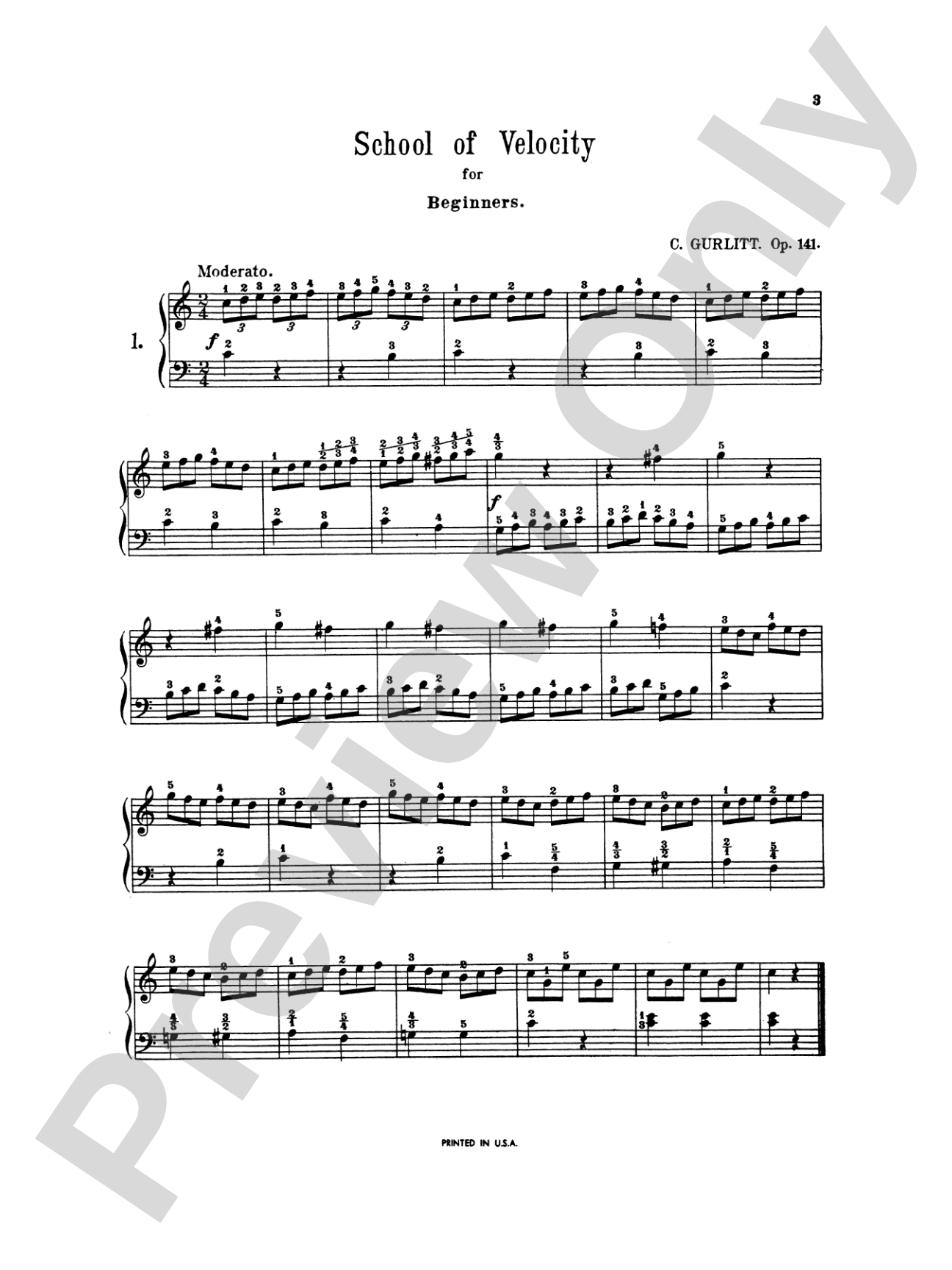

Gurlitt: School of Velocity for Beginners, Op. 141: Piano Book
By Cornelius Gurlitt
Item: 00-PK-0003124

$9.99
Pickup currently not available
Buy Extra Parts (Digital PDF Download)
Parts Added to Cart!
Related Items
School of Velocity for Beginners, Opus 141: Piano Book |
$9.95
|
View |
Description
Expertly arranged Piano music by Cornelius Gurlitt from the Kalmus Edition series. This is from the Romantic era.


Don't just read it, hear it, play along with it, and watch your students grow with it. In MakeMusic Cloud, Gurlitt: School of Velocity for Beginners, Op. 141: Piano Book comes alive with professional accompaniment, adjustable tempo, and built-in practice tools that turn solo practice into real progress.
Open in the Player
Jump straight in and assign it today.
Start Your Free Trial
Open this title and explore the full library in minutes.
Sample Audio
No sample audio found.
Sample Video
No sample videos found.
Additional Details
Series:
Kalmus Edition
Publisher:
Alfred Music
Page Count:
28
SKU:
00-PK-0003124
More about this title
About the Composer: Cornelius Gurlitt
Cornelius Gurlitt (1820, 1901) was a German composer and pedagogue whose prolific output shaped piano instruction across Europe and America. His methodical approach to technique building, grounded in the Romantic idiom, made him a fixture in conservatory curricula for generations. Gurlitt understood what young pianists needed: progressively challenging material that developed velocity and finger independence without sacrificing musicality.
The Op. 141 collection exemplifies his gift for meeting students where they are. Rather than relegating technique to dry exercises, Gurlitt embedded velocity studies within short, melodic pieces that students actually wanted to play. This blend of pedagogy and artistry cemented his reputation as one of the nineteenth century's most thoughtful writing composers for developing musicians.
Why we love this
This collection teaches finger independence and speed without the tedium students dread. Gurlitt's figures are short, tuneful, and designed to build velocity gradually—each study has musical shape, so students feel they're playing something worthwhile rather than simply grinding through patterns.
What to expect
These compact studies pulse with gentle forward motion. Gurlitt writes in transparent, often diatonic harmonic language that lets students hear where they're going, and the exercises feel conversational rather than severe—brief bursts of scalar or arpeggio work that ask the hands to speak clearly without demanding virtuosity.
Who it's for
Pianists in early-intermediate stages who have moved past absolute beginner materials and are ready for patterned velocity work. Studio teachers use this book to address finger clarity and hand independence without assigning boring études.
How to get the most out of it
- Establish a steady tempo before adding speed; rushing the opening exercises undermines the technical foundation they're meant to build.
- Shape each phrase even at slower speeds, treating the studies as miniature compositions rather than pure mechanics.
- Separate hands initially to cement finger patterns, then layer them back together only when the slower hand gains confidence.
How to use it
Assign studies sequentially as technical foundations for solo repertoire at the same level; a student preparing a Burgmüller sonatina or early Schumann work benefits from pairing it with corresponding exercises from this book. Studio recital programs also feature individual studies as performance pieces, especially for younger pianists gaining confidence in public playing.
Skills your students will build
- Finger velocity and scalar technique
- Hand independence through parallel and contrary motion figures
- Rhythmic clarity and steady pulse maintenance
- Sight-reading fluency in common keys and patterns
- Musical phrasing applied to technical material