
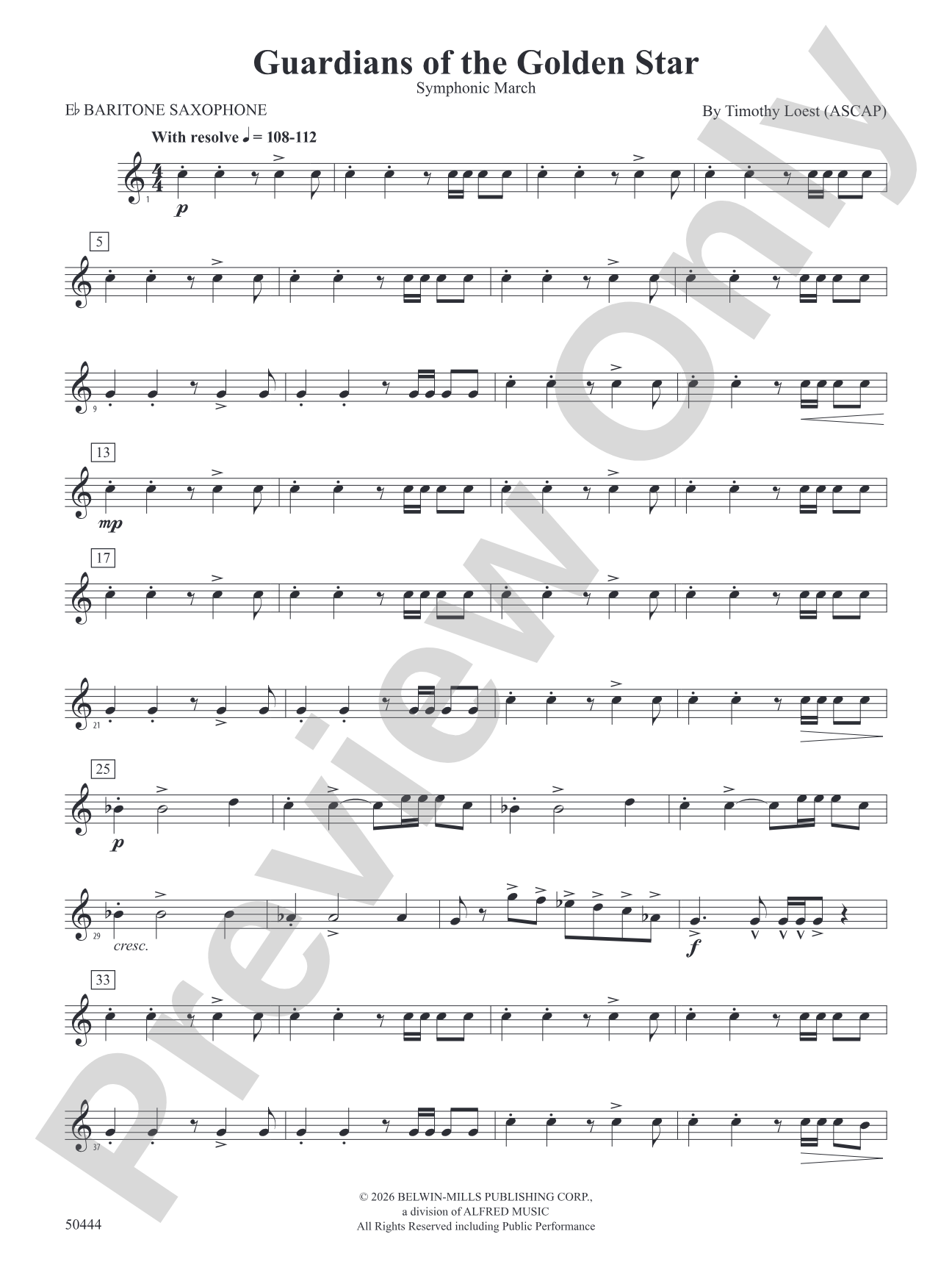

Guardians of the Golden Star: E-flat Baritone Saxophone
Symphonic March
By Timothy Loest
Grade: 3
Item: 00-PC-0019783_BTX
$3.00
Pickup currently not available
Description
This stirring symphonic march honors our fallen soldiers and their brave Gold Star families. Inspired by the true story of Pfc. James Howard Monroe, whose valorous actions saved the lives of his comrades at the cost of his own, Timothy Loest's Guardians of the Golden Star pays tribute to the ultimate sacrifice made in the name of duty and virtue. Perfect for any concert, it shines especially on Veterans Day and Memorial Day. Bold, iconic, and undeniably memorable.


Don't just read it, hear it, play along with it, and watch your students grow with it. In MakeMusic Cloud, Guardians of the Golden Star: E-flat Baritone Saxophone comes alive with professional accompaniment, adjustable tempo, and built-in practice tools that turn solo practice into real progress.
Open in the Player
Jump straight in and assign it today.
Start Your Free Trial
Open this title and explore the full library in minutes.
Sample Audio
1
Audio File
--:--
0:00
0:00
Sample Video
Additional Details
Series:
Belwin Concert Band
Publisher:
Alfred Music
SKU:
00-PC-0019783_BTX
More about this title
About the Composer: Timothy Loest

Timothy Loest has spent over three decades in the classroom at F.E. Peacock Middle School in Itasca, Illinois, where he developed both his compositional voice and his deep understanding of what young musicians can achieve. His works are performed by bands across the country, and his influence extends beyond the concert hall through collaborations on several widely adopted band methods, including Measures of Success and the Warm-ups and Beyond series. His compositions have appeared on national television programs ranging from The Tonight Show to Good Morning America, and in 2017, one of his pieces was performed for over 5,000 people at Chicago's Millennium Park. That same year, he received the Illinois Grade School Music Association's Cloyd Myers Memorial Award for Excellence in Music Education.
Loest founded Fanfare Music Press in 2022 to publish compositions and arrangements that meet the highest musical and pedagogical standards for band. A member of ASCAP and a regular commissioned composer, he holds degrees from Illinois State University and Northwestern University. His work is characterized by accessibility without compromise, writing that respects the abilities of developing musicians while creating pieces that audiences find genuinely moving.
Why we love this
Loest crafts this march with real structural weight and emotional authenticity. Rather than relying on bombast alone, he builds momentum through careful orchestration and harmonic development, which gives your students meaningful musical work to do while honoring the subject matter with genuine dignity. The piece works equally well as a strong concert closer or as part of a thematic program, and Grade 3 bands can execute it convincingly without oversimplifying the arrangement.
What to expect
This march moves with steady, deliberate power, building from thoughtful opening statements into bold, well-earned climaxes. The harmonic language and orchestration convey both solemnity and strength, creating a piece that audiences recognize as sincere rather than sentimental.
Who it's for
Concert bands at the Grade 3 level who want substantial repertoire with genuine expressive purpose. This works for school and community ensembles performing on Veterans Day, Memorial Day, or any concert that calls for patriotic music with substance rather than surface-level patriotism.
How to get the most out of it
- Shape the melodic line with purposeful phrasing rather than treating each section as isolated blocks; the march gains its impact from forward motion and architectural clarity.
- Balance your brass section carefully during tuttis so that the fundamental harmonic progression remains clear to listeners rather than becoming a wall of sound.
- Let younger players experience the full conductor score during rehearsals so they understand how their individual parts contribute to the larger design.
How to use it
Program this as a concert anchor in the second half of your concert, where it can land with full impact. It pairs well alongside other concert marches or as a transition piece leading into lighter fare, and it serves equally well as a season opener that establishes your ensemble's musical seriousness.
Skills your students will build
- Sustained ensemble balance across dynamic changes
- Phrasing and sectional form awareness in march contexts
- Brass and woodwind independence within harmonic textures
- Responding to conductors' tempo and expressive intentions