
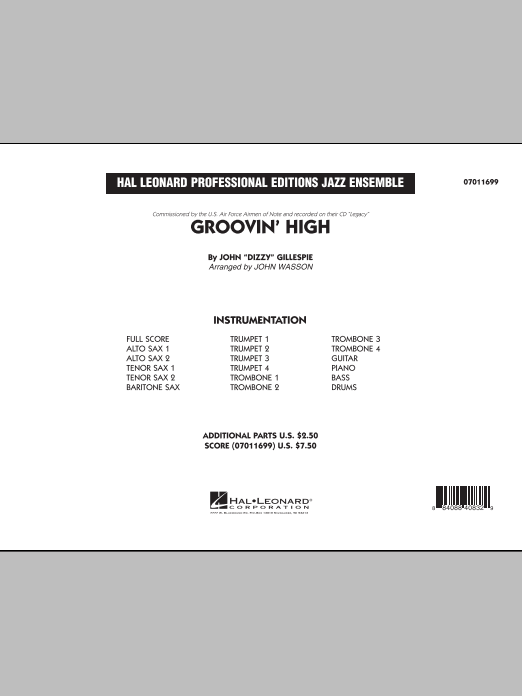

Groovin' High: Jazz Ensemble Conductor Score & Parts
By Dizzy Gillespie / Arranged by John Wasson
Grade: 5
Item: 35-PK00143250
$60.00
Pickup currently not available
Buy Extra Parts (Digital PDF Download)
| Product | Price | Quantity |
|---|---|---|
| Groovin' High - Conductor Score (Full Score) | $7.50 | |
| Groovin' High - Alto Sax 1 | $6.00 | |
| Groovin' High - Alto Sax 2 | $6.00 | |
| Groovin' High - Tenor Sax 1 | $6.00 | |
| Groovin' High - Tenor Sax 2 | $6.00 | |
| Groovin' High - Baritone Sax | $6.00 | |
| Groovin' High - Trumpet 1 | $6.00 | |
| Groovin' High - Trumpet 2 | $6.00 | |
| Groovin' High - Trumpet 3 | $6.00 | |
| Groovin' High - Trumpet 4 | $6.00 | |
| Groovin' High - Trombone 1 | $6.00 | |
| Groovin' High - Trombone 2 | $6.00 | |
| Groovin' High - Trombone 3 | $6.00 | |
| Groovin' High - Trombone 4 | $6.00 | |
| Groovin' High - Guitar | $6.00 | |
| Groovin' High - Piano | $6.00 | |
| Groovin' High - Bass | $6.00 | |
| Groovin' High - Drums | $6.00 |
Parts Added to Cart!
Description
Written for and recorded by the U.S. Air Force Airmen of Note, Joe Jackson director, John Wasson has created a stunning and unique setting of this long-standing jazz classic. The chart is filled with twists and turns, blazing ensemble passages and also features solo space for two alto saxes (optional alto sax and trumpet). For the mature band, here is a real showstopper.


Groovin' High: Jazz Ensemble Conductor Score & Parts isn't in MakeMusic Cloud just yet...but it could be. Let us know you'd like to see it, and you'll help shape what comes next. In the meantime, start a free trial and dive into thousands of interactive titles your students can play along with today.
Request This Title
Tell us you want it.
Start Your Free Trial
Explore everything that's ready to play right now.
Sample Audio
No sample audio found.
Sample Video
No sample videos found.
Additional Details
Publisher:
Hal Leonard
SKU:
35-PK00143250
More about this title
About the Composer: Dizzy Gillespie
Dizzy Gillespie revolutionized jazz trumpet playing and composition in the 1940s, establishing bebop as the dominant language of modern jazz. His harmonic innovations, blazing technical facility, and fearless approach to melody fundamentally changed what jazz could express. For educators, Gillespie's work remains essential because it bridges the gap between accessibility and artistic sophistication; his compositions reward careful listening and serious study.
As a bandleader, composer, and tireless advocate for jazz education, Gillespie spent decades mentoring younger musicians and championing jazz as a legitimate art form worthy of concert halls and classrooms. His compositions like "Groovin' High" have become repertoire standards, taught in universities and performed by ensembles at every level because they contain both immediate appeal and inexhaustible musical content.
Why we love this
Wasson's arrangement takes a bebop cornerstone and reimagines it with orchestral clarity and dramatic arc, making the harmonic sophistication of Gillespie's original accessible without diluting it. The optional alto sax and trumpet solos give your section leaders real showcase moments while keeping the chart flexible for groups of varying sizes. For a finale or special concert moment, this chart delivers the energy and musicianship audiences expect from mature jazz ensembles.
What to expect
The music shifts between moments of crisp, energetic ensemble writing and spaces that let the soloists stretch into the pocket of the groove. Wasson's setting captures the wit and buoyancy of the original while adding unexpected harmonic colors and textural variety that keep both players and listeners engaged throughout.
Who it's for
This arrangement fits Grade 5 ensembles with solid section players, reliable soloists, and enough rehearsal time to work through the harmonic and rhythmic demands. Your group needs musicians who can read jazz vocabulary fluently and respond to a conductor's shaping of tempo and dynamics.
How to get the most out of it
- Balance the blazing ensemble passages so individual voices cut through the texture; the twists and turns Wasson included work best when listeners can track the compositional sleight of hand.
- Let your soloists breathe during their featured moments. Even though the chart surrounds them with support, the best recordings of bebop standards succeed when the soloist has rhythmic freedom to respond to the groove.
- Establish a rock-solid time feel in the rhythm section before adding the ensemble. Gillespie's language sits on top of a strong quarter-note pulse, and your foundation has to lock in completely.
- Study the Air Force Airmen of Note recording to hear how Wasson's arrangement unfolds across a full ensemble; the recorded version reveals which moments should push forward and where to breathe.
How to use it
Close a jazz concert with this if you want to send the audience out energized and impressed. It pairs well with a program that mixes standards and contemporary jazz compositions; the Gillespie authorship gives it historical weight while the Wasson arrangement proves that classic material can sound fresh and surprising on stage.
Skills your students will build
- Reading bebop vocabulary and harmonic language
- Responding to unexpected harmonic twists and ensemble rhythmic figures
- Solo interpretation within a structured arrangement
- Locking rhythm section parts with precise harmonic coordination
- Balancing individual voices within dense ensemble textures