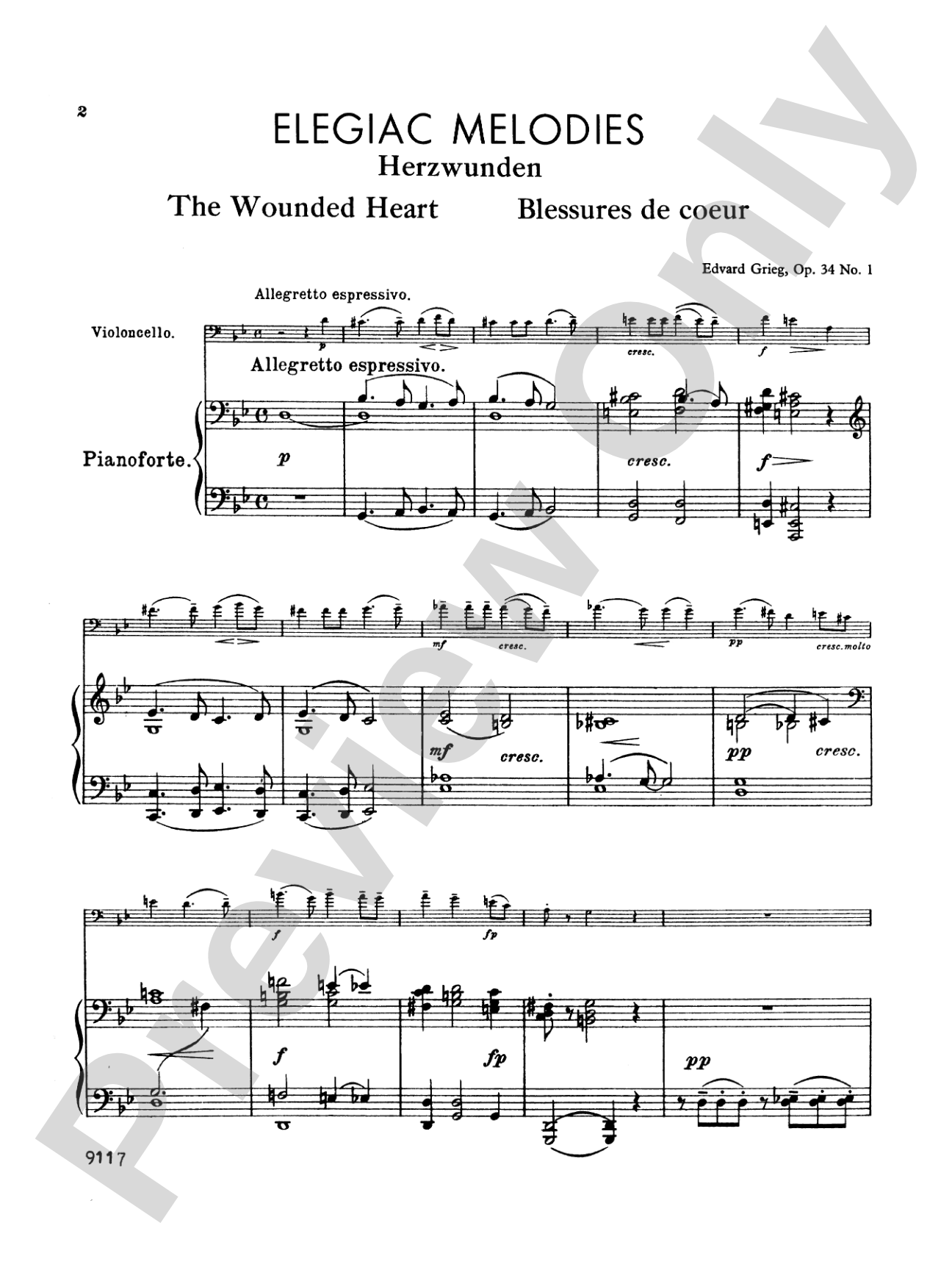
Grieg: Elegiac Melodies, Op. 34 Sheet Music Preview

Grieg: Elegiac Melodies, Op. 34

By Edvard Grieg

Item: 00-PC-0011757

Digital Download
$3.99
Description
A Cello solo with Piano Accompaniment composed by Edvard Grieg.

Don't just read it, hear it, play along with it, and watch your students grow with it. In MakeMusic Cloud, Grieg: Elegiac Melodies, Op. 34 comes alive with professional accompaniment, adjustable tempo, and built-in practice tools that turn solo practice into real progress.

Sample Audio
No sample audio found.
Sample Video
Additional Details
Series: Kalmus Edition
Publisher: Alfred Music
Page Count: 12
SKU: 00-PC-0011757

More about this title

About the Composer: Edvard Grieg

Edvard Grieg (1843-1907) stands as Norway's most celebrated composer, creating a body of work that brought Scandinavian musical idioms into the concert hall and drew the attention of Europe's finest performers. His gift for melody and harmonic color found expression across all genres, though his chamber and piano works remain closest to his compositional heart. Grieg's influence on music education stems not from a desire to simplify or popularize, but from his ability to write music of genuine substance that remains accessible to advancing musicians.

Grieg spent much of his career in Bergen and Christiania (Oslo), establishing himself as a conductor, pianist, and teacher whose standards were uncompromising. His Elegiac Melodies occupy a special place in the Romantic cello repertoire, crafted with the instrument's lyrical possibilities always in mind. For cellists and their teachers, Grieg's work represents a touchstone for understanding how to balance expressive depth with musical clarity.

Why we love this

These two melodies sit in a sweet spot between technical accessibility and genuine artistic substance. Cellists at the intermediate-to-advanced level will find them rewarding to perform without the virtuosic fireworks that obscure musicality, and audiences hear the full emotional weight of Romantic voice leading without feeling they're listening to a study.

What to expect

These elegies capture a distinctly Nordic sensibility: plaintive and introspective, yet never despairing. The writing flows with the ease of a natural melody, but beneath lies sophisticated harmonic language that makes the simplicity deceptive. There is a quietness to these pieces, even in moments of passion, that rewards patient, attentive listening.

Who it's for

Cellists working at the late intermediate to early advanced level, particularly those ready to engage with Romantic-era chamber literature that demands interpretive maturity alongside technical security. This is equally suitable for cellists preparing for competitions, recitals, or advanced studio work where a substantial single piece is needed.

How to get the most out of it

  • Shape the melodic line as if singing a Scandinavian folk ballad: lean into rubato that honors the text-like phrasing rather than strict metronomic time.
  • Attend to the piano's harmonic foundation, particularly in moments where Grieg uses unexpected chromatic shifts to deepen emotional color.
  • Explore the range of vibrato strategically, using less on moments of repose and more as the melody reaches its peaks, allowing the tone to breathe naturally.
  • Let the cello's lowest register resonate fully in the more introspective passages; Grieg writes for the instrument's warmth, not its brilliance.

How to use it

Program these elegies as contrasts to technically showy repertoire, or pair them with other chamber works that emphasize the cello's singing voice. They work equally well as a recital centerpiece or as part of a Romantic-era survey that explores how different national traditions shaped 19th-century compositional voice.

Skills your students will build

  • Sustaining long melodic lines with consistent tone and phrasing across register shifts
  • Interpreting Romantic-era rubato and expressive timing within a structured harmonic context
  • Balancing solo voice with collaborative listening to the piano accompaniment
  • Reading and realizing Grieg's harmonic language and its subtle chromatic inflections
  • Building interpretive independence through analysis of structural and emotional landmarks

You May Also Like