
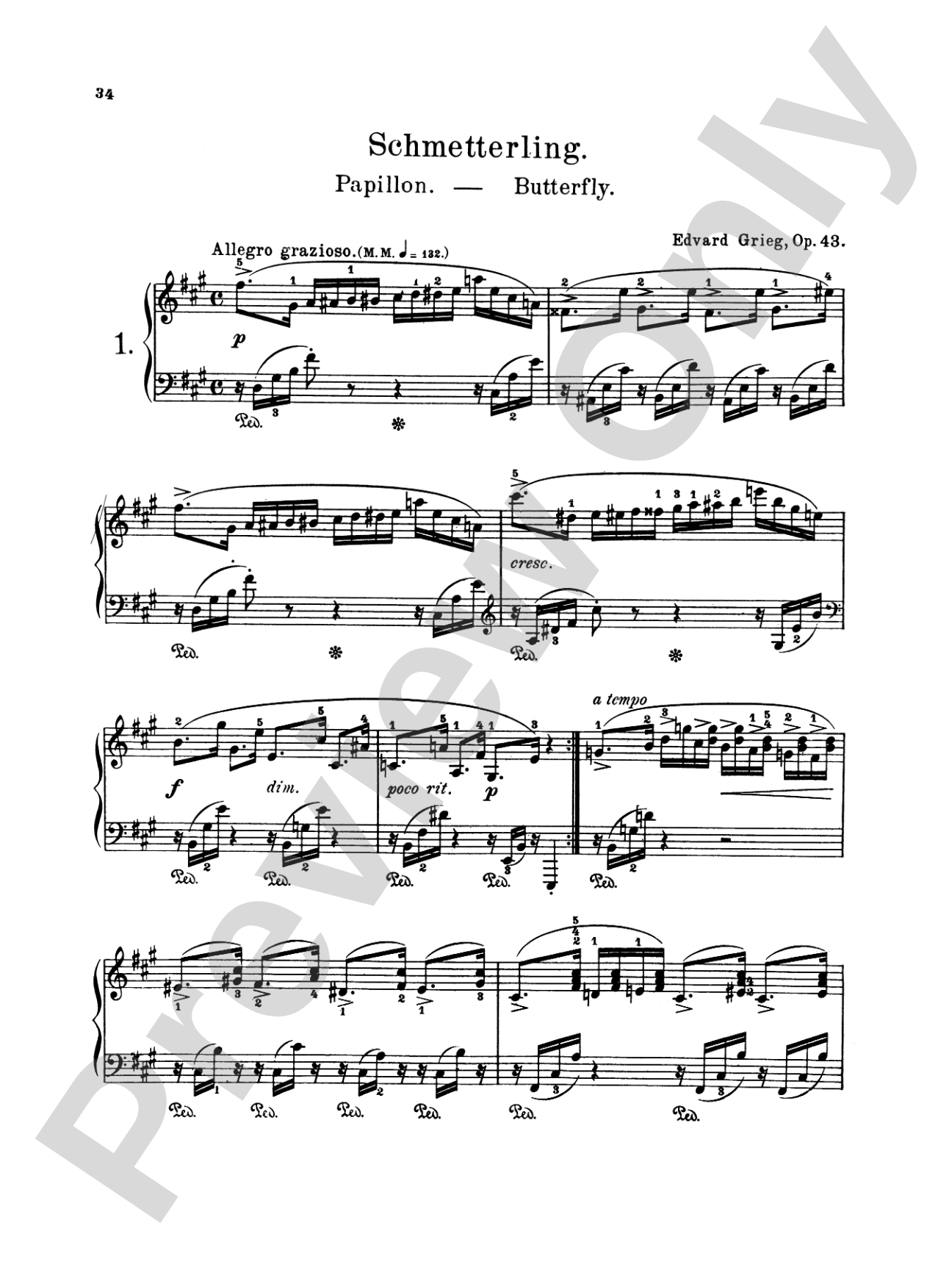

Grieg: Complete Lyric Pieces
By Edvard Grieg
Level: Intermediate / Advanced
Item: 00-PC-0012867
$0.99
Pickup currently not available
Description
Op. 12, Op. 38, Op. 43, Op. 47, Op. 54.


Don't just read it, hear it, play along with it, and watch your students grow with it. In MakeMusic Cloud, Grieg: Complete Lyric Pieces comes alive with professional accompaniment, adjustable tempo, and built-in practice tools that turn solo practice into real progress.
Open in the Player
Jump straight in and assign it today.
Start Your Free Trial
Open this title and explore the full library in minutes.
Sample Audio
No sample audio found.
Sample Video
No sample videos found.
Additional Details
Series:
Kalmus Edition
Publisher:
Alfred Music
Page Count:
216
SKU:
00-PC-0012867
More about this title
About the Composer: Edvard Grieg
Edvard Grieg (1843-1907) was a Norwegian composer who shaped Romantic music through his distinctive harmonic language and deep connection to Scandinavian folk traditions. Though best known for larger orchestral works like the Piano Concerto in A Minor, Grieg devoted considerable creative energy to the lyric piece, a short character form that allowed him to explore intimate musical ideas with remarkable depth and economy.
Greig's lyric pieces represent a masterclass in miniature composition. These works distill Romantic expression into focused moments, moving seamlessly between reflective passages and moments of genuine drama. For pianists and students of music history alike, they remain essential windows into how a major composer worked at the smallest scale, proving that brevity demands greater craft, not less.
Why we love this
Grieg's lyric pieces sit at the intersection of accessibility and sophistication. Pianists find immediate musical reward in these pieces while discovering layers of harmonic innovation and structural subtlety that reward deeper study. This collection spans Grieg's most productive period, allowing teachers to sequence repertoire by both difficulty and artistic development, tracing his evolving voice across five opuses.
What to expect
These pieces evoke the Norwegian landscape Grieg loved: intimate parlor scenes give way to glimpses of folklore and nature, while tender passages shift unexpectedly into moments of passion or wistfulness. The harmonies often surprise, pulling you toward unexpected harmonic destinations that feel both mysterious and inevitable. There is elegance without affectation, depth without heaviness.
Who it's for
This collection serves intermediate to advanced pianists ready to move beyond student repertoire into genuine art music. It works equally well for conservatory students building a recital program, adult learners seeking substantial yet manageable material, and teachers looking for repertoire that demonstrates how a major composer handled the miniature form.
How to get the most out of it
- Attend closely to Grieg's pedal markings and tempo indications. These pieces rely on color and atmosphere as much as melody, and respecting his expressive directions shapes the entire character of a performance.
- Pace yourself through rubato; Grieg's romantic gestures can overwhelm without restraint. Reserve the most flexible timing for moments of genuine harmonic surprise or folk-like melody, letting other sections breathe more steadily.
- Balance the delicate middle voices that often carry harmonic progression. Many of these pieces feature melody in the treble with essential harmonic support in the alto range; clarity here prevents the music from sounding muddy despite the pedal.
- Explore the range of dynamic control across five opuses. Early pieces often favor intimacy and subtlety, while later works embrace bolder gestures. Let the collection's arc inform your interpretation and help pianists understand Grieg's artistic evolution.
How to use it
Individual lyric pieces work beautifully as encores or shorter concert numbers, allowing you to vary mood and pace within a recital without requiring large-scale works. Alternatively, group pieces from the same opus or select complementary pieces across opuses to create a thematic program exploring Grieg's lyric voice. Teachers can assign single pieces from this edition over months of study, using the collection as a pedagogical resource that grows with the student.
Skills your students will build
- Romantic-era harmonic vocabulary and chromatic voice-leading
- Pedal technique and color control in the absence of orchestration
- Structural clarity in short forms without repetitive patterns
- Interpretive independence in music with flexible rubato and rubato-free sections
- Folk melody recognition and its harmonic treatment in classical contexts
- Nuanced dynamic control and tonal palette development