
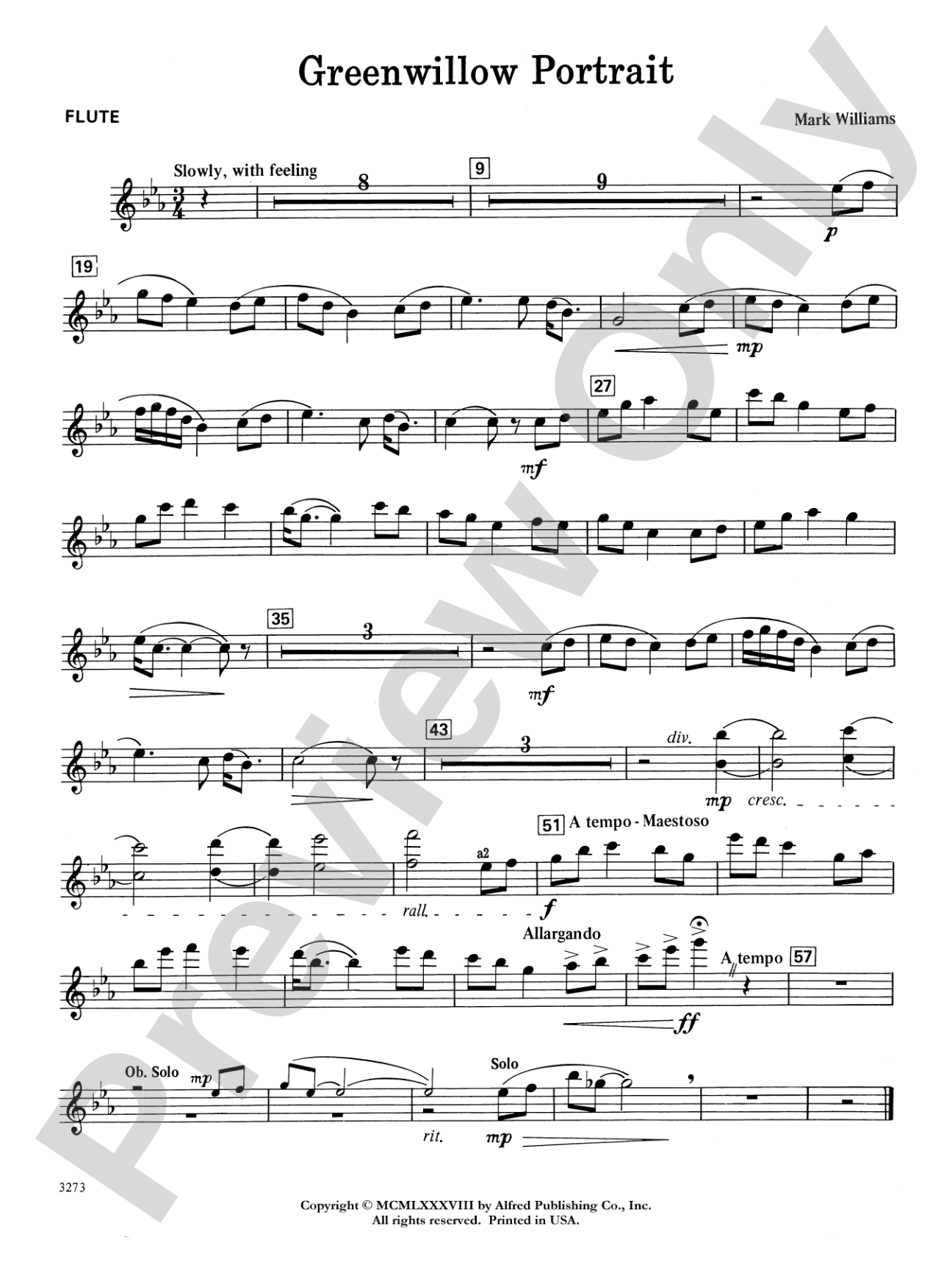

Greenwillow Portrait: Flute
By Mark Williams
Grade: 3 (Medium)
Item: 00-PC-0001834_F1
$3.00
Pickup currently not available
Description
This is a beautifully scored ballad in the British folk song style. If you love the Percy Grainger sound but don't have the band to do it, try this composition. (Grade 3) This title is available in MakeMusic Cloud.


Don't just read it, hear it, play along with it, and watch your students grow with it. In MakeMusic Cloud, Greenwillow Portrait: Flute comes alive with professional accompaniment, adjustable tempo, and built-in practice tools that turn solo practice into real progress.
Open in the Player
Jump straight in and assign it today.
Start Your Free Trial
Open this title and explore the full library in minutes.
Sample Audio
1
Audio File
--:--
0:00
0:00
Sample Video
No sample videos found.
Additional Details
Series:
Growing Band Series
Publisher:
Alfred Music
Page Count:
124
SKU:
00-PC-0001834_F1
More about this title
About the Composer: Mark Williams

Mark Williams shaped school band repertoire for generations through both teaching and composition. A Chicago-born musician who spent his career in Washington state, Williams earned degrees from Eastern Washington University and served as a woodwind performer and arranger for the 560th Air Force Band. He co-authored the Accent on Achievement Band Method, a foundational text in instrumental music education, while maintaining an active performance schedule as a bassoon player and conductor of the Spokane British Brass Band.
With over 200 published works for band, orchestra, and choir, Williams established himself as one of the most prolific composers writing for school ensembles. His clinician schedule took him across 34 states, five Canadian provinces, and Australia, where he shared his compositional philosophy and mentored young musicians. His honors include the Western International Band Clinic's Gralia Competition and multiple ASCAP Special Awards, recognition of his sustained impact on American music education.
Why we love this
Williams channels the lyrical warmth of the British folk tradition without requiring the outsized forces that make Grainger transcriptions challenging for developing ensembles. At Grade 3, this ballad sits comfortably within reach while maintaining genuine musical sophistication, allowing your band to explore expressive conducting and sectional balance work that often gets overlooked in faster, technically demanding repertoire.
What to expect
A quiet moment of reflection, the kind you find in a folk melody passed down through generations. The piece settles into your ear with the familiarity of something half-remembered, built on the gentle undulation of British instrumental tradition rather than dramatic gesture.
Who it's for
Directors working with Grade 3 concert bands who want to program music with genuine artistic depth. This is ideal for ensembles developing their ability to sustain long lines and shape balladic material, as well as for directors seeking repertoire that demonstrates musicality without relying on flashy technique.
How to get the most out of it
- Shape the melodic line as you would a vocalist performing a folk song; the beauty lives in the sustained phrases and gentle direction of the tune rather than in technical display.
- Balance the inner voices carefully so that harmonic support remains audible without overwhelming the primary melody. This kind of transparent orchestration rewards detailed sectional rehearsals.
- Bring out the folk song character through subtle rubato and attention to phrase endings; resist the impulse to conduct mechanically even though the time signature remains steady.
- Use the minor key and modal inflections to guide your dynamic choices; these tools naturally suggest where to press and where to release without requiring extreme contrasts.
How to use it
Pair this with more energetic Grade 3 selections to create a concert program with dynamic variety; the balladic character makes it an excellent centerpiece between opening movement pieces and lighter closers. It also works well as a festival entry for bands seeking to demonstrate ensemble musicianship and control in a more introspective repertoire choice.
Skills your students will build
- Sustaining long melodic phrases with consistent tone and breath support
- Balancing melody and harmony to create transparent orchestration
- Responding to subtle conducting gestures for dynamic and tempo inflection
- Interpreting folk song style and modal harmonic language
- Maintaining tuning and intonation during slower, exposed passages