
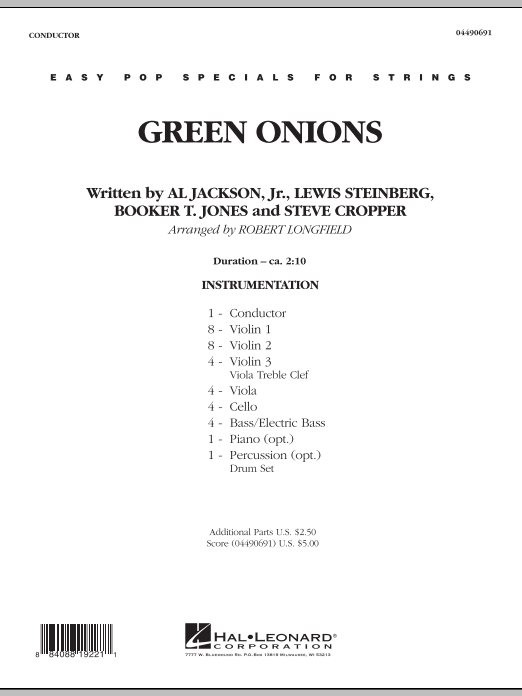

Green Onions: String Orchestra Conductor Score & Parts
As performed by Booker T. The MG's / Arranged by Robert Longfield
Grade: 2-3
Item: 35-PK00096239
$45.00
Pickup currently not available
Buy Extra Parts (Digital PDF Download)
| Product | Price | Quantity |
|---|---|---|
| Green Onions - Full Score | $6.00 | |
| Green Onions - Violin 1 | $7.00 | |
| Green Onions - Violin 2 | $7.00 | |
| Green Onions - Violin 3 (Viola Treble Clef) | $7.00 | |
| Green Onions - Viola | $7.00 | |
| Green Onions - Cello | $7.00 | |
| Green Onions - Bass | $7.00 | |
| Green Onions - Percussion | $7.00 | |
| Green Onions - Piano | $7.00 |
Parts Added to Cart!
Description
From an era past comes this infectious minor blues shuffle from Booker T. The MG's. There is an open section for improvised solos, which includes an approachable written-out solo for developing players. Dur: 2:10


Green Onions: String Orchestra Conductor Score & Parts isn't in MakeMusic Cloud just yet...but it could be. Let us know you'd like to see it, and you'll help shape what comes next. In the meantime, start a free trial and dive into thousands of interactive titles your students can play along with today.
Request This Title
Tell us you want it.
Start Your Free Trial
Explore everything that's ready to play right now.
Sample Audio
No sample audio found.
Sample Video
No sample videos found.
Additional Details
Publisher:
Hal Leonard
SKU:
35-PK00096239
More about this title
About the Artist: Booker T. The MG's
Booker T. Jones and The MG's emerged from Memphis in the 1960s as one of the most influential instrumental soul groups in American music history. Their lean, groove-centered approach to funk and soul proved that a keyboard player, bassist, guitarist, and drummer could command a room with as much authority as any horn section. "Green Onions," their 1962 debut single, became a radio staple and jazz standard, showcasing Jones's Hammond B3 organ work alongside Steve Cropper's restrained yet soulful guitar playing.
Why we love this
Longfield's arrangement captures the groove-driven essence of the original while making it genuinely playable for developing string players. The written-out solo option removes the intimidation factor of improvisation without sacrificing authenticity, and the minor blues tonality gives students direct experience with a foundational jazz language.
What to expect
Relaxed yet propulsive. The minor blues shuffle creates a gently swaying sensation that never loses momentum, driven by a rhythm that feels effortless but demands precision. There's a vintage cool to it, the sound of a smoky room and musicians completely comfortable in their own pocket.
Who it's for
This works beautifully for orchestras navigating the Grade 2–3 range who want to venture into styles beyond classical and contemporary. It's also ideal for programs looking to include twentieth-century popular music as part of a comprehensive repertoire diet, or as a standalone concert opener that energizes an audience.
How to get the most out of it
- Establish the shuffle feel early in rehearsals by isolating the rhythm section (cello and bass). This groove is the skeleton everything else hangs on, so lock it in before layering the other voices.
- Encourage players taking the improvised section to listen to the original recording multiple times. Hearing how restraint and space are just as important as notes will shift how they approach their solo.
- Balance the organ comping texture in the accompaniment so it doesn't overshadow the soloists. Strings are accustomed to being the primary voice, so conscious dynamic control here prevents the blues feeling from flattening.
How to use it
Pair this with other blues or soul-influenced works to build a thematic concert section, or use it as a palate cleanser between heavier classical pieces. It's also a perfect teaching tool early in the school year when students need immediate success and infectious material that reminds them why they play.
Skills your students will build
- Shuffle rhythm interpretation and feel-based playing
- Reading and performing minor blues chord progressions
- Listening and responding to improvisation within a fixed harmonic framework
- Dynamic balance when supporting soloists in small ensemble textures
- Connection between notated classical technique and popular music idiom