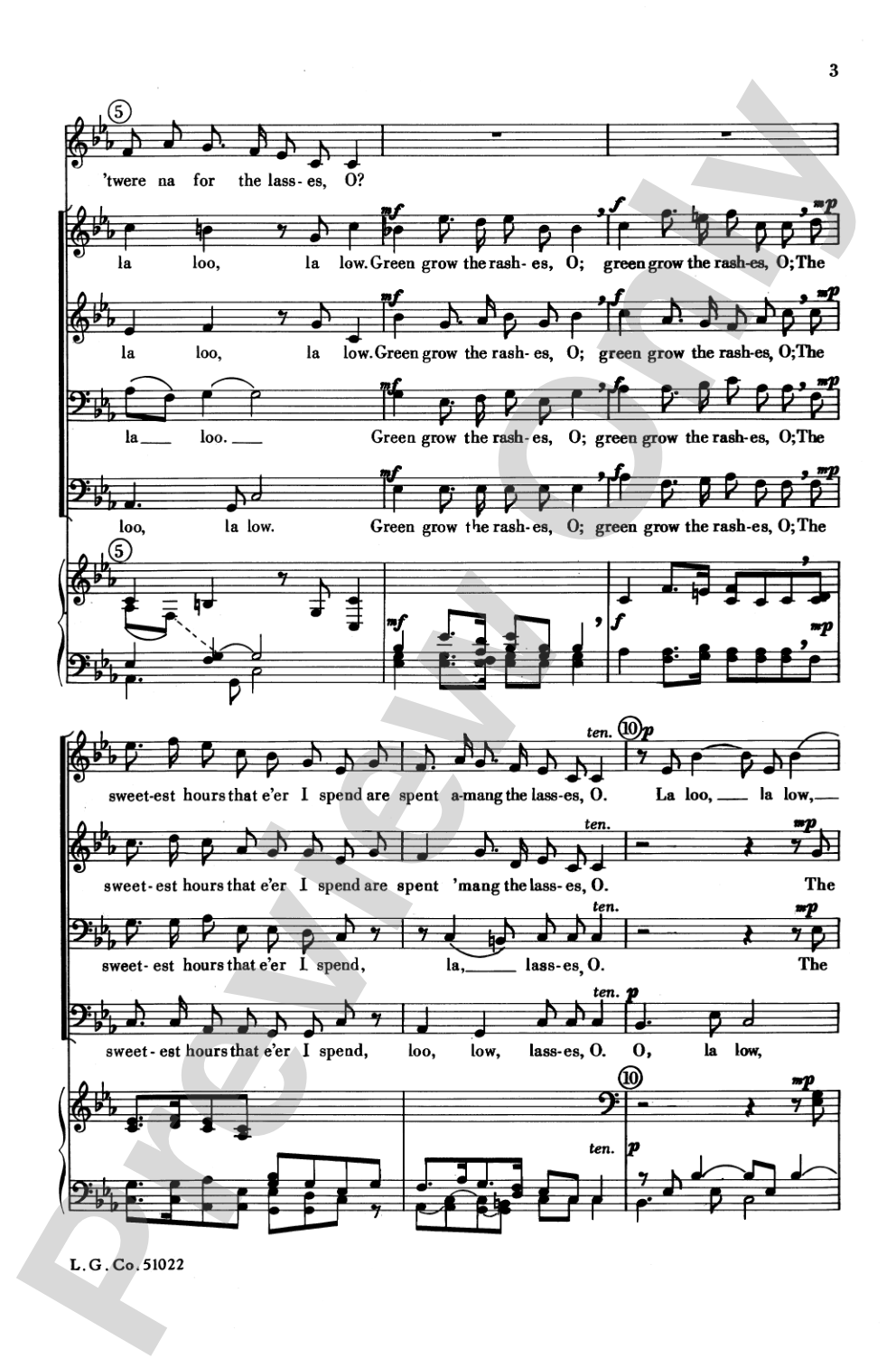
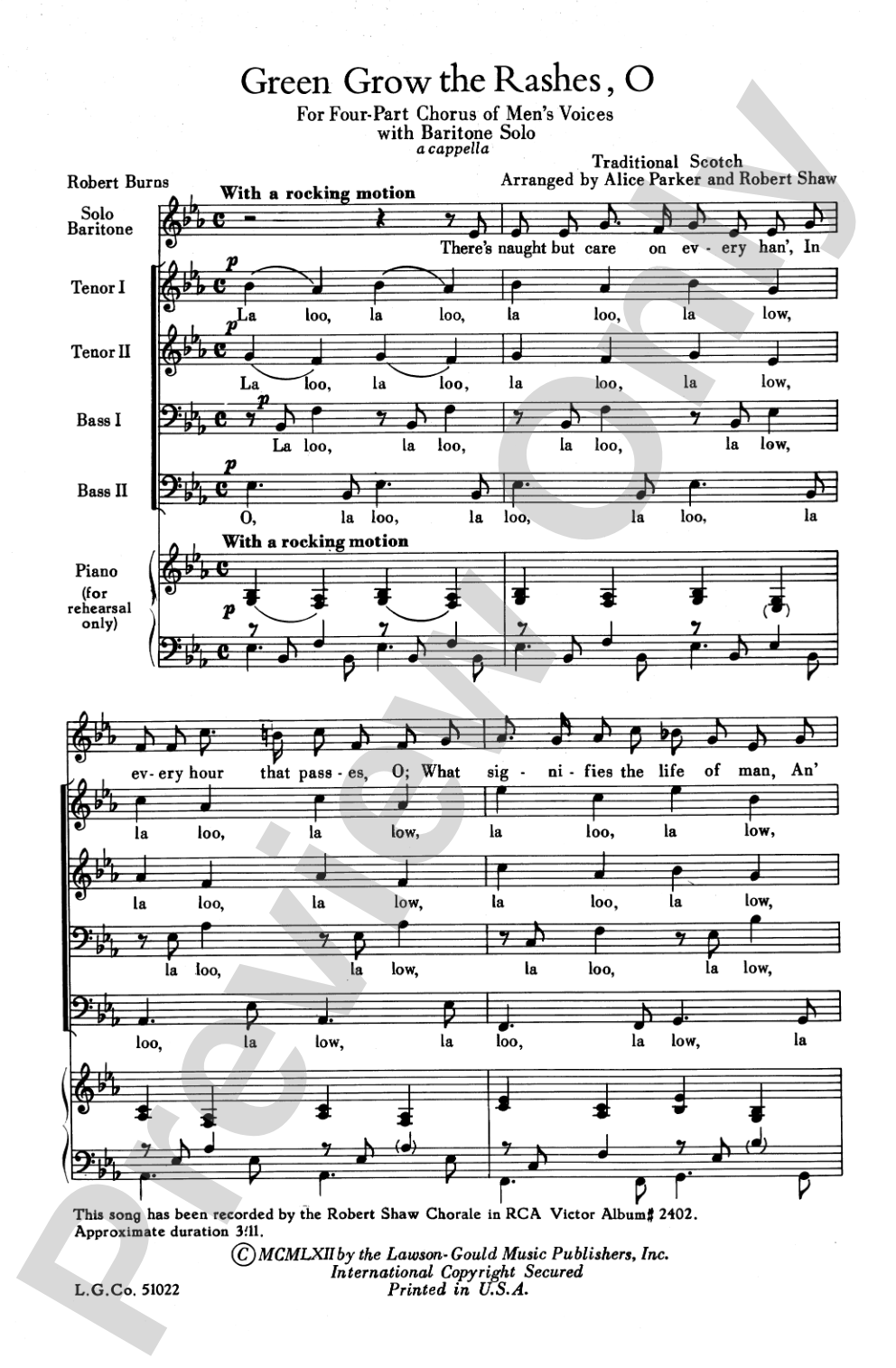
Green Grow the Rashes, O Sheet Music Preview

Green Grow the Rashes, O: TTBB Choral Octavo

Arr. Robert Shaw and Alice Parker

Item: 00-PO-0004960

Digital Download
$2.25

Minimum order quantity: 20 copies

Description

Green Grow the Rashes, O: TTBB Choral Octavo isn't in MakeMusic Cloud just yet...but it could be. Let us know you'd like to see it, and you'll help shape what comes next. In the meantime, start a free trial and dive into thousands of interactive titles your students can play along with today.

Sample Audio
0:00
0:00
Sample Video
Additional Details
Series: Alfred Archive Edition: Robert Shaw Choral Series
Publisher: Alfred Music
Page Count: 8
SKU: 00-PO-0004960

More about this title

About the Arranger: Robert Shaw

Robert Shaw (1916-1999) was a legendary choral conductor and arranger whose influence shaped American choral music across six decades. As founder and director of the Robert Shaw Chorale, he developed a distinctive approach to ensemble sound that emphasized clarity, blend, and musical depth. His arrangements became standard repertoire for college and professional choirs, prized for their musicality and accessibility without sacrificing artistic substance.

Why we love this

Shaw and Parker's treatment of this Scottish folksong brings wit and character to a traditional melody without overcomplicating it. The flexible voicing options (TB, TTB, TBB, TTBB) mean you can program this regardless of your group's current makeup, and the eight-page score gives singers enough musical material to invest in without demanding excessive rehearsal time for a folksong.

What to expect

Warm and direct, with the flavor of a folk setting that's been refined without losing its earthiness. The arrangement honors the melody's straightforward character while layering in harmonic interest that keeps singers engaged across multiple verses.

Who it's for

TTBB ensembles and men's choirs looking for a substantial folksong arrangement that works for college, community, or advanced high school groups. Directors seeking a piece that feels contemporary in approach yet rooted in tradition will find this a natural fit for mixed-voice programming.

How to get the most out of it

  • Pay attention to the harmonic shifts between verse and refrain; Shaw's arrangement uses them to clarify the song's form, so let those changes breathe rather than smoothing through them.
  • Balance the voices so the melody reads clearly without burying the accompanying voices; these harmonies contain the song's character, and each line matters.
  • Approach the text with conversational ease; this is a song meant to feel sung rather than performed, so ground your interpretation in natural speech rhythms.

How to use it

Pair this with other folksong arrangements or secular choral works to create a thematic set on traditional music. It also makes a strong standalone piece for concerts emphasizing choral artistry, particularly for groups building a reputation for sensitive interpretation of repertoire across styles.

Skills your students will build

  • Balancing primary and secondary melodic lines in close harmony
  • Interpreting text with conversational authenticity rather than theatrical delivery
  • Sight-reading flexible voicing layouts (understanding how the same piece functions across multiple voice configurations)
  • Blending vowels across sustained harmonic movement

You May Also Like