
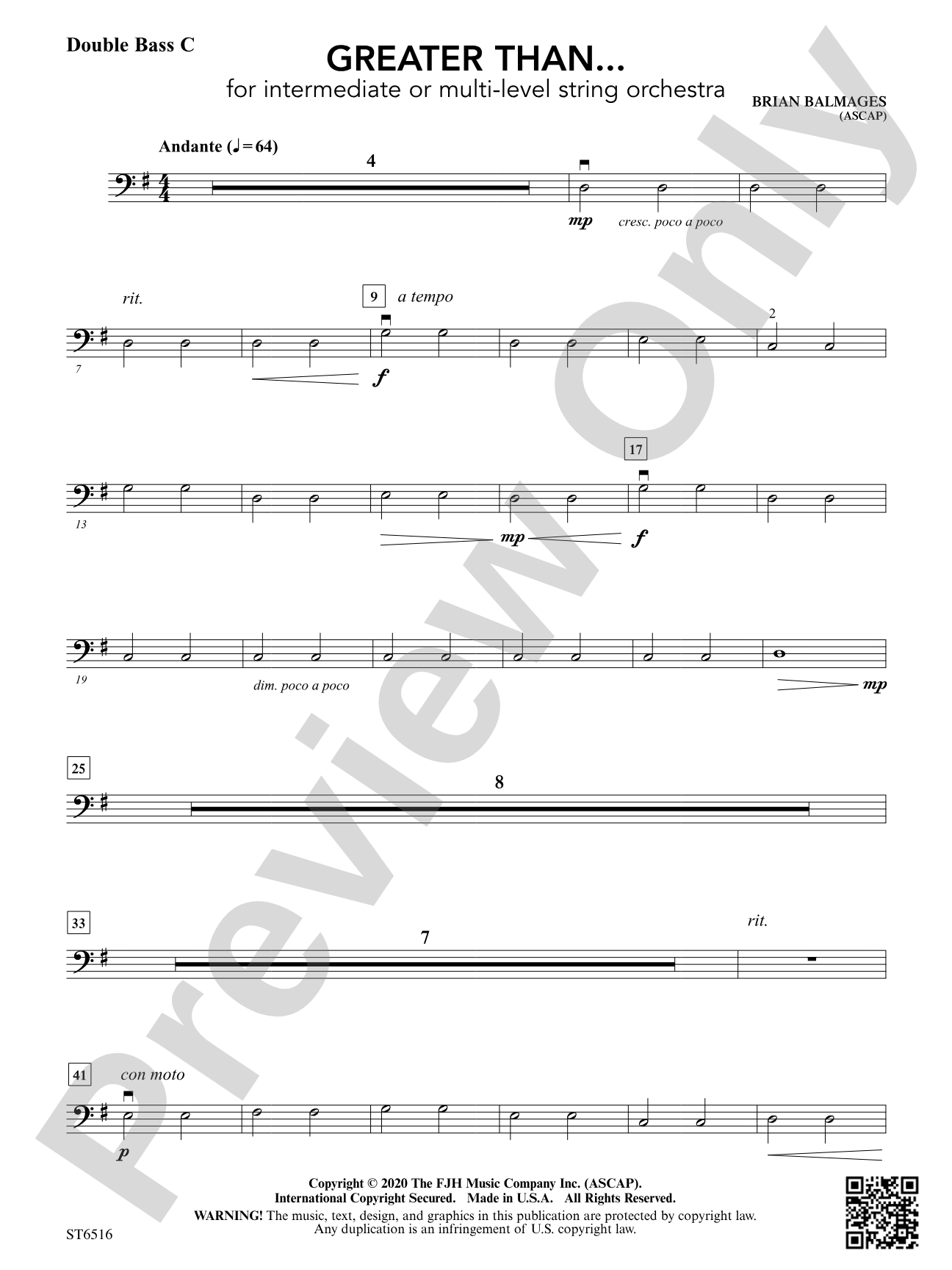

Greater Than...: Double Bass C
(Supplemental Set)
Brian Balmages
Grade: 1-2
Item: 98-PC-DST6516_SBC
$7.00
Pickup currently not available
Description
The multi-level supplemental Parts & Score for this gorgeous lyrical work, Commissioned by the National String Project Consortium. These multi-level supplemental parts, for beginning and developing string students, are orchestrated to celebrate inclusion and diversity, designed to sound far "greater than" the intermediate version alone. Not performable alone. Requires purchase of intermediate level version ST6488.


Greater Than...: Double Bass C isn't in MakeMusic Cloud just yet...but it could be. Let us know you'd like to see it, and you'll help shape what comes next. In the meantime, start a free trial and dive into thousands of interactive titles your students can play along with today.
Request This Title
Tell us you want it.
Start Your Free Trial
Explore everything that's ready to play right now.
Sample Audio
1
Audio File
--:--
0:00
0:00
Sample Video
No sample videos found.
Additional Details
Series:
FJH String Orchestra
Publisher:
FJH Music Company Inc.
SKU:
98-PC-DST6516_SBC
More about this title
About the Composer: Brian Balmages

Brian Balmages has established himself as a composer and conductor working across orchestral, band, and chamber repertoire with equal fluency. His works have been performed by ensembles spanning from professional symphony orchestras to school programs at venues including Carnegie Hall, the Kennedy Center, and Sydney Opera House. He received the A. Austin Harding Award from the American School Band Directors Association and won the 2020 NBA William D. Revelli Composition Contest for Love and Light. He is an elected member of the American Bandmasters Association and received the inaugural James Madison University Distinguished Alumni Award from the School of Visual and Performing Arts.
As a conductor, Balmages maintains active guest engagements with all-state ensembles, university groups, and professional orchestras worldwide. He has appeared at the Midwest Clinic, Western International Band Clinic, and numerous state ASTA conferences. His music was performed during the 2013 Presidential Inaugural Prayer Service. He currently serves as Director of MakeMusic Publications and Digital Education for Alfred and MakeMusic.
Why we love this
This piece demonstrates Balmages' gift for writing string music that sounds substantially richer when beginning and developing players join the intermediate ensemble. Rather than treating supplemental parts as an afterthought, he orchestrated them as integral voices that create genuine ensemble texture while remaining accessible to younger students. Programming it alongside the intermediate version makes for an impressive concert moment that celebrates what your full program can accomplish together.
What to expect
Serene and beautifully shaped, this lyrical work unfolds with warmth and clarity. The orchestration celebrates what each level of student brings to the ensemble, creating a sense of genuine collaboration and shared musical purpose.
Who it's for
String orchestra directors programming mixed-level ensembles who want an inclusive performance opportunity rather than separate concerts. This arrangement serves beginning and developing players by giving them an authentic role within a musically sophisticated work, not a simplified parallel version.
How to get the most out of it
- Balance the beginning and developing parts so they support rather than overpower the intermediate section. The supplemental voices are designed to add color and fullness, not carry the main lines.
- Work the intermediate version thoroughly before combining ensembles. Once your intermediate students have internalized the piece, adding the additional parts will feel like expansion rather than distraction.
- Use rehearsal time to let students hear how their individual parts contribute to the larger texture. Spot-checking sections with and without the supplemental voices helps everyone understand the arrangement.
- Shape the lyrical lines with consistent bow direction across all sections. This piece rewards a unified approach to phrasing even when parts move at different rhythmic rates.
How to use it
Program this as the culmination of a concert that moves from younger to more advanced repertoire, or feature it as a festival entry that demonstrates your program's depth and inclusivity. The commission from the National String Project Consortium makes it a meaningful choice for celebrations of music education and ensemble growth.
Skills your students will build
- Reading and performing lyrical melodic lines with consistent phrasing
- Balancing individual parts within a multi-level ensemble texture
- Understanding how supporting voices contribute to overall musical structure
- Sustaining tone and intonation through longer, flowing passages
- Responding to conductor direction across mixed ability levels