
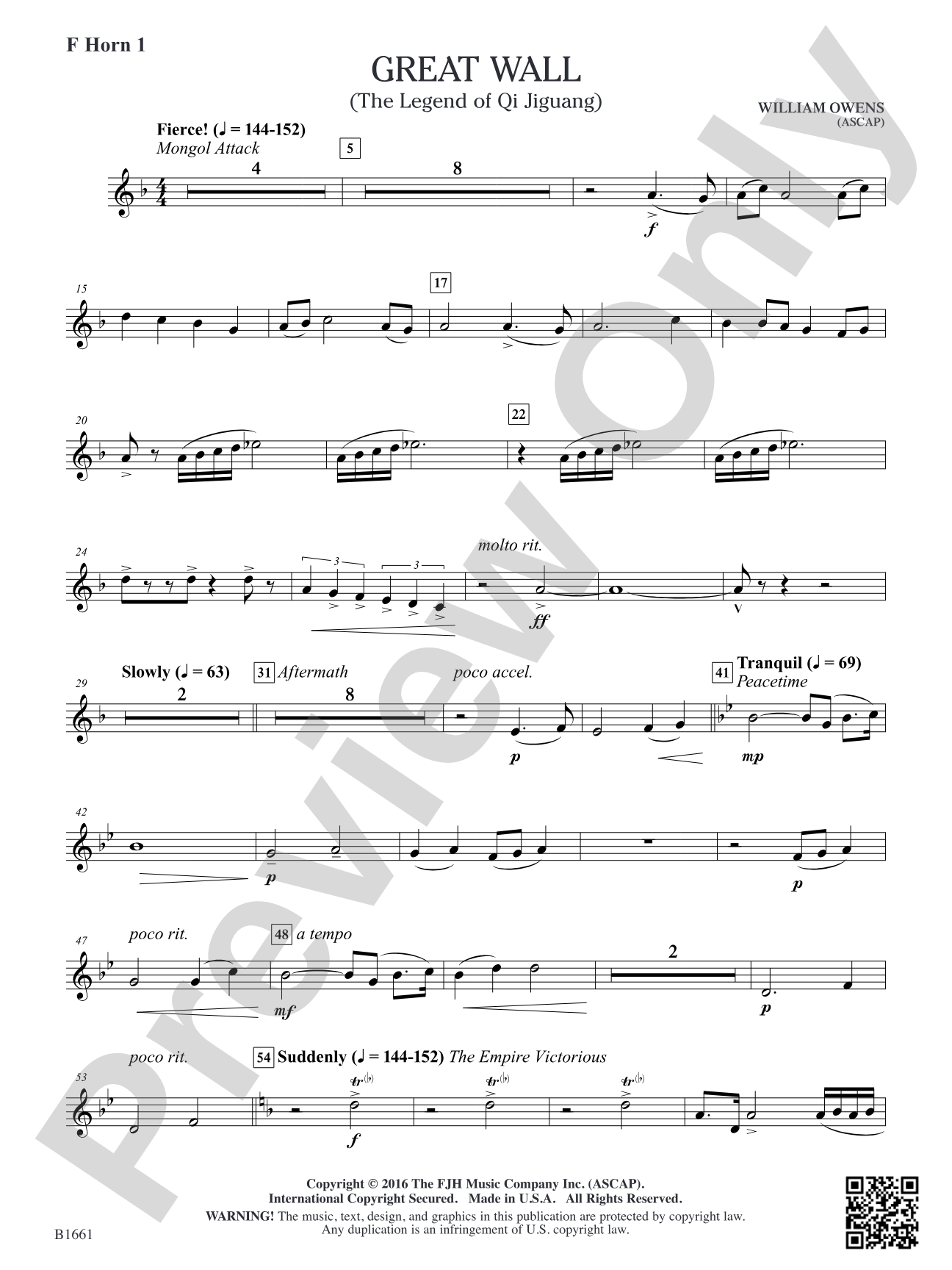

Great Wall: F Horn 1
By William Owens
Grade: 3
Item: 98-PC-DB1661_H1
$7.00
Pickup currently not available
Description
Experience the fire and ferocity of the Chinese Ming Dynasty military through this bold, explosive work! Boisterous war drums and an imposing melodic statement are at the forefront of the Mongol Attack. The mystery of the Aftermath and the beauty of Peacetime gently precede The Empire Victorious, juggernauting to a smashing conclusion. Epic!


Great Wall: F Horn 1 isn't in MakeMusic Cloud just yet...but it could be. Let us know you'd like to see it, and you'll help shape what comes next. In the meantime, start a free trial and dive into thousands of interactive titles your students can play along with today.
Request This Title
Tell us you want it.
Start Your Free Trial
Explore everything that's ready to play right now.
Sample Audio
1
Audio File
--:--
0:00
0:00
Sample Video
No sample videos found.
Additional Details
Series:
FJH Concert Band
Publisher:
The FJH Music Company, Inc.
SKU:
98-PC-DB1661_H1
More about this title
About the Composer: William Owens

William Owens (b. 1963) is a prolific composer from Gary, Indiana, whose work has shaped the young band repertoire for over three decades. A VanderCook College of Music graduate and former band director of 30 years in Texas, Owens brings classroom experience to every score he writes; his compositions appear on required music lists across North America and in educational texts as models of accessible, engaging writing for developing ensembles.
Owens holds membership in ASCAP, the Texas Music Educators Association, and Phi Beta Mu International Bandmasters Fraternity, and has received commissions from major organizations including the American Bandmasters Association. He was honored as a Distinguished Alumnus by VanderCook and received the Texas Bandmasters Association's Meritorious Achievement Award. Since 1993, his catalog exceeds 300 titles for concert band, string orchestra, and chamber ensembles. He resides in Fort Worth, Texas.
Why we love this
Owens crafts narratives that engage developing musicians without sacrificing musical substance. This three-movement arc from conflict through reflection to triumph gives students a story to inhabit, and the Grade 3 writing balances accessibility with enough textural and orchestrational interest to hold young players' attention. The percussion writing is particularly generous, giving rhythm section students real ownership of the dramatic arc.
What to expect
Great Wall is muscular and cinematic. The opening explodes with percussion and brass might; the middle section draws back into mystery and introspection before the final movement channels that accumulated energy into a victorious surge. It's a piece that makes young musicians feel capable of something grand.
Who it's for
Grade 3 concert bands with developing technical control and the maturity to shape a multi-movement narrative. This works well for ensembles that have solid fundamentals in tune and time but are ready for more sophisticated musical architecture than simple one-movement pieces.
How to get the most out of it
- Establish the war drums in the opening section with precision and unity; they anchor the entire attack motif. Have the percussion section rehearse independently to lock the ostinato before adding winds.
- Shape the melodic statement in the Mongol Attack with forward momentum. Resist holding back the tempo; the aggressiveness comes from commitment, not rush.
- Contrast the Aftermath's restraint deliberately. If the opening is extroverted, this section should feel introspective. Direct your ensemble to listen inward and support the exposed writing.
- Build The Empire Victorious gradually so the final push feels earned. The "smashing conclusion" works only if there's dynamic and textural clarity in the approach.
How to use it
Program this as an anchor piece in a concert celebrating world cultures or military/historical themes, pairing it with lighter fare to balance the dramatic intensity. It also serves as a satisfying finale to a full concert, giving the band a chance to showcase both technical control and dramatic presence in a single work.
Skills your students will build
- Dynamic contrast across three distinct musical sections
- Melodic phrasing and forward motion at Grade 3 technical level
- Ensemble balance with prominent percussion and mixed ensemble textures
- Sustained articulation clarity in rapid figures
- Interpreting programmatic structure and narrative intent