
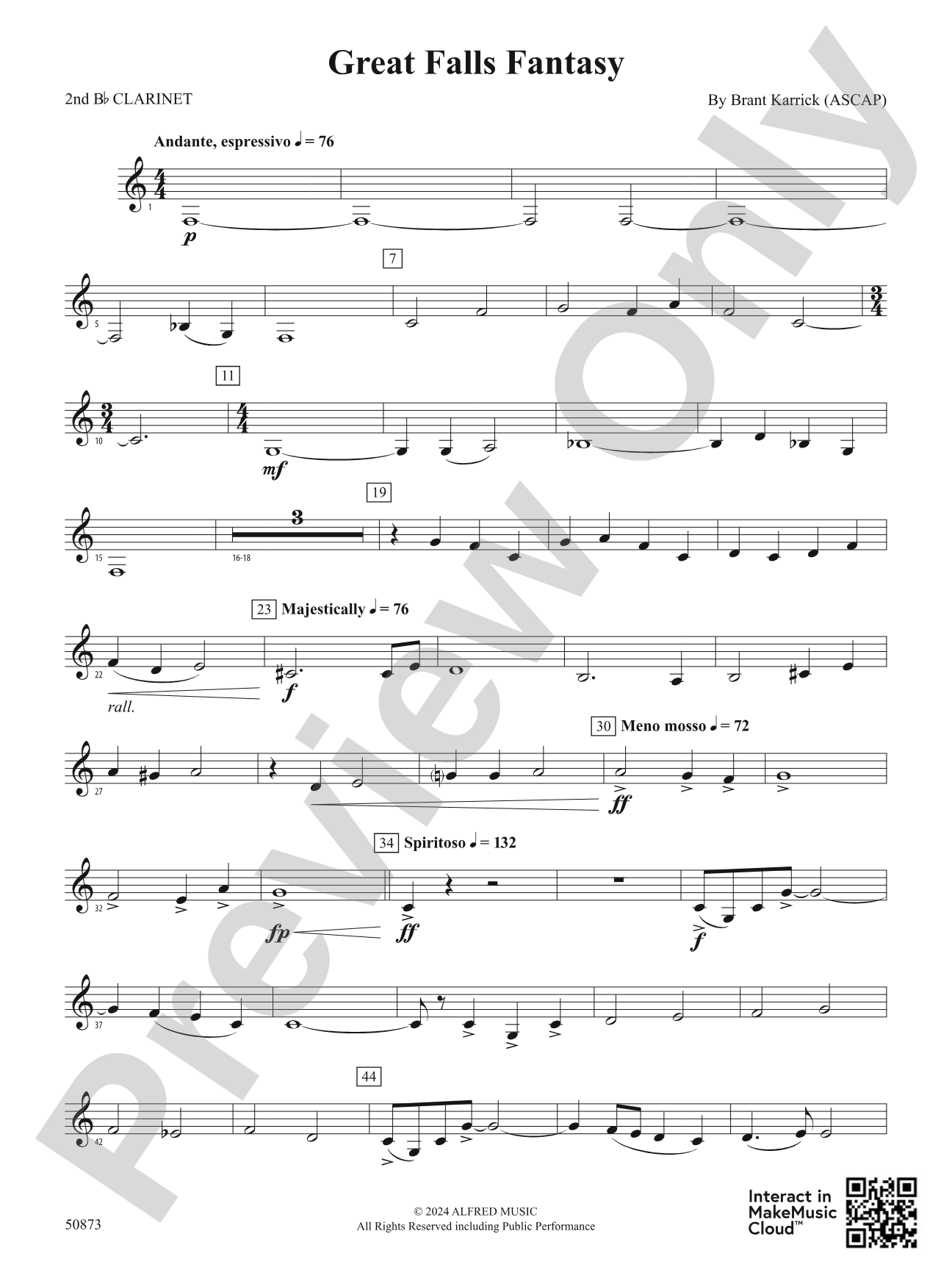

Great Falls Fantasy: 2nd B-flat Clarinet
By Brant Karrick
Grade: 2.5
Item: 00-PC-0019295_C2
$3.00
Pickup currently not available
Description
Inspiration for Great Falls Fantasy, by Brant Karrick, comes from The Great Falls of the Potomac River, considered one of the most spectacular landmarks in the Washington D.C. area. A Coplandesque theme weaves its way through unique harmonies, including inversions and extended chords, reflecting the majesty and beauty of the river and its surroundings. (3:30)


Don't just read it, hear it, play along with it, and watch your students grow with it. In MakeMusic Cloud, Great Falls Fantasy: 2nd B-flat Clarinet comes alive with professional accompaniment, adjustable tempo, and built-in practice tools that turn solo practice into real progress.
Open in the Player
Jump straight in and assign it today.
Start Your Free Trial
Open this title and explore the full library in minutes.
Sample Audio
1
Audio File
--:--
0:00
0:00
Sample Video
Additional Details
Series:
Young Symphonic
Publisher:
Alfred Music
SKU:
00-PC-0019295_C2
More about this title
About the Composer: Brant Karrick

Brant Karrick has shaped band programs across three decades of teaching, bringing composition and conducting expertise to every role he takes on. Since 2003, he has directed the band program at Northern Kentucky University, where he oversees the Symphonic Winds, Concert Band, and Chamber Winds while teaching conducting, orchestration, and music education courses. His trajectory includes nine years at the University of Toledo and seven years in Kentucky public schools, along with doctoral study in music education at Louisiana State University (completed 1994).
As a composer and arranger, Karrick's works have reached ensembles worldwide across North America, Europe, South Africa, South America, Japan, and Australia. He remains active as a guest conductor, clinician, and adjudicator while maintaining professional memberships in NAFME, CBDNA, Phi Beta Mu, and ASCAP. His studies under conducting mentor Frank Wickes and composition teachers David Livingston, Steve Beck, and Cecil Karrick informed his approach to writing music that serves both artistic and pedagogical goals.
Why we love this
Karrick captures the scale and grandeur of a natural landmark in under four minutes without requiring advanced technical demands from your ensemble. The Coplandesque melody carries unmistakable Americana flavor, while his inventive harmonic language keeps the writing fresh for both performers and listeners. At Grade 2.5, this sits in that sweet spot where students can experience genuine compositional sophistication without fighting complicated rhythms or ranges.
What to expect
Great Falls Fantasy unfolds like a landscape painting in sound. The Coplandesque theme evokes open air and flowing water, supported by harmonies that shift and color the melody with unexpected richness. The piece balances spaciousness with gentle intensity, never overwhelming but always present.
Who it's for
This work suits concert bands in grades 2-4 who want to program something with genuine artistic merit and regional or patriotic resonance. It's particularly strong for ensembles preparing for festival adjudication or community concerts where you want to showcase emerging musicianship without programming well-worn show pieces.
How to get the most out of it
- Shape the Coplandesque theme with long phrases that mirror water movement. Resist the urge to accent every structural point; let the melody breathe across bar lines.
- Balance the extended and inverted chords carefully in the middle voices. These harmonies define the piece's personality, so clarify them without letting them overwhelm the primary melody.
- Use the optional parts strategically. Not all sections need to be doubled; consider which lines genuinely need reinforcement for balance and which can stay transparent.
- Control dynamics to reflect the landscape. The Potomac's majesty comes through restraint as much as climax, so shape crescendos gradually and resist sudden jumps in volume.
How to use it
Open a patriotic or Americana-themed concert with this piece, or pair it with other Grade 2-3 works that share its transparent orchestration and lyrical aesthetic. The three-and-a-half minute runtime makes it ideal for festival competitions or community events where you want a full concert arc without demanding excessive rehearsal time on a single work.
Skills your students will build
- Phrasing extended melodic lines across structural breaks
- Balance and blend in support of harmonic color rather than harmonic function
- Conducting and ensemble precision in moderate tempos with flowing rhythmic profiles
- Recognition of Americana and Coplandesque compositional language