
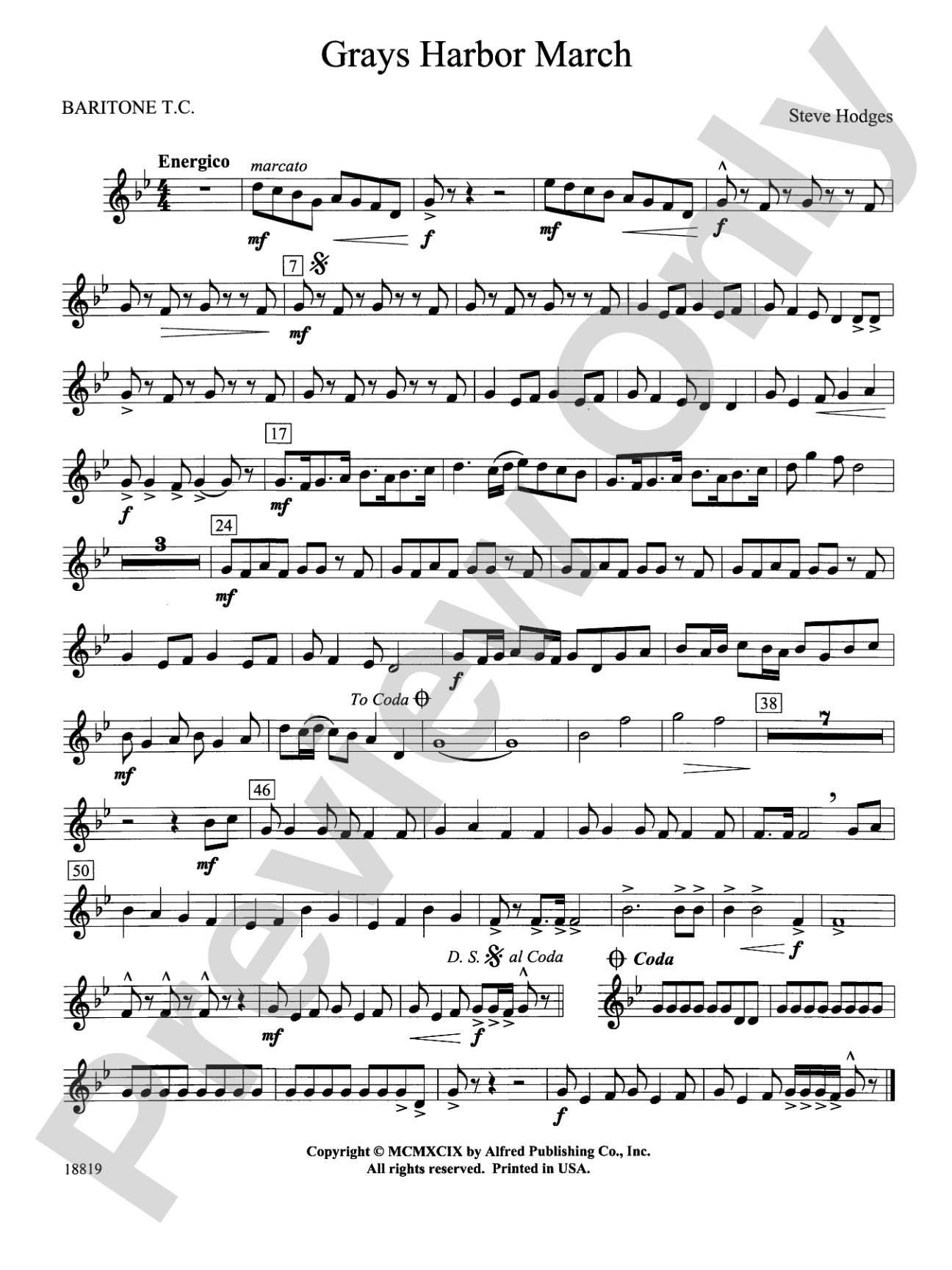

Grays Harbor March: Baritone T.C.
By Steve Hodges
Grade: 3 (Medium)
Item: 00-PC-0000288_BTC1
$5.99
Pickup currently not available
Description
Here's an energetic concert or festival opener by Steve Hodges. Grays Harbor March was commissioned by the George B. Miller Junior High School in Aberdeen, Washington. This exciting march was written in two distinct styles. Set in the minor mode, the driving opening will give your trumpets a chance to show off their rhythmic skill. Then, a graceful transition leads to the flowing middle section in the relative major, only to return back to the original theme for the fantastic finish. Open your next concert by taking your audience to Grays Harbor!


Don't just read it, hear it, play along with it, and watch your students grow with it. In MakeMusic Cloud, Grays Harbor March: Baritone T.C. comes alive with professional accompaniment, adjustable tempo, and built-in practice tools that turn solo practice into real progress.
Open in the Player
Jump straight in and assign it today.
Start Your Free Trial
Open this title and explore the full library in minutes.
Sample Audio
1
Audio File
--:--
0:00
0:00
Sample Video
No sample videos found.
Additional Details
Series:
Alfred Concert Band
Publisher:
Alfred Music
Page Count:
68
SKU:
00-PC-0000288_BTC1
More about this title
About the Composer: Steve Hodges

Steve Hodges studied music education at Western Oregon University and earned his master's degree from Central Washington University. Over four decades, he directed bands, choirs, and chamber ensembles across public school systems before retiring from the classroom.
Since 1986, Hodges has composed more than 120 concert band works published through Alfred Music, along with choral arrangements released by Staff Music and Shawnee Press. His commissioned pieces have appeared in honor bands and festivals throughout North America, from Virginia to British Columbia, and his music has been featured on TBS and ESPN broadcasts. A member of ASCAP, Hodges now lives in The Dalles, Oregon, where he remains active in community music alongside his extended family.
Why we love this
Grays Harbor March delivers exactly what a festival opener should: an engaging, audience-friendly piece that gives your ensemble immediate opportunities to shine. The contrasting sections (minor-key rhythmic drive, then the graceful major-key middle) hold listener attention without demanding virtuosic technique, and the return to the opening theme provides satisfying structural closure. At Grade 3, it sits in the sweet spot where developing bands can tackle something genuinely musical without struggling through complexity.
What to expect
Grays Harbor March opens with propulsive minor-key rhythm and bright trumpet figures that feel eager and direct, then unfolds into a graceful, lyrical middle section that lets the ensemble breathe. The return to the driving theme brings back that energetic momentum, creating a piece that feels complete and satisfying from downbeat to final chord.
Who it's for
Concert bands at the Grade 3 level who want a polished opener that's both musically rewarding to perform and engaging for audiences. It suits school programs, festival appearances, and honor band scenarios where directors need a piece that builds confidence without requiring advanced technique.
How to get the most out of it
- Lock the rhythmic precision of those opening trumpet figures in the minor section; crisp articulation and steady pulse will make the most of their "show off" moment.
- Shape the transition into the relative major deliberately, treating it as a genuine breath rather than simply shifting keys; this makes the tonal contrast land for your audience.
- Balance the full band sound during the flowing middle section so the melody sings clearly without the supporting voices clouding the texture.
- Return to the opening theme with fresh energy on the final statement; the "fantastic finish" works best when it feels like a real destination, not just a repeat.
How to use it
Lead your next concert with this piece; it establishes forward momentum and audience goodwill immediately. It also works well in festival settings where strong openers set the tone for the rest of your program, and its accessibility means you can program it earlier in the season while your students are still building chops.
Skills your students will build
- Minor and major key signatures and tonal relationships
- Rhythmic precision and rhythmic independence (trumpets in the A section)
- Contrast and transition between musical sections
- Full ensemble balance and voice independence
- Phrasing across contrasting tempos and characters