
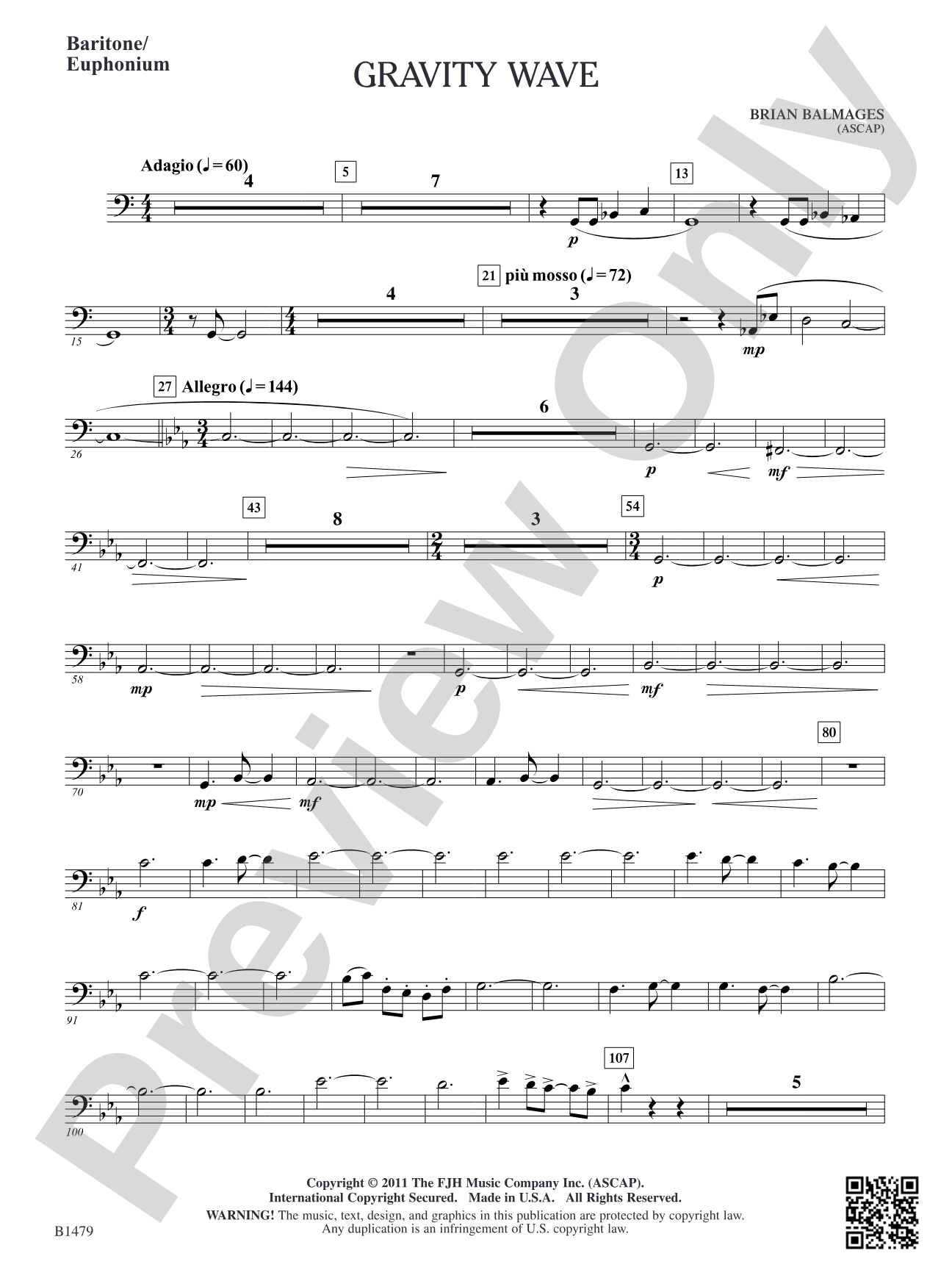

Gravity Wave: Baritone/Euphonium
By Brian Balmages
Grade: 4
Item: 98-PC-DB1479_BBC1
$7.00
Pickup currently not available
Description
This dynamic and intense work describes a phenomenon in which clouds follow the same pattern as waves in the ocean. After an introspective opening, the music grows in intensity with long sustained chords pushing through intense rhythmic movement. Eventually, woodwinds become the focus of the work in a subdued section before undulating percussion begin the final powerful drive. Woodwinds join in a flurry of activity while brass players sustain epic chords once more, until a whirlwind of notes converge into one chaotic statement, punctuated by dissonant chords in the brass. The final sequence will leave the audience gasping. Intense!


Don't just read it, hear it, play along with it, and watch your students grow with it. In MakeMusic Cloud, Gravity Wave: Baritone/Euphonium comes alive with professional accompaniment, adjustable tempo, and built-in practice tools that turn solo practice into real progress.
Open in the Player
Jump straight in and assign it today.
Start Your Free Trial
Open this title and explore the full library in minutes.
Sample Audio
1
Audio File
--:--
0:00
0:00
Sample Video
No sample videos found.
Additional Details
Series:
FJH Symphonic Band
Publisher:
The FJH Music Company, Inc.
SKU:
98-PC-DB1479_BBC1
More about this title
About the Composer: Brian Balmages

Brian Balmages has established himself as a composer and conductor working across orchestral, band, and chamber repertoire at every level. His works have been performed by ensembles ranging from professional orchestras to school groups in major venues including Carnegie Hall, the Kennedy Center, Sydney Opera House, and Toronto Centre for the Arts. He holds membership in the American Bandmasters Association and received the A. Austin Harding Award from the American School Band Directors Association. His composition Love and Light won the 2020 NBA William D. Revelli Composition Contest.
Balmages has conducted all-state, regional, university, and professional ensembles worldwide and has appeared as a guest conductor at the Midwest Clinic, Western International Band Clinic, College Band Directors Conference, and numerous state conferences. He received the inaugural James Madison University Distinguished Alumni Award from the School of Visual and Performing Arts and was commissioned by the University of Miami to compose music for the inauguration of its sixth president. His work has been performed at the Presidential Inaugural Prayer Service and in international venues including Teatro dell'Aquila in Italy. He currently serves as Director of MakeMusic Publications and Digital Education for Alfred and MakeMusic.
Why we love this
This piece gives you a complete arc that keeps an audience engaged from the introspective opening through the chaotic final statement. The instrumentation demands are strategic but not overwhelming for Grade 4 bands, and the contest/festival designation means it's built to showcase what your ensemble can accomplish under pressure.
What to expect
Gravity Wave transports listeners through an imagined atmospheric phenomenon, beginning with quiet contemplation before building into something increasingly turbulent and urgent. The final section becomes almost overwhelming, with all forces converging in a dissonant burst that leaves no doubt about what has transpired. The overall trajectory is one of mounting intensity punctuated by moments of surprising calm.
Who it's for
Concert bands at Grade 4 level looking for a contest or festival piece with genuine dramatic substance and contemporary appeal. Directors who want their ensemble to experience the full range of musical storytelling, from introspection to chaos, within a single work.
How to get the most out of it
- Balance the sustained chords in the intense rhythmic sections by anchoring the woodwinds and brass separately before blending them; this prevents the texture from muddying when multiple layers press forward.
- Shape the subdued woodwind section with clear phrasing and dynamic control to create the dramatic contrast that makes the final drive land harder.
- Lock the undulating percussion patterns with the conductor's beat early in rehearsal; they're the engine that propels the piece into its powerful conclusion.
- Approach the final dissonant brass chords as deliberate punctuation marks rather than mistakes; they're compositionally intentional and should hit with precision.
How to use it
Program this as a showcase piece near the end of a concert, where its powerful conclusion becomes the final impression. It pairs well with a contrasting lyrical work earlier in the program, allowing the gravity wave concept to intensify as the concert progresses.
Skills your students will build
- Balancing sustained chords with rhythmic countermelodies
- Controlling dynamics across large ensemble textures
- Coordinating complex rhythmic figures between woodwind and percussion sections
- Performing dissonant harmonic language with confidence and precision
- Responding to dramatic shifts in musical intensity within a single movement