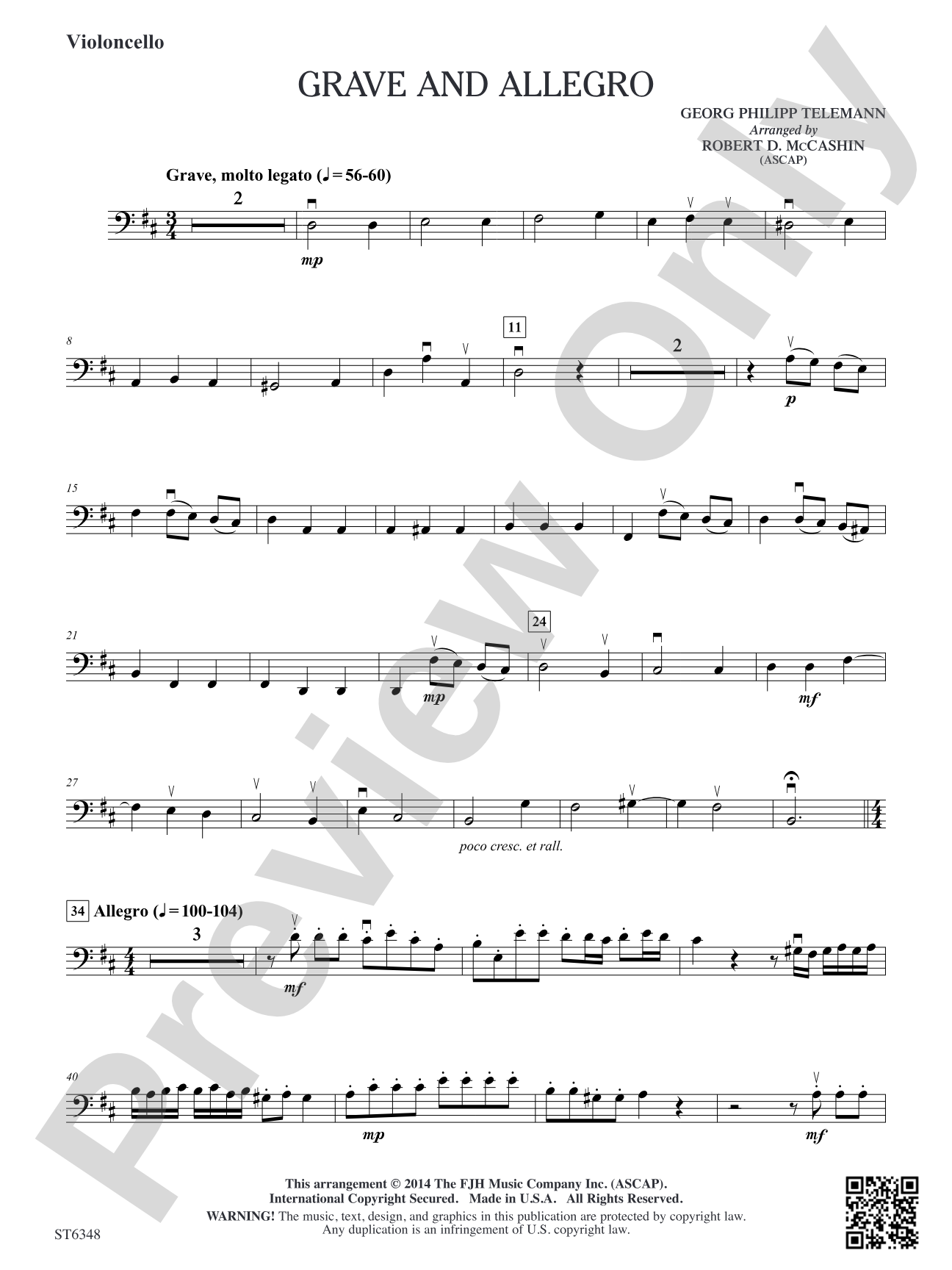
Grave and Allegro: Violoncello Sheet Music Preview

Grave and Allegro: Violoncello

By George Philipp Telemann / arr. Robert D. McCashin

Grade: 3.5;4

Item: 98-PC-DST6348_VC1

Digital Download
$7.00
Description
This two-movement work contrasts lyrical beauty with rhythmic precision. The opening Grave features sweeping lines with gorgeous suspensions while the melodic lines weave their way throughout the entire ensemble. The joyful Allegro showcases a delightful interplay between sections as the music moves to an exhuberant conclusion. Wonderful!

Don't just read it, hear it, play along with it, and watch your students grow with it. In MakeMusic Cloud, Grave and Allegro: Violoncello comes alive with professional accompaniment, adjustable tempo, and built-in practice tools that turn solo practice into real progress.

Sample Audio
0:00
0:00
Sample Video
Additional Details
Series: FJH String Orchestra
Publisher: The FJH Music Company, Inc.
SKU: 98-PC-DST6348_VC1

More about this title

About the Composer: George Philipp Telemann

George Philipp Telemann (1681-1767) was one of the most prolific composers of the Baroque era, producing over 3,600 works across virtually every genre. A master of accessibility without sacrificing musical substance, Telemann wrote with clarity and elegance that made his music ideal for both professional musicians and serious amateurs. His gift for memorable melody and transparent orchestration have secured his place in the string orchestra repertoire.

Telemann's output spanned a career of extraordinary longevity and versatility. He worked as a church musician, opera composer, and court conductor across German cities, constantly writing music suited to the needs and skill levels of performers around him. This pragmatic approach to composition explains why his work remains so valuable in educational settings today.

Why we love this

McCashin's arrangement captures the essential Baroque sophistication of Telemann while remaining genuinely playable at the Grade 3.5-4 level. The contrast between the lyrical Grave and spirited Allegro gives young orchestras a chance to demonstrate both musical sensitivity and rhythmic ensemble control without requiring advanced technical facility. It's the kind of piece that sounds impressive at a festival without demanding months of preparation.

What to expect

The Grave opens with the elegance and restraint of 18th-century chamber writing, its suspensions creating gentle harmonic tension that resolves with quiet satisfaction. The Allegro shifts the mood entirely, bringing infectious rhythmic energy and a sense of joyful dialogue between string sections that builds toward a genuinely celebratory finish.

Who it's for

This work suits intermediate string orchestras at the high school level or strong middle school ensembles that have developed solid intonation and basic ensemble balance. It works equally well for festival performances, concert programming, or chamber orchestra contexts where musicians want to play genuine Baroque literature without overextending their technical abilities.

How to get the most out of it

  • Balance the sweeping suspensions in the Grave by encouraging players to listen across the ensemble rather than focusing only on their own part; the implied harmony emerges through collective tuning and breath.
  • Shape the Allegro's section interplay with clear articulation and precise attacks; the rhythmic precision that makes this movement work requires synchronized bowing and crisp rhythmic clarity from all players.
  • Let the transition between movements breathe with a genuine pause; this gives both conductor and ensemble a mental reset and heightens the dramatic contrast Telemann intended.

How to use it

Pair this with another contrasting work to create a balanced concert half. The two-movement structure and clear character distinction make it particularly effective as a bridge piece between a heavier contemporary work and a lighter finale. It also serves well as a festival piece that demonstrates musicianship without requiring extended rehearsal time.

Skills your students will build

  • Baroque phrasing and the expressive use of suspensions
  • Balancing multiple melodic lines within an ensemble texture
  • Maintaining rhythmic precision during rapid section interplay
  • Intonation awareness across sustained harmonic passages

You May Also Like