
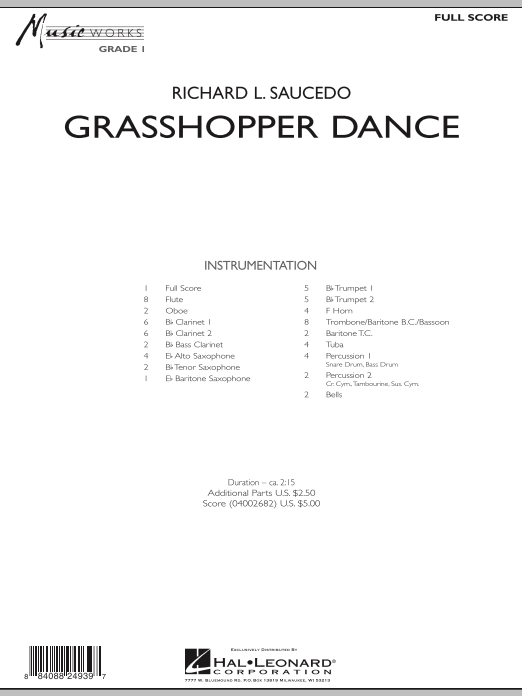

Grasshopper Dance: Concert Band Conductor Score & Parts
By Richard L. Saucedo
Grade: 1-1.5
Item: 35-PK00119523
$45.00
Pickup currently not available
Buy Extra Parts (Digital PDF Download)
| Product | Price | Quantity |
|---|---|---|
| Grasshopper Dance - Full Score | $6.00 | |
| Grasshopper Dance - Flute | $6.00 | |
| Grasshopper Dance - Oboe | $6.00 | |
| Grasshopper Dance - Bb Clarinet 1 | $6.00 | |
| Grasshopper Dance - Bb Clarinet 2 | $6.00 | |
| Grasshopper Dance - Bb Bass Clarinet | $6.00 | |
| Grasshopper Dance - Eb Alto Saxophone | $6.00 | |
| Grasshopper Dance - Bb Tenor Saxophone | $6.00 | |
| Grasshopper Dance - Eb Baritone Saxophone | $6.00 | |
| Grasshopper Dance - Bb Trumpet 1 | $6.00 | |
| Grasshopper Dance - Bb Trumpet 2 | $6.00 | |
| Grasshopper Dance - F Horn | $6.00 | |
| Grasshopper Dance - Trombone | $6.00 | |
| Grasshopper Dance - Baritone T.C. | $6.00 | |
| Grasshopper Dance - Tuba | $6.00 | |
| Grasshopper Dance - Percussion 1 | $6.00 | |
| Grasshopper Dance - Percussion 2 | $6.00 | |
| Grasshopper Dance - Bells | $6.00 |
Parts Added to Cart!
Description
Cleverly written with creative effects and an energetic style, Richard has created a unique-sounding original for very young players that's guaranteed to be a blast to perform. Dur: 2:15


Grasshopper Dance: Concert Band Conductor Score & Parts isn't in MakeMusic Cloud just yet...but it could be. Let us know you'd like to see it, and you'll help shape what comes next. In the meantime, start a free trial and dive into thousands of interactive titles your students can play along with today.
Request This Title
Tell us you want it.
Start Your Free Trial
Explore everything that's ready to play right now.
Sample Audio
No sample audio found.
Sample Video
No sample videos found.
Additional Details
Publisher:
Hal Leonard
SKU:
35-PK00119523
More about this title
About the Composer: Richard L. Saucedo

Richard L. Saucedo spent 31 years at Carmel High School in Indiana as Director of Bands and Chairman of Performing Arts, building a program that earned state, regional, and national recognition across concert, jazz, and marching ensembles. His tenure included three appearances by the Wind Symphony I at the Music for All National Concert Band Festival, multiple Indiana State Championships, and 17 consecutive top-ten finishes at the Bands of America Grand National Championship, with national titles in 2005 and 2012. He earned Indiana's Bandmaster of the Year award in 1998-99 and was inducted into both the Music for All Hall of Fame and Drum Corps International Hall of Fame.
Beyond his teaching legacy, Saucedo has composed and arranged extensively for marching bands, concert bands, choral groups, and orchestras. He served as Brass Arranger and Composer for the Cavaliers Drum and Bugle Corps, contributing to five DCI world championships, and currently coordinates music ensembles for the Blue Devils Drum and Bugle Corps. He holds memberships in the American Bandmasters Association and serves as a Senior Educational Consultant for Music for All and Bands of America.
Why we love this
Saucedo nails the balance that Grade 1-1.5 directors crave: genuinely musical writing that young players can execute without months of polishing. The creative effects and energetic character give your ensemble something that sounds polished and fun, not simplistic or condescending. At just 2:15, it's an ideal opener for a concert or a confidence builder early in the season.
What to expect
Imagine a tiny creature darting and leaping across stage with playful mischief. The orchestration bounces along with quirky character, full of lightness and humor, never heavy or demanding. It captures that joy that made students want to join band in the first place.
Who it's for
First-year and second-year band directors working with students who need a win. This piece gives emerging musicians the chance to perform something genuinely entertaining without technical obstacles getting in the way. It's equally valuable for enrichment programs, festival selections, or as a morale booster mid-season.
How to get the most out of it
- Keep the tempo bouncy and steady from start to finish. Young ensembles tend to rush novelty pieces, so anchor the rhythm section early and maintain consistent pulse through rehearsals.
- Balance the creative effects carefully so they enhance rather than overwhelm. If the piece includes staccato articulation, pizzicato, or unusual colors, highlight them in sectionals and bring them together with intention.
- Let the energy come from precision, not volume. Grade 1 students play best when they focus on clean attacks and releases rather than pushing for intensity.
How to use it
Open a concert with this piece to set an upbeat, welcoming tone before moving into more serious repertoire. Pair it with another novelty or short contemporary work to build confidence, or use it as the finale to celebrate achievement. Early fall performances work especially well when ensembles are still building their fundamentals.
Skills your students will build
- Consistent pulse maintenance in an energetic tempo
- Clean articulation and release in staccato passages
- Balancing ensemble blend while executing rhythmic precision
- Responding to creative orchestration and color effects
- Musical phrasing and direction in straightforward melodies