
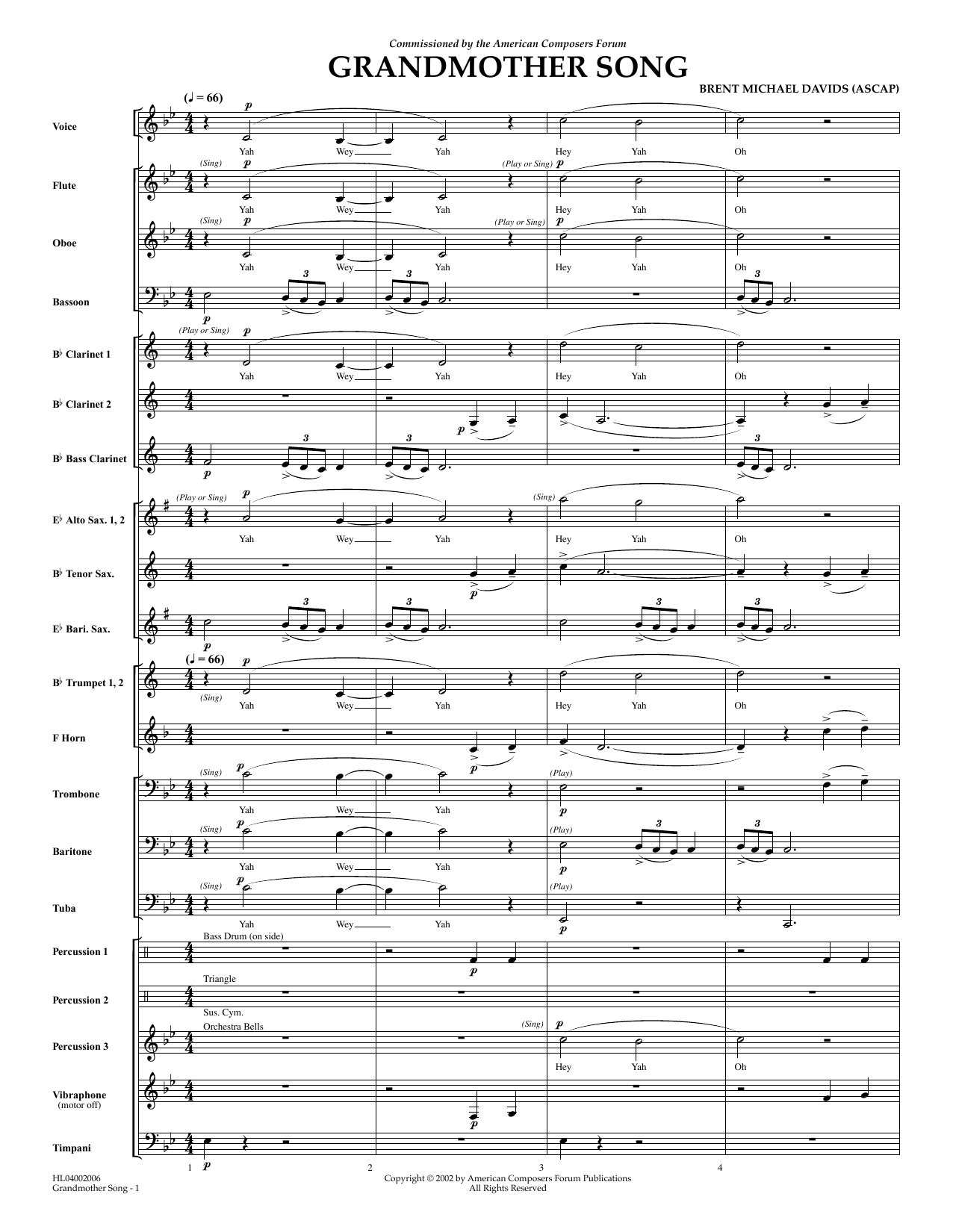

Grandmother Song: Concert Band Conductor Score & Parts
By Brent Michael Davids
Grade: 3
Item: 35-PK00425344
$60.00
Pickup currently not available
Buy Extra Parts (Digital PDF Download)
| Product | Price | Quantity |
|---|---|---|
| Grandmother Song - Full Score | $5.00 | |
| Grandmother Song - Voice | $3.99 | |
| Grandmother Song - Flute | $3.99 | |
| Grandmother Song - Oboe | $3.99 | |
| Grandmother Song - Bassoon | $3.99 | |
| Grandmother Song - Bb Clarinet 1 | $3.99 | |
| Grandmother Song - Bb Clarinet 2 | $3.99 | |
| Grandmother Song - Bb Bass Clarinet | $3.99 | |
| Grandmother Song - Eb Alto Sax 1 | $3.99 | |
| Grandmother Song - Eb Alto Sax 2 | $3.99 | |
| Grandmother Song - Bb Tenor Saxophone | $3.99 | |
| Grandmother Song - Eb Baritone Saxophone | $3.99 | |
| Grandmother Song - Bb Trumpet 1 | $3.99 | |
| Grandmother Song - Bb Trumpet 2 | $3.99 | |
| Grandmother Song - F Horn | $3.99 | |
| Grandmother Song - Trombone | $3.99 | |
| Grandmother Song - Euphonium in Bass Clef | $3.99 | |
| Grandmother Song - Euphonium in Treble Clef | $3.99 | |
| Grandmother Song - Tuba | $3.99 | |
| Grandmother Song - Percussion 1 | $3.99 | |
| Grandmother Song - Percussion 2 | $3.99 | |
| Grandmother Song - Percussion 3 | $3.99 | |
| Grandmother Song - Vibraphone | $3.99 | |
| Grandmother Song - Timpani | $3.99 |
Parts Added to Cart!
Description
"Grandmother Song" is an introduction to the Mohican tradition of "sung syllables," or what Native Americans call "vocables." Combining them with traditional wood flute songs, composer Brent Michael Davids offers a fresh look at the "sound" of Native American songs. Band instruments are performed less as musical instruments and more as talking sticks, singing reeds, rustling winds and shooting thunder. Through this beautiful ballad, students are given the materials to understand how Native Americans celebrate the world around them through the blending of words and song. (Includes score and parts.)
BandQuest, an exciting series of new music and accompanying curricula for band, is a program published by the American Composers Forum. The series was started as a response to feedback from music educators that there is a pressing need for new, fresh band music. The heart of this program is new works written by a diverse group of leading American composers who have created challenging pieces that are a true departure from standard middle school repertoire. Every BandQuest project includes a residency component in which the composer works collaboratively with a middle school as they create their new piece. Many BandQuest pieces are accompanied by an interdisciplinary curriculum designed to assist students as they learn the music and to integrate each piece with non-music studies.
Learn more on Youtube: https://www.youtube.com/user/ComposersForum/search?query=brent+michael+davids+%29
Visit www.bandquest.org to learn more about this innovative series, and email bandquest@composersforum.org to request a free downloadable audio catalog.


Discover MakeMusic Cloud: thousands of interactive titles your students can play along with today.
Sample Audio
No sample audio found.
Sample Video
No sample videos found.
Additional Details
Publisher:
Hal Leonard
SKU:
35-PK00425344
More about this title
About the Composer: Brent Michael Davids
Brent Michael Davids is a composer and educator whose work centers Indigenous musical traditions and contemporary concert music. His compositions for wind ensembles frequently draw on Native American musical elements, creating pieces that serve both as artistic statements and as educational bridges between cultures. Davids has worked extensively with school communities through residency programs, collaborating directly with students and teachers to develop works that challenge conventional thinking about what band music can be.
Why we love this
This piece does something most Grade 3 band music doesn't: it reframes what instruments can do and why we make sound in the first place. By treating the band as a voice for storytelling rather than a display of technical prowess, Davids gives your students permission to think deeply about musical intention. The accompanying curriculum support transforms a concert selection into a genuine learning experience across disciplines.
What to expect
Intimate and expansive at once. The vocables create a meditative quality that draws listeners inward, while the instrumental textures evoke natural soundscapes: rustling winds, distant thunder, the tonal qualities of wood and breath. There's spaciousness here, both in the orchestration and in the pacing, giving the ear room to settle and reflect.
Who it's for
Grade 3 bands ready to move beyond standard concert fare and into music with cultural substance. This works especially well for ensembles whose directors want to develop listening skills and cultural awareness alongside technical growth. It's also ideal for programs seeking interdisciplinary connections or incorporating Native American perspectives into the curriculum.
How to get the most out of it
- Spend rehearsal time on vocables before the instruments enter. Have your band sing the syllables first so they understand they're serving as extended vocal lines, not playing notes.
- Adjust your conducting to emphasize breath and natural phrasing over metronomic precision. This music asks for flexibility and space.
- Encourage your ensemble to listen for the wood flute references in the orchestration. Once they hear those connections, the piece coheres as a unified gesture rather than a collection of parts.
- Balance the textures so that no single voice overpowers the ensemble sound. These "talking sticks" and "singing reeds" work best when they're in conversation with each other.
How to use it
Feature this on a concert exploring cultural traditions or world music influences. Its reflective nature makes it an excellent choice for opening a program or creating a quieter moment between more energetic works. Pair it with the BandQuest curriculum materials to deepen students' understanding of Indigenous musical practices and vocable traditions before and after the performance.
Skills your students will build
- Understanding vocables and their role in Native American musical expression
- Performing with expressive phrasing and breath awareness rather than technical display
- Listening for instrumental color and tonal storytelling
- Interpreting compositional intent that prioritizes cultural meaning over conventional technical demands
- Ensemble balance in sparse, texture-focused arrangements