
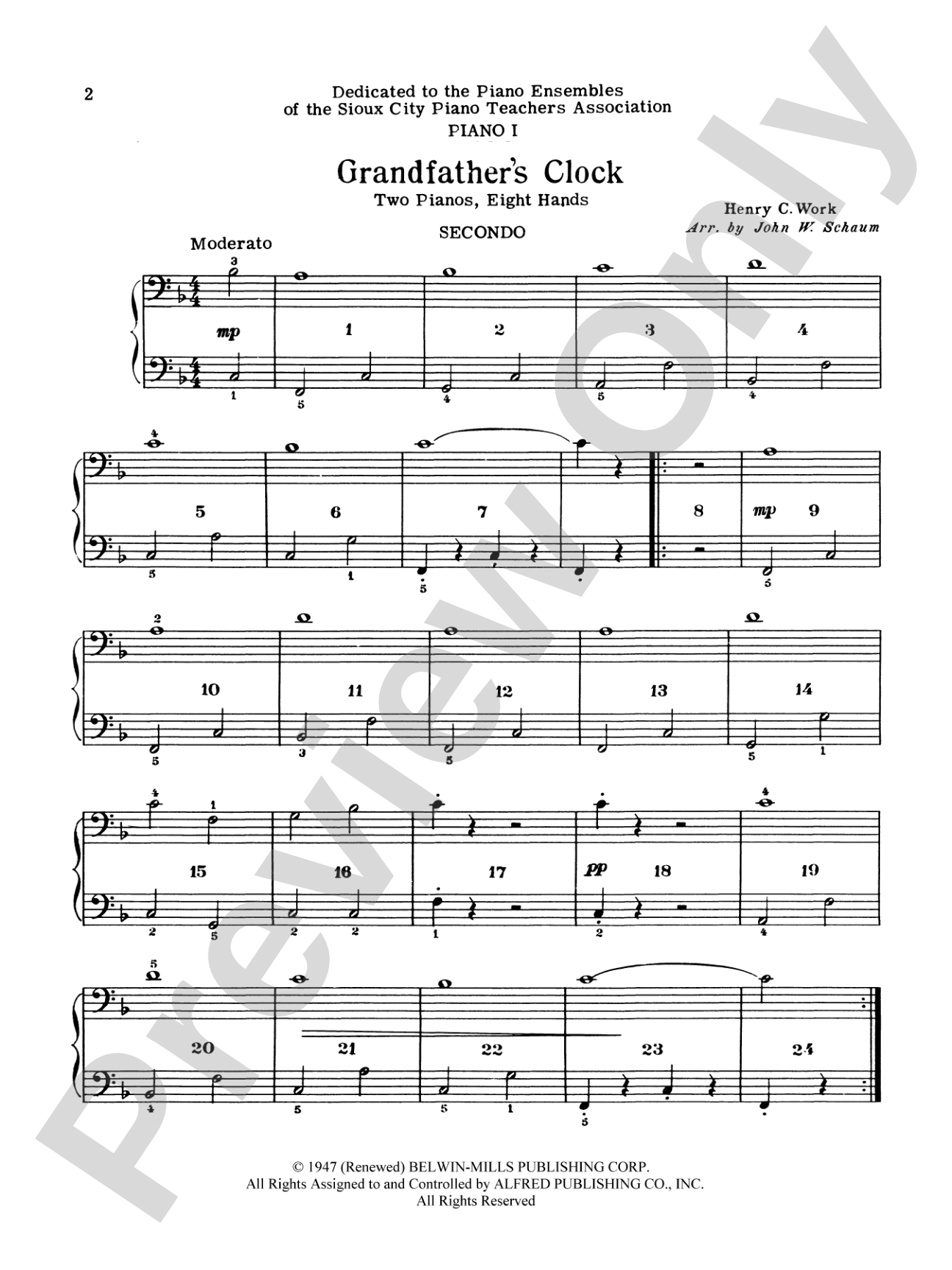

Grandfather's Clock - Piano Quartet (2 Pianos, 8 Hands): Piano
By Henry C. Work / arr. John W. Schaum
Level: Elementary
Item: 00-PB-0000799
$4.99
Pickup currently not available
Related Items
Grandfather's Clock: Piano Quartet (2 Pianos, 8 Hands) Sheet (2 copies included) |
$4.99
|
View |
Description
Four elementary level pianists playing at two pianos will enjoy tick-tocking their way through this famous 1876 song about the clock that ran faithfully for 90 years but then finally ceased ticking upon the death of its owner. Schaum level 1. A Federation Festivals 2024-2028 selection.


Grandfather's Clock - Piano Quartet (2 Pianos, 8 Hands): Piano isn't in MakeMusic Cloud just yet...but it could be. Let us know you'd like to see it, and you'll help shape what comes next. In the meantime, start a free trial and dive into thousands of interactive titles your students can play along with today.
Request This Title
Tell us you want it.
Start Your Free Trial
Explore everything that's ready to play right now.
Sample Audio
No sample audio found.
Sample Video
No sample videos found.
Additional Details
Publisher:
Alfred Music
Page Count:
8
SKU:
00-PB-0000799
More about this title
About the Composer: Henry C. Work
Henry C. Work (1832-1884) was an American songwriter and composer whose gift for narrative storytelling through song made him one of the most popular musical voices of the Civil War and Reconstruction era. Though trained as a printer, Work became a prolific composer of sentimental ballads and patriotic songs that resonated deeply with American audiences; his compositions were sung in parlors, concert halls, and on battlefields throughout the 1860s and 1870s.
Work's legacy rests on a relatively small number of songs that captured the emotional tenor of his time. "Grandfather's Clock," published in 1876, became his most enduring composition. The song's blend of nostalgic melody and poignant storytelling, combined with its vivid depiction of a clock as a faithful witness to family life, transformed what could have been a novelty into a genuine American standard that has been recorded hundreds of times across nearly 150 years.
Why we love this
Four pianists at two pianos create a satisfying collaborative sound without requiring a large ensemble or shifting personnel between rehearsals. The Schaum arrangement captures the gentle, deliberate character of the original song while giving each player meaningful material to perform, making it rewarding for elementary musicians who are ready to experience ensemble playing with immediate musical payoff.
What to expect
The piece captures the measured, rhythmic comfort of a grandfather clock marking time, with a gentle melody that unfolds like a reminiscence. There is tenderness in the harmony, and a quiet dignity in how the arrangement moves toward its final moment when the clock's faithful ticking finally comes to rest.
Who it's for
Elementary pianists who have reached Level 1 Schaum materials and are ready to experience chamber music with peers. This arrangement works well for studio teachers coordinating group performances or for music programs seeking accessible quartet repertoire that all four players will find musically satisfying.
How to get the most out of it
- Establish a steady tempo before the first note sounds; the "tick-tock" rhythm that frames the piece requires group precision, so count off clearly and maintain a patient pulse throughout.
- Balance the melody and accompaniment between the two pianos by listening to the overall sound rather than playing isolated instruments; ask the ensemble to identify who carries the tune at each moment so everyone understands the hierarchical texture.
- Pay attention to the transition between pianos when the melody line passes from one instrument to another; ensure the handoff is seamless by rehearsing those specific measures as a pair of duets.
- Slow the tempo slightly at the final section where the clock stops ticking; this musical moment honors the song's narrative arc and needs space to land emotionally.
How to use it
This arrangement fits naturally into a recital or festival performance where ensemble diversity matters; it gives elementary pianists a chamber experience without the complexity of larger orchestrations. The Federation Festivals 2024-2028 selection status makes it an ideal choice for preparing young musicians for competitive festival participation while building collaborative skills.
Skills your students will build
- Ensemble listening and balance between two pianos
- Maintaining steady pulse within a group setting
- Tracking melody and accompaniment roles across instruments
- Coordinating with peers through clear cues and entrances
- Reading and performing arranged material at elementary level