
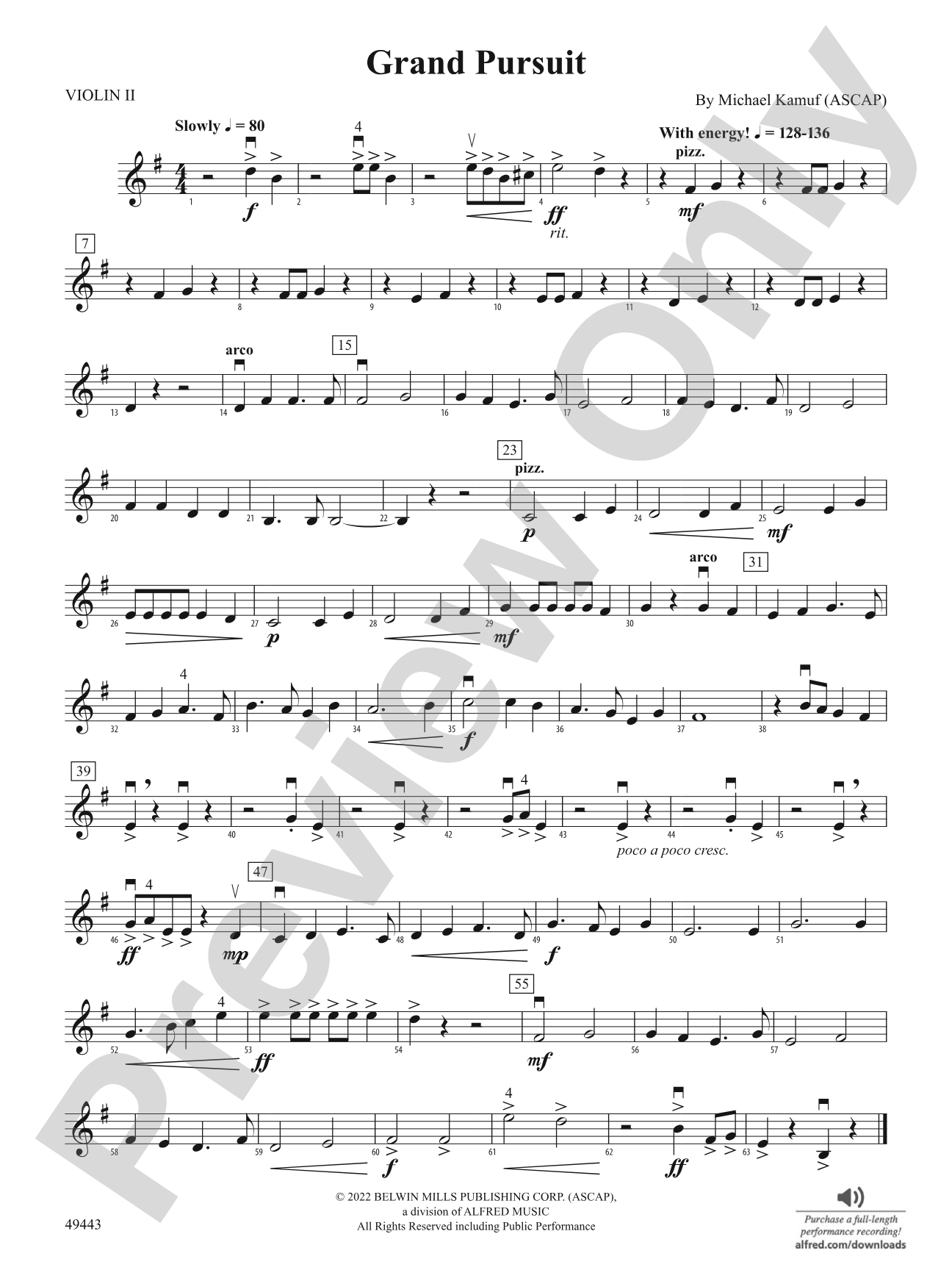

Grand Pursuit: 2nd Violin
By Michael Kamuf
Grade: 2
Item: 00-PC-0018769_VN2
$3.00
Pickup currently not available
Description
Written to reinforce dotted quarter/eighth note patterns, Grand Pursuit by Michael Kamuf features contrasting melodies, bold harmonies, and a fun, groove-oriented development section that combine to create a piece both your students and audiences will enjoy. (2:00)


Don't just read it, hear it, play along with it, and watch your students grow with it. In MakeMusic Cloud, Grand Pursuit: 2nd Violin comes alive with professional accompaniment, adjustable tempo, and built-in practice tools that turn solo practice into real progress.
Open in the Player
Jump straight in and assign it today.
Start Your Free Trial
Open this title and explore the full library in minutes.
Sample Audio
1
Audio File
--:--
0:00
0:00
Sample Video
Additional Details
Series:
Belwin Intermediate String Orchestra
Publisher:
Alfred Music
SKU:
00-PC-0018769_VN2
More about this title
About the Composer: Michael Kamuf

Michael Kamuf studied jazz performance and music education at Youngstown State University's Dana School of Music, then earned a master's degree in instrumental conducting from George Mason University. His compositions and arrangements have been recorded by the Woody Herman and Glenn Miller Orchestras, the USAF Airmen of Note, the US Navy Commodores, and soloists including James Moody, Eddie Daniels, and Sean Jones. He has performed as a member of the Woody Herman and Tommy Dorsey Orchestras and served as assistant principal trumpet with the Youngstown Symphony Orchestra.
Kamuf is an exclusive Belwin composer with over 100 published titles spanning jazz, orchestra, and concert band. His jazz ensemble arrangements have become standard repertoire for young ensembles, with additional works published by UNC Jazz Press, Neil A. Kjos Music, and FJH Music Company. He taught instrumental music for thirty years in Maryland's Montgomery County Public Schools, serving as Director of Bands and Orchestras and Music Department Chairperson at John T. Baker Middle School, where he led ensembles to consistent festival recognition and facilitated multiple commissions for young concert bands. Kamuf currently leads the Mike Kamuf Little Big Band, a jazz octet based in the Baltimore and Washington, DC region.
Why we love this
Kamuf nails the Grade 2 sweet spot by anchoring the piece around a specific rhythmic concept (dotted quarter/eighth patterns) without letting the pedagogy overshadow musicality. The contrasting melodies and bold harmonies keep ensemble members engaged, while the groove-oriented development section gives audiences something to lean into. At two minutes, it's perfectly paced for festival play or as an energizer in a concert.
What to expect
Grand Pursuit moves with purposeful energy, driven by its rhythmic foundation and fueled by shifting harmonies that create forward momentum. The piece balances precision with playfulness, especially in its groove-oriented section where the string sound takes on a contemporary, almost percussion-like character before resolving into its contrasting melodic material.
Who it's for
This piece works for string orchestras at the early intermediate level who are ready to tackle rhythmic sophistication without overwhelming technical demands. It's ideal for ensembles preparing for festival competition or seeking accessible concert repertoire that sounds polished and intentional.
How to get the most out of it
- Lock the dotted quarter/eighth figures early in rehearsal by isolating that rhythm in unison or by part. Once students internalize the pattern, the melodic content clicks into place faster.
- Balance the contrasting melodies so neither voice overwhelms the other. Listen for blend between your melody carriers and harmonic support; this is where ensemble cohesion shows.
- Keep the groove section rhythmically tight by emphasizing the steady pulse underneath the movement. A light touch on dynamics prevents the development from feeling rushed.
- Shape the transitions between sections with subtle tempo and dynamic adjustments. These moments give the piece breathing room and clarify its structure for the audience.
How to use it
Program this as a festival selection where its two-minute duration fits neatly into time constraints while showcasing strong ensemble fundamentals. It also pairs well in a concert between a lyrical ballad and a bigger showpiece, providing rhythmic contrast and demonstrating your students' range of musical character.
Skills your students will build
- Reading and executing dotted quarter/eighth note rhythmic patterns
- Maintaining groove and pulse in contemporary styles
- Balancing contrasting melodic lines within ensemble texture
- Interpreting harmonic movement and voice leading in flexible string voicings