
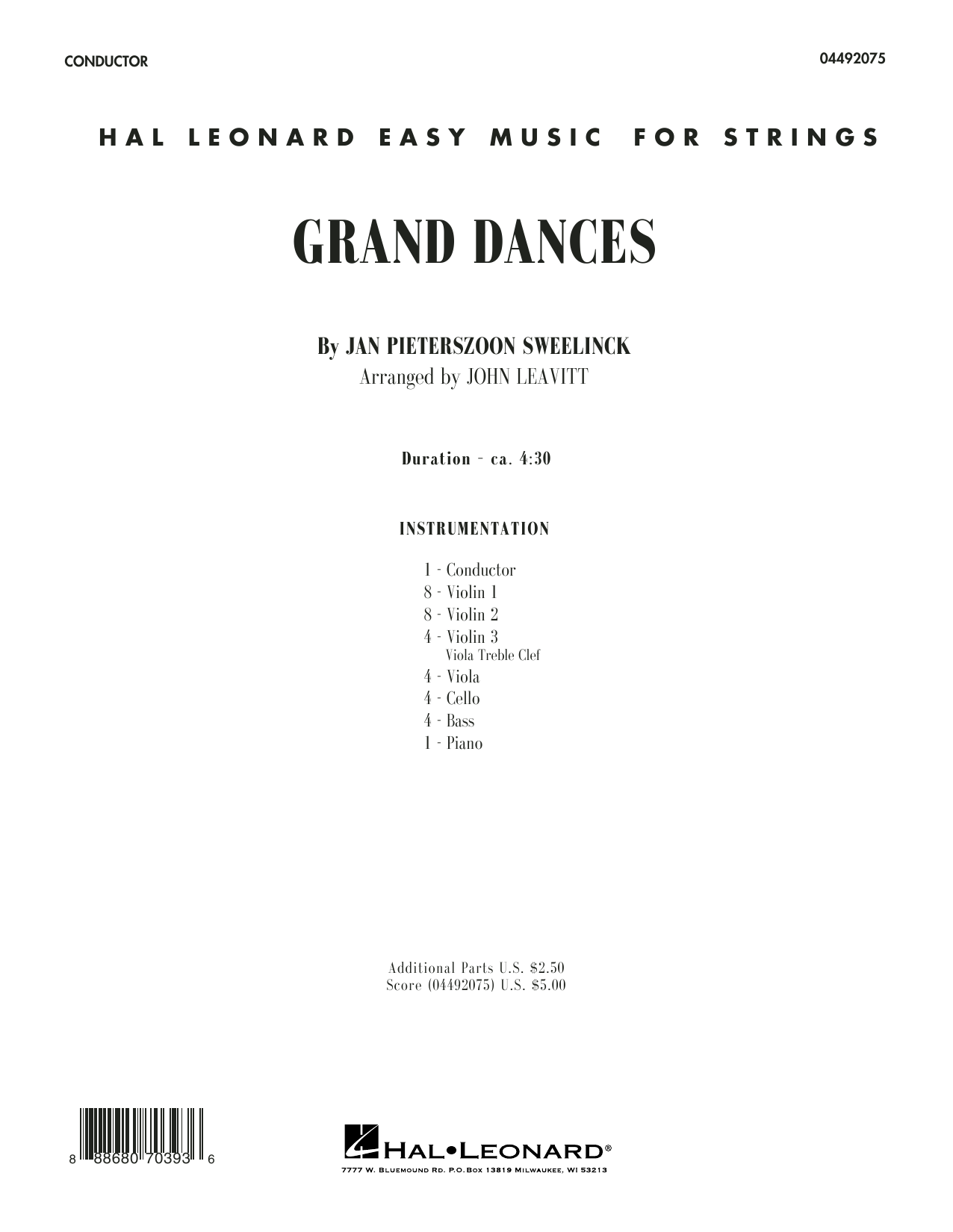

Grand Dances: String Orchestra Conductor Score & Parts
As performed by Jan Pieterszoon Sweelinck / Arranged by John Leavitt
Grade: 2
Item: 35-PK00389014
$45.00
Pickup currently not available
Buy Extra Parts (Digital PDF Download)
| Product | Price | Quantity |
|---|---|---|
| Grand Dances - Conductor Score (Full Score) | $6.00 | |
| Grand Dances - Violin 1 | $7.00 | |
| Grand Dances - Violin 2 | $7.00 | |
| Grand Dances - Violin 3 (Viola Treble Clef) | $7.00 | |
| Grand Dances - Viola | $7.00 | |
| Grand Dances - Cello | $7.00 | |
| Grand Dances - Bass | $7.00 | |
| Grand Dances - Piano | $7.00 |
Parts Added to Cart!
Description
Dur: 4:30


Grand Dances: String Orchestra Conductor Score & Parts isn't in MakeMusic Cloud just yet...but it could be. Let us know you'd like to see it, and you'll help shape what comes next. In the meantime, start a free trial and dive into thousands of interactive titles your students can play along with today.
Request This Title
Tell us you want it.
Start Your Free Trial
Explore everything that's ready to play right now.
Sample Audio
No sample audio found.
Sample Video
No sample videos found.
Additional Details
Publisher:
Hal Leonard
SKU:
35-PK00389014
More about this title
About the Artist: Jan Pieterszoon Sweelinck
Jan Pieterszoon Sweelinck (1562–1621) was the dominant figure of Dutch musical life and one of the most influential keyboard composers of the Renaissance. Working primarily in Amsterdam, he synthesized Italian and Northern European styles while establishing himself as a master of counterpoint and variation technique. His instrumental music, particularly his fantasias and dance movements, shaped the development of keyboard writing across generations of composers.
Why we love this
John Leavitt's arrangement captures Sweelinck's elegant structural clarity without sacrificing the ornamental character of the original keyboard writing. At Grade 2, this offers young orchestras genuine Renaissance material with authentic compositional substance rather than simplified pastiche. The dance forms provide clear sectional architecture that helps developing ensembles build awareness of phrase structure and form.
What to expect
Elegant and purposeful, with the measured grace of court dances transformed for the concert stage. The writing sparkles without demanding virtuosity, creating a sense of cultivated refinement that appeals to both players and audiences.
Who it's for
String orchestras working at Grade 2 who want to program historical repertoire with real musical depth. This suits ensembles building toward more complex Renaissance and Baroque literature while staying within manageable technical boundaries.
How to get the most out of it
- Shape the lines with consistent phrase direction. Sweelinck's dances often feature sequential passages where forward momentum matters more than individual note clarity.
- Balance the melodic contours across all string sections. Renaissance music benefits from transparent voice leading, so attend to which instruments carry the primary voice in each passage.
- Keep the tempo steady and confident. These dances were meant to move, so avoid dragging even when navigating technical passages.
- Allow the articulation to reflect the sectional structure. Clean attacks at new dance sections help audiences follow the form.
How to use it
Include this in a concert exploring Renaissance instrumental music, pairing it with other arranged harpsichord or organ works. The four-and-a-half minute duration makes it ideal for a program opener that establishes a refined classical tone before moving into larger works.
Skills your students will build
- Identifying and responding to Renaissance phrase structures and form
- Tracking independent melodic lines across multiple voice parts
- Maintaining steady tempo through sequential passages
- Applying historically informed articulation and style awareness
- Balancing parts to support transparent counterpoint