
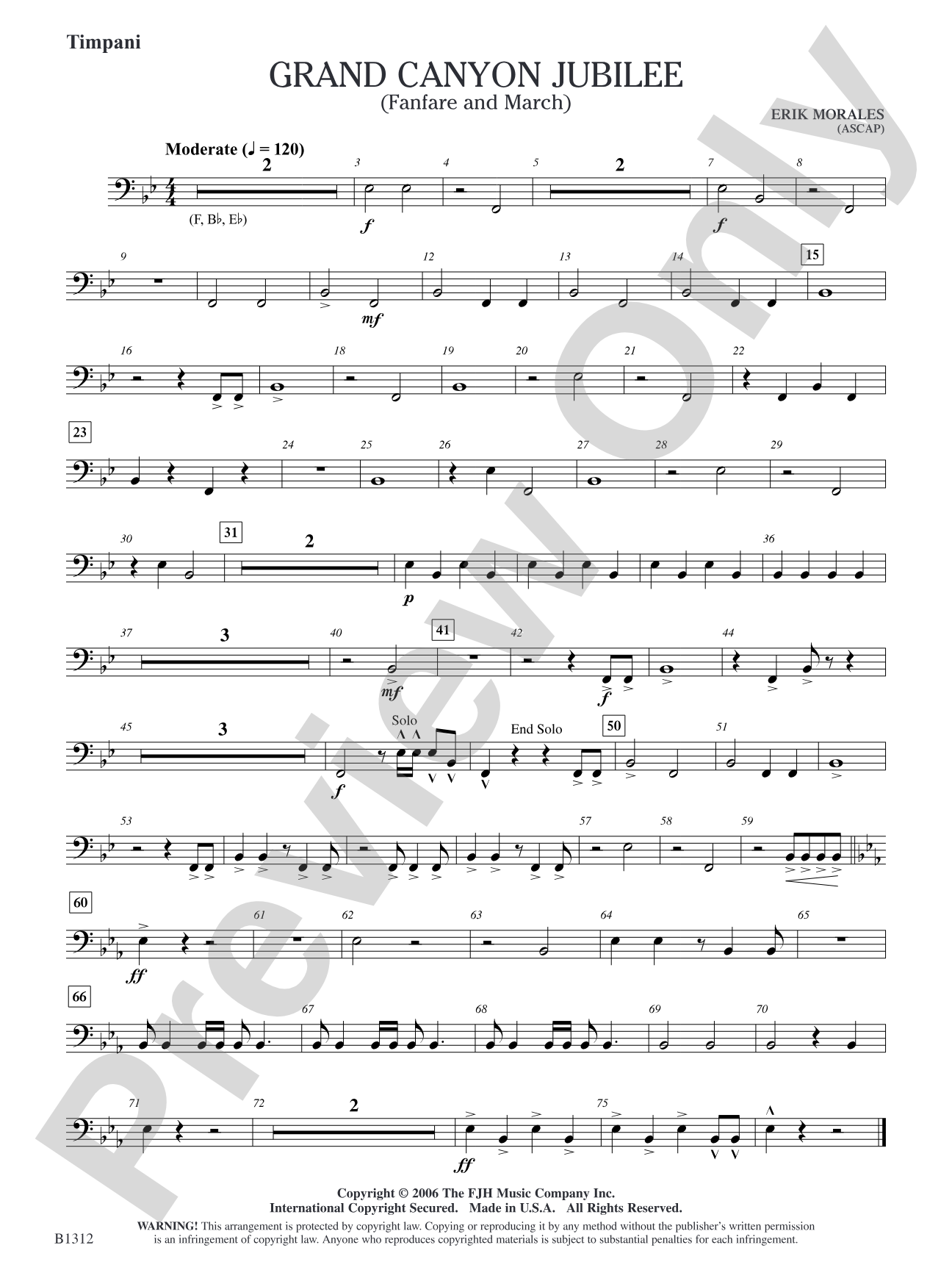

Grand Canyon Jubilee (Fanfare and March): Timpani
Fanfare and March
By Erik Morales
Grade: 2
Item: 98-PC-DB1312_TMP
$7.00
Pickup currently not available
Description
A bold fanfare sets the stage for this celebratory work set in a unique Southwestern style. Inspired by visions of the American West, the infectious march-style melody will stick with your audience long after the performance. This is the perfect work for directors looking to program a march but are interested in a nontraditional march form.


Grand Canyon Jubilee (Fanfare and March): Timpani isn't in MakeMusic Cloud just yet...but it could be. Let us know you'd like to see it, and you'll help shape what comes next. In the meantime, start a free trial and dive into thousands of interactive titles your students can play along with today.
Request This Title
Tell us you want it.
Start Your Free Trial
Explore everything that's ready to play right now.
Sample Audio
1
Audio File
--:--
0:00
0:00
Sample Video
No sample videos found.
Additional Details
Series:
FJH Young Band
Publisher:
The FJH Music Company, Inc.
SKU:
98-PC-DB1312_TMP
More about this title
About the Composer: Erik Morales

Erik Morales began composing shortly after graduating high school in south Florida in 1985, when his former band director commissioned him to arrange music for the marching band. Since then, he has established himself as a prolific composer with over 150 publications spanning wind, orchestral, jazz, and chamber settings. His work has been performed and commissioned by schools and organizations across the country, and he has made particular contributions to the trumpet repertoire, with several works premiering at national conferences including the International Trumpet Guild.
Moreover, Morales completed his formal training at Florida International University and earned his bachelor's degree from the University of Louisiana, Lafayette in 1989. His trumpet concertos have garnered recognition at major competitions, and in 2016 he was inducted into the Louisiana Association for Jazz Education's Hall of Fame. Throughout his career, he has focused on balancing artistic integrity with educational accessibility, making his music appealing to both developing musicians and experienced audiences worldwide.
Why we love this
Morales gifts you a march that refuses convention. The opening fanfare grabs attention immediately, then the melody lands with genuine staying power, yet the overall structure keeps listeners from hearing what they expect. Grade 2 bands can absolutely execute this, making it a smart choice for directors who want to program something that sounds substantial and thoughtful without overreaching technically.
What to expect
Grand Canyon Jubilee opens with fanfare brass cutting through the air, conjuring wide-open spaces and ceremonial energy. When the march arrives, it carries an infectious, propulsive spirit rooted in Southwestern tradition, yet distinctive enough that audiences won't mistake it for something heard a hundred times before. The overall effect is celebratory without being saccharine, spirited without being generic.
Who it's for
Grade 2 concert bands ready to explore a march that stands apart from traditional march writing. Directors seeking festival or contest material that showcases both technical competency and musical character will find this especially useful.
How to get the most out of it
- Let the fanfare breathe. The opening moment sets the entire tone, so resist the urge to rush through it. Give that brass section room to establish presence and grandeur before pivoting into the march.
- Lean into the Southwestern character. The style evocation isn't just flavor; it shapes phrasing and articulation. Consult with your ensemble about what that regional identity means for tone color and rhythmic precision.
- Balance transparency with full sound in the march section. Even though this is Grade 2, the orchestration likely asks different voices to carry material. Make sure inner parts aren't buried, or the inventive harmonic vocabulary disappears.
How to use it
This works beautifully as a concert opener or as the anchor march on a festival entry. Its nontraditional form makes it a compelling programming choice when you want to include a march without simply repeating standard repertoire. It also pairs well with other Americana-inspired works if you're building a thematic concert around regional or patriotic music.
Skills your students will build
- Executing fanfare style with crisp articulation and controlled dynamics
- Sustaining lyrical phrasing within a march context
- Balancing multiple melodic lines in Southwestern-inflected harmonic writing
- Reading and performing in march form with non-traditional structural choices
- Responding to stylistic character instruction and regional musical identity