

Granados: Goyescas (Complete)
By Enrique Granados
Item: 00-PC-0011889
$1.99
Pickup currently not available
Description
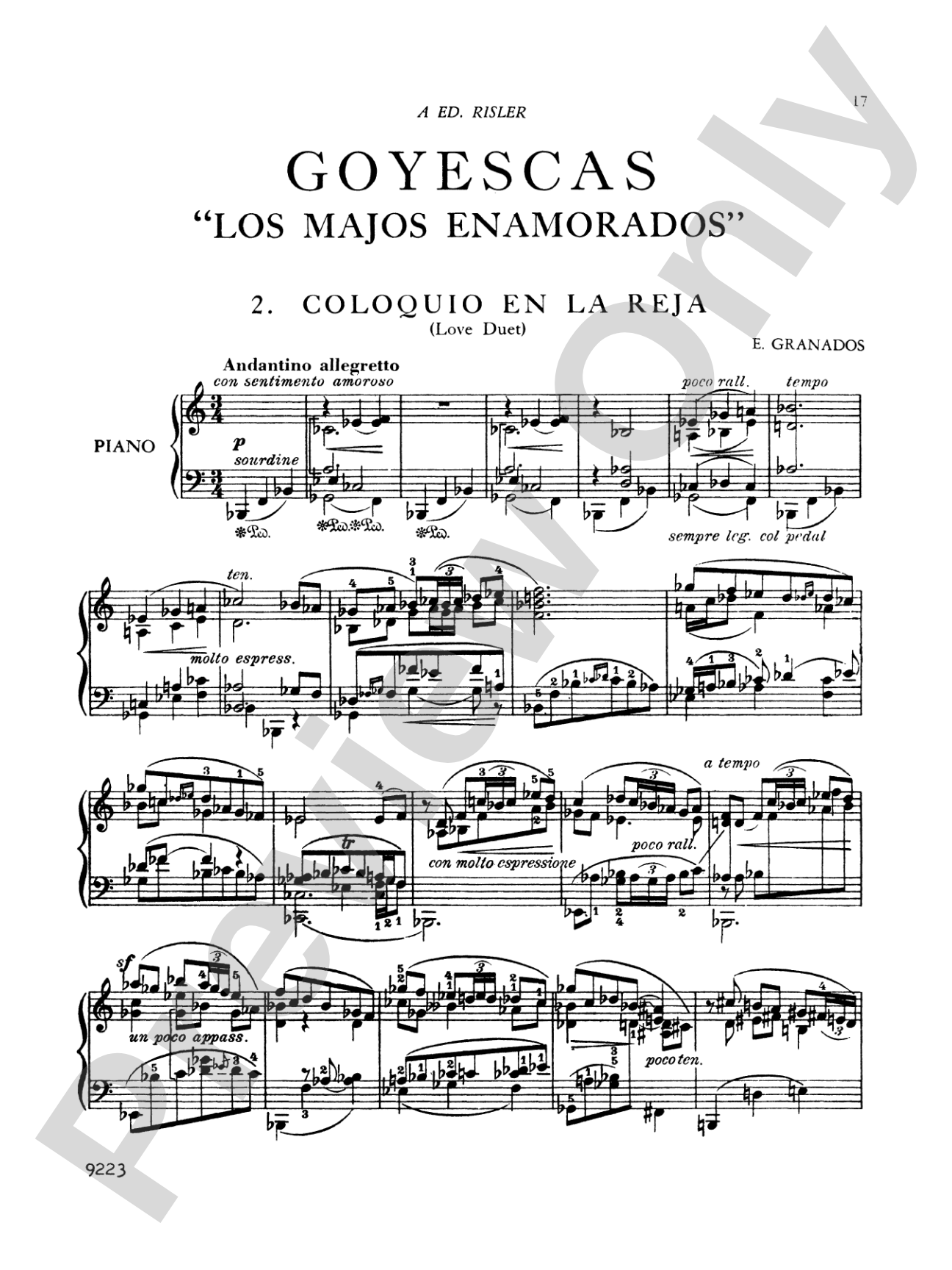
Titles: 1. Los Requiebros * 2. Coloquio en la Reja * 3. El Fandango de Candil * 4. Quejas ó la Maja y el Ruiseñor * 5. El Amor y la Muerte * 6. Epilogo (Serenata del Espectro).


Don't just read it, hear it, play along with it, and watch your students grow with it. In MakeMusic Cloud, Granados: Goyescas (Complete) comes alive with professional accompaniment, adjustable tempo, and built-in practice tools that turn solo practice into real progress.
Open in the Player
Jump straight in and assign it today.
Start Your Free Trial
Open this title and explore the full library in minutes.
Sample Audio
No sample audio found.
Sample Video
No sample videos found.
Additional Details
Series:
Kalmus Edition
Publisher:
Alfred Music
Page Count:
72
SKU:
00-PC-0011889
More about this title
About the Composer: Enrique Granados
Enrique Granados (1867-1916) was a Spanish composer and pianist whose works embody the nationalist spirit of late Romantic music while drawing deeply from Spanish folk traditions and visual art. His career spanned the turn of the 20th century, a period when European composers were mining their own cultural heritage for harmonic and melodic innovation. Granados was equally accomplished as a virtuoso performer and a composer; his understanding of the piano's expressive possibilities shaped every note he wrote.
Granados drew inspiration from the paintings of Francisco Goya, whose work explored Spanish life, emotion, and social commentary. This connection to visual art infuses his compositions with narrative depth and dramatic intensity. He remains a central figure in the piano repertoire, studied by advanced students and performed regularly by concert pianists.
Why we love this
Goyescas represents the pinnacle of Spanish Romantic piano writing, combining technical brilliance with genuine emotional substance. Each movement tells a distinct story through character and atmosphere rather than explicit program notes, giving pianists room to shape narrative interpretation while the music itself guides them. The cycle works equally well as a complete recital work or as a source for individual selections, making it adaptable to different performance contexts and advancing pianists at the intermediate-to-advanced level.
What to expect
Goyescas captures the sensuality, passion, and melancholy of Spanish life as filtered through Romantic sensibility. The music moves between intimate dialogue and theatrical drama, conjuring images of serenades, romantic encounters, and the ghostly epilogue that ends the cycle. There is an undeniable Spanish flavor in the rhythms and ornamental language, yet the harmonic vocabulary and emotional scope feel fully European and deeply personal.
Who it's for
This collection serves advanced pianists preparing recital repertoire or studying the nationalist traditions that shaped early 20th-century piano writing. It works well for students transitioning from Classical and early Romantic works into more harmonically adventurous material, as well as for performers looking to deepen their Spanish repertoire beyond the more commonly programmed Albeniz or Turina.
How to get the most out of it
- Study the harmonic language in isolation before tackling the full technical demands; Granados' chromaticism and modal inflections require clarity of voice leading to avoid muddiness, particularly in densely voiced passages.
- Shape rubato through the Spanish rhythmic idioms (particularly the fandango sections) as an interpretive tool rather than arbitrary tempo flexibility; the music gains authenticity when rhythmic freedom serves the dance character.
- Approach the ornamental figuration as essential to character rather than decoration; every trill, turn, and runs functions as part of the emotional expression and should be voiced with clarity and purpose.
- Balance the lyrical passages (Quejas ó la Maja y el Ruiseñor) with generous pedaling to achieve the warm, romantic sonority Granados intended, while maintaining harmonic transparency through careful attention to damper timing.
How to use it
This complete cycle makes a compelling standalone recital, though individual movements work effectively as contrasting centerpieces within a broader Spanish or Romantic program. The opening movement (Los Requiebros) serves as an engaging entry point for audiences less familiar with Granados, while pianists with concert experience can program the entire work to showcase architectural thinking and interpretive stamina. Consider pairing it with other Spanish composers or with works that share Granados' harmonic language and expressive palette.
Skills your students will build
- Chromatic harmony and modal mixture in a tonal context
- Spanish rhythmic idioms including fandango rhythm and habanera patterns
- Pedal technique for controlling harmonic resonance in densely voiced passages
- Rubato and interpretive flexibility in Romantic music
- Ornamental figuration (trills, turns, runs) as expressive rather than decorative elements
- Large-scale cycle planning and narrative arc across multiple movements