
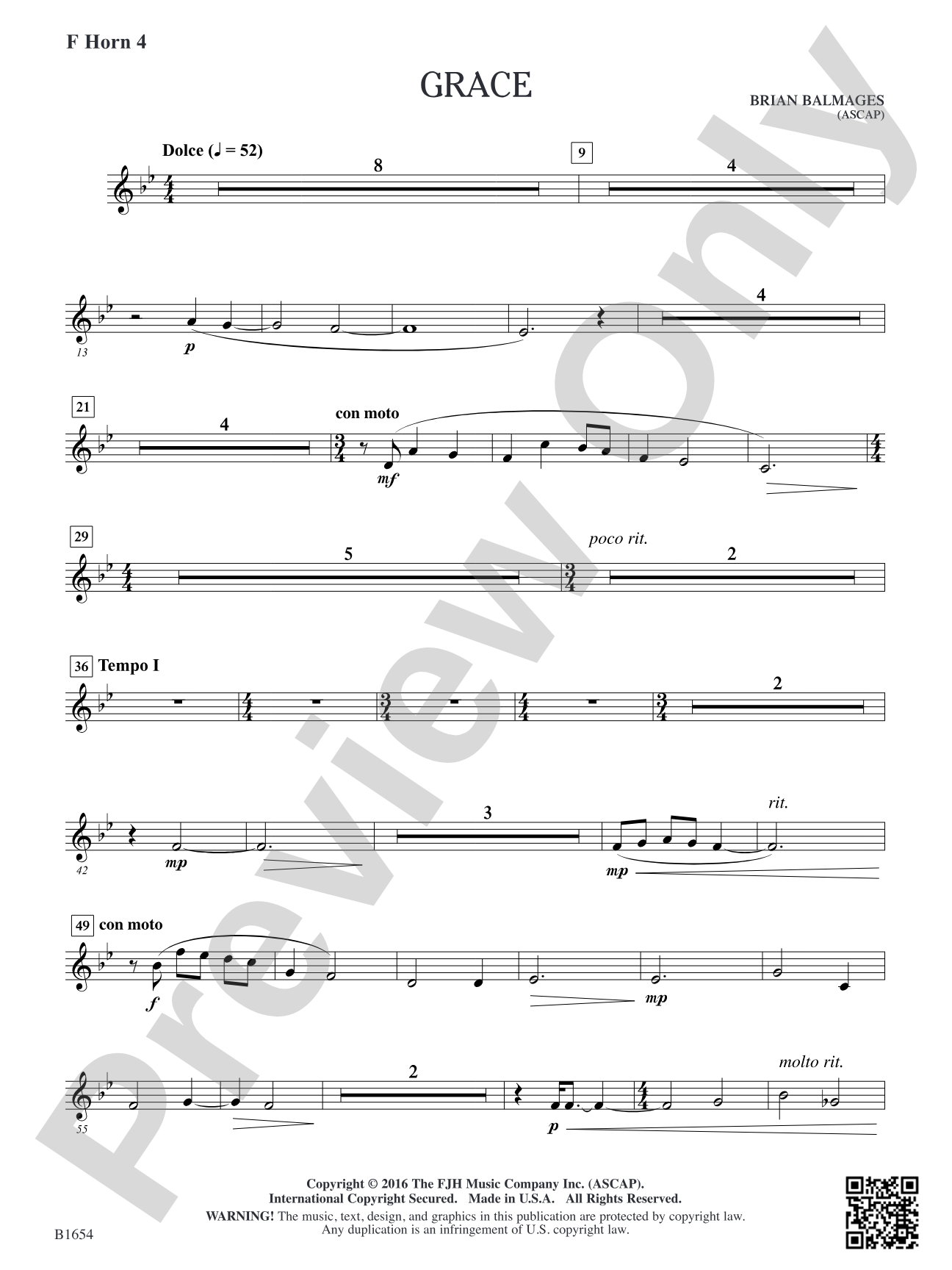

Grace: F Horn 4
By Brian Balmages
Grade: 4
Item: 98-PC-DB1654_H4
$7.00
Pickup currently not available
Description
This stunning and emotional work is based on the single word "grace." Largely original, the music weaves a tapestry of solitude, tension, patience and peace. Toward the end of the work, the melody of Amazing Grace emerges subtly and draws the audience in further. An emotional rollercoaster that explores great musical depth.


Grace: F Horn 4 isn't in MakeMusic Cloud just yet...but it could be. Let us know you'd like to see it, and you'll help shape what comes next. In the meantime, start a free trial and dive into thousands of interactive titles your students can play along with today.
Request This Title
Tell us you want it.
Start Your Free Trial
Explore everything that's ready to play right now.
Sample Audio
1
Audio File
--:--
0:00
0:00
Sample Video
No sample videos found.
Additional Details
Series:
FJH Symphonic Band
Publisher:
The FJH Music Company, Inc.
SKU:
98-PC-DB1654_H4
More about this title
About the Composer: Brian Balmages

Brian Balmages has established himself as a composer and conductor whose work spans orchestral, band, and chamber music at the highest levels. His compositions have been performed by ensembles ranging from professional orchestras to school groups in venues including Carnegie Hall, the Kennedy Center, and the Sydney Opera House. He is an elected member of the American Bandmasters Association and received the A. Austin Harding Award from the American School Band Directors Association. His 2020 NBA William D. Revelli Composition Contest win for Love and Light reflects his standing among his peers.
Balmages holds degrees from James Madison University and the University of Miami, both of which have honored his contributions to music. He was commissioned by the University of Miami to compose for the presidential inauguration of Dr. Julio Frenk, and his work was performed at the 2013 Presidential Inaugural Prayer Service. As a conductor, he maintains regular engagements with all-state ensembles, university groups, and professional organizations worldwide, and has guest conducted at major conferences including the Midwest Clinic and the College Band Directors Conference. He currently serves as Director of MakeMusic Publications and Digital Education for Alfred and MakeMusic.
Why we love this
Balmages crafts an emotional arc that doesn't rely on bombast to move your audience. The restraint in the orchestration combined with the subtle emergence of Amazing Grace near the work's end creates a moment of genuine connection, making this a standout choice for directors seeking concert repertoire that deepens rather than decorates a program. At Grade 4, it's accessible to capable bands while offering enough harmonic and structural sophistication to keep musicians engaged.
What to expect
Grace unfolds like a meditation, moving through quiet reflection into moments of restless yearning before settling into acceptance. The score creates spaces of solitude and periods of internal struggle, then resolves into something recognizable and deeply human. Audiences experience the piece as a journey inward and outward simultaneously, culminating in a sense of peace.
Who it's for
Band directors programming Grade 4 ensembles who want concert pieces that are musically rewarding without excessive technical demands. This work suits bands serious about contest and festival appearances, as well as directors seeking repertoire that challenges students to think about musical storytelling and emotional communication rather than only technical proficiency.
How to get the most out of it
- Balance the original material against the familiar melody when Amazing Grace enters; the tune should feel like a discovery rather than an announcement, so moderate dynamic contrast allows it to land with quiet power.
- Shape the tension passages with deliberate phrasing and breath support; allow small moments of silence to emphasize the emotional peaks rather than rushing through them.
- Use the recorded accompaniment to lock ensemble precision during the middle sections where textural layering creates potential balance challenges across the woodwind and brass choirs.
- Encourage singers and players to internalize the emotional narrative of "grace" itself; musical intention ripples outward and will resonate with your audience.
How to use it
Position this work as a centerpiece in a concert designed around a thematic arc; it pairs beautifully with contrasting lighter fare both before and after, allowing it to create a memorable emotional anchor. Its introspective character makes it ideal for spring concert programming or for festival appearances where judges respond to musical maturity and compositional craft.
Skills your students will build
- Balancing dynamic control across multiple voice parts to support emotional phrasing
- Sustaining focus through slower tempos and passages of textural transparency
- Recognizing and executing compositional techniques that create tension and resolution
- Interpreting familiar melodic material within a new harmonic and structural context
- Collaborating across sections to shape a unified emotional narrative across a full concert band