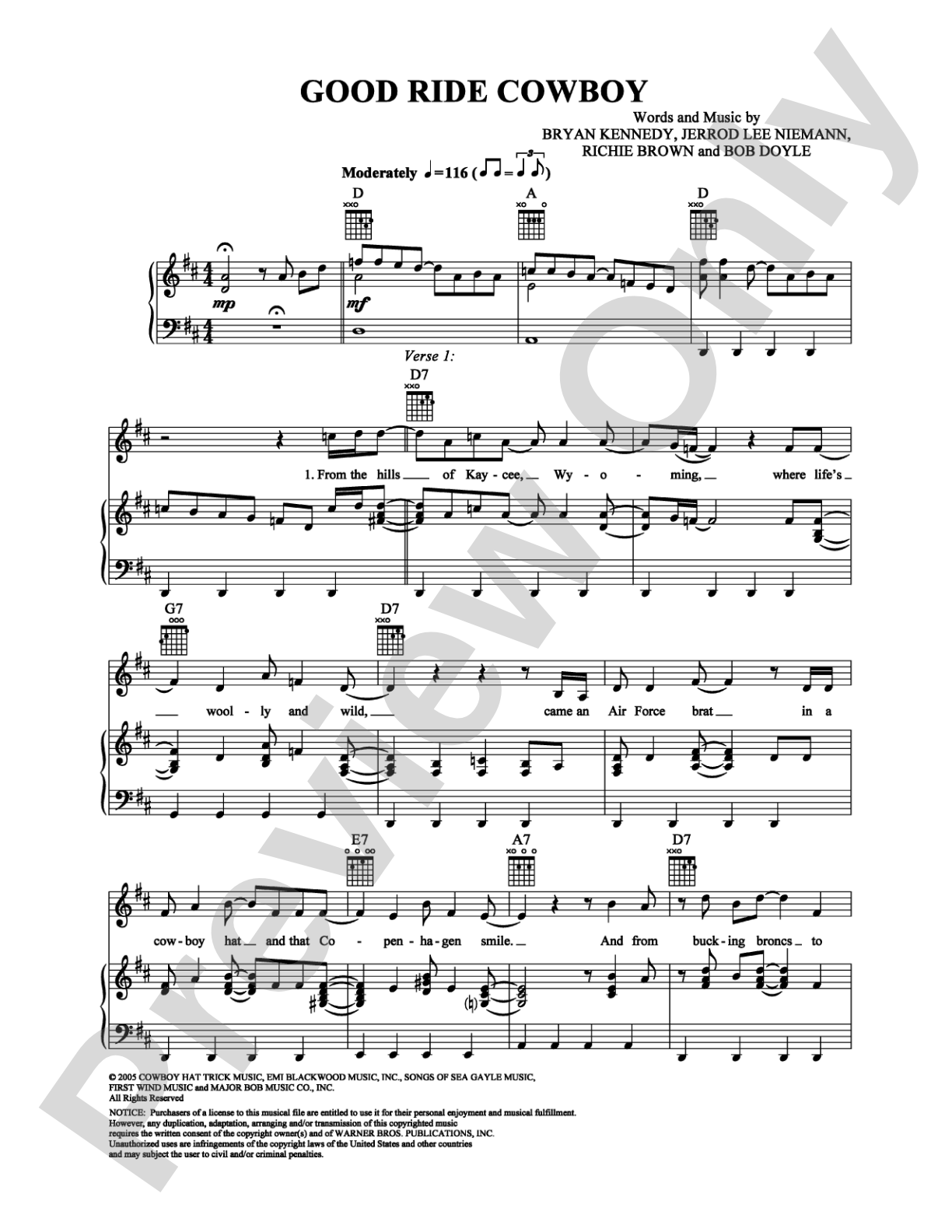
Good Ride Cowboy: Piano/Vocal/Chords Digital Sheet Music

Good Ride Cowboy: Piano/Vocal/Chords Digital Sheet Music

Garth Brooks, Bryan Kennedy, Jerrod Lee Niemann, Richie Brown, Bob Doyle

Item: 00-PS-0004092

Digital Download
$3.99
Description

Good Ride Cowboy: Piano/Vocal/Chords Digital Sheet Music isn't in MakeMusic Cloud just yet...but it could be. Let us know you'd like to see it, and you'll help shape what comes next. In the meantime, start a free trial and dive into thousands of interactive titles your students can play along with today.

Sample Audio
No sample audio found.
Sample Video
Additional Details
SKU: 00-PS-0004092

More about this title

About the Artist: Garth Brooks

Garth Brooks stands as one of the best-selling music artists of all time, with a career spanning four decades of country music innovation. His influence on modern country extends far beyond sales figures; Brooks brought theatrical energy, emotional directness, and sophisticated production to a genre often dismissed by mainstream audiences. For music educators, his catalogue represents a bridge between traditional country songwriting and contemporary pop sensibility, making his work valuable for students exploring how genre conventions can expand without losing their core identity.

Why we love this

This song captures what makes Brooks' writing so teachable: a strong melodic hook, straightforward harmonic movement, and lyrics that tell a complete emotional story in under four minutes. The piano/vocal/chords format gives students room to interpret the arrangement themselves, whether they're learning to comp chords, add fills, or find their own voice in the accompaniment. It's the kind of song that keeps students engaged because they already know it works.

What to expect

The song carries a reflective, almost cinematic quality despite its country roots. There's a sense of movement and resilience woven through the narrative, supported by Brooks' characteristic blend of vulnerability and determination in the melody.

Who it's for

Vocalists preparing audition material, pop/country crossover repertoire, or performing artists looking for accessible contemporary material that doesn't require a full band will find this digital sheet essential. Piano students and accompanists benefit from the straightforward but rewarding task of crafting a full arrangement from the chord chart. Music directors teaching contemporary songwriting or programming casual concerts will appreciate having a recognizable, well-loved song ready to arrange for their ensemble's strengths.

How to get the most out of it

  • Use the chord symbols to explore different voicing options on the piano. Brooks' recordings favor open, ringing harmonies; experiment with inversions and seventh extensions to match that sound without overshadowing the vocal line.
  • Approach the vocal melody with the conversational phrasing typical of Brooks' delivery. The story matters as much as the notes, so let lyrical punctuation guide your breath and tempo adjustments rather than fighting against it.
  • Balance the piano's role carefully. In verses, a light touch on the keys supports the narrative without distraction. The chorus can open up with fuller voicings and strategic dynamics that lift the emotional peak of the song.
  • Pay attention to how the harmonic rhythm supports the story arc. Slower chord changes in reflective moments shift to tighter rhythmic movement during moments of action or decision in the lyric.

How to use it

Consider this for a casual concert or singer-songwriter showcase where contemporary country sits naturally alongside other genres. It also works as a teaching piece in a piano accompanying class, giving students a real-world example of how to build a complete arrangement from chords alone. For music theory or composition courses, the song's harmonic structure and lyrical-musical alignment offer clear examples of how commercial songs balance accessibility with emotional depth.

Skills your students will build

  • Interpreting lead sheets and building piano accompaniments from chord symbols
  • Phrasing vocal melodies with narrative clarity and emotional intention
  • Balancing accompaniment dynamics to support rather than overshadow the singer
  • Understanding country song structure and contemporary country melodic conventions

You May Also Like