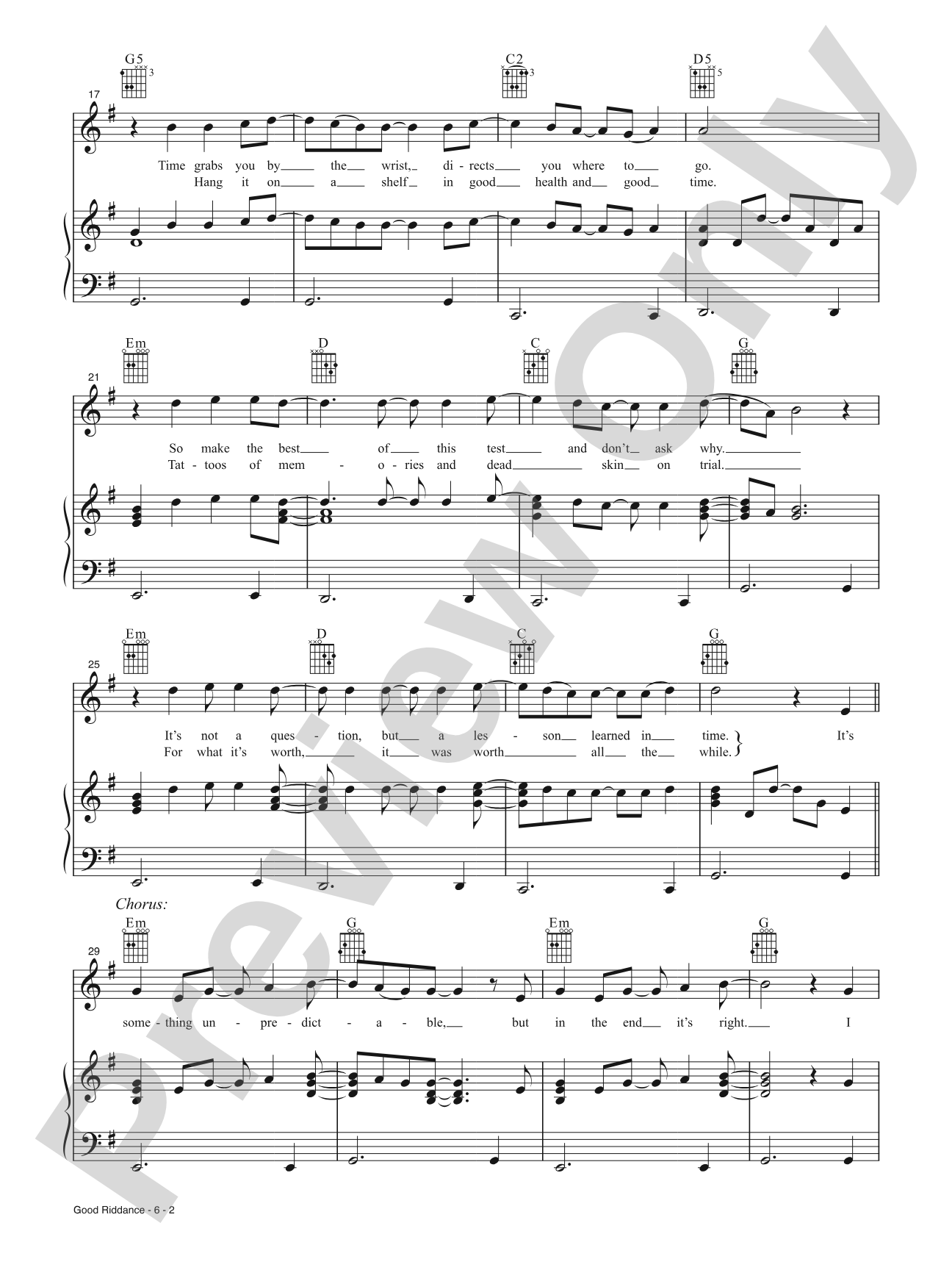
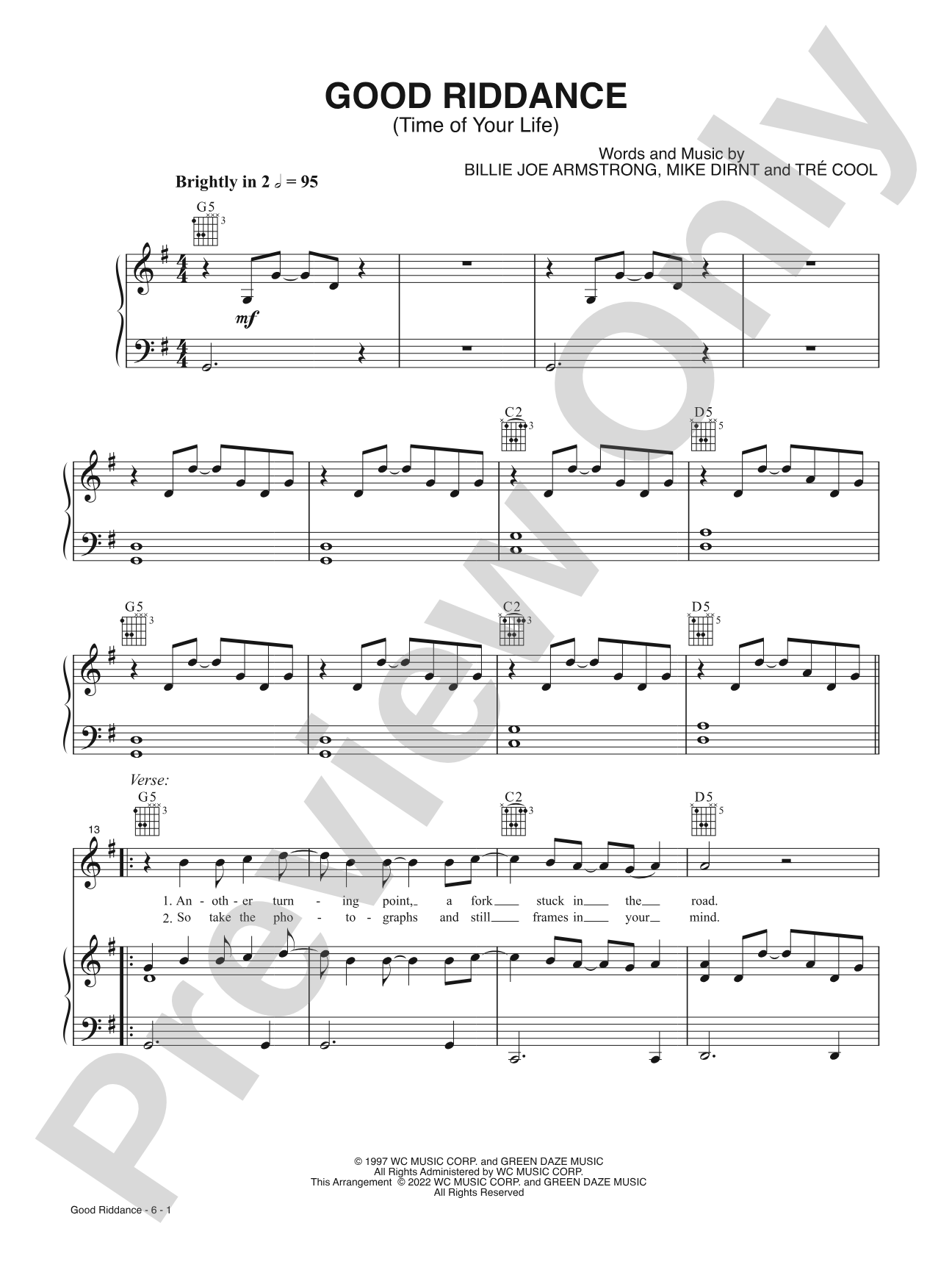
Good Riddance (Time of Your Life) Sheet Music Preview

Good Riddance (Time of Your Life): Piano/Vocal/Guitar

Words and Music by BILLIE JOE ARMSTRONG, MIKE DIRNT and TRÉ COOL

Item: 00-PS-0016724

Digital Download
$3.99

One moment…

Description
"Good Riddance (Time of Your Life)" (or "Time of Your Life (Good Riddance)") by American rock band Green Day, released in December 1997 as the second single from their fifth studio album, Nimrod (1997).

Good Riddance (Time of Your Life): Piano/Vocal/Guitar isn't in MakeMusic Cloud just yet...but it could be. Let us know you'd like to see it, and you'll help shape what comes next. In the meantime, start a free trial and dive into thousands of interactive titles your students can play along with today.

Sample Audio
No sample audio found.
Sample Video
Additional Details
SKU: 00-PS-0016724

More about this title

About the Composer: Billie Joe Armstrong

Billie Joe Armstrong is the lead vocalist, guitarist, and primary songwriter of Green Day, the punk rock band that emerged from the East Bay music scene in the early 1990s. His songwriting approach combines accessible melodies with emotionally resonant lyrics, a skill demonstrated across Green Day's catalog from their breakthrough album Dookie (1994) through their later stadium-filling work. Armstrong's compositions have reached audiences far beyond the punk and rock worlds, proving that strong melodies and honest storytelling transcend genre boundaries.

Why we love this

This song lives in a rare space where genuine sentiment and rock credibility coexist without irony. The piano part carries the emotional weight that makes the song accessible to singers and pianists who might not otherwise engage with punk repertoire, while the underlying structure respects the original's integrity. Students recognize it immediately, which transforms potential indifference into genuine investment.

What to expect

A moment of quiet reflection wrapped in genuinely melancholic warmth. The piano supports rather than drives, creating space for the voice to carry questions about time, memory, and presence without offering easy answers. There is strength in its restraint and genuine emotion beneath what might initially read as simple.

Who it's for

Singers preparing for auditions, recitals, or casual performance contexts will find a song that feels authentic without excessive technical demand. Pianists looking to accompany vocalists or perform this solo benefit from an arrangement that values melodic clarity and emotional accessibility. This works equally well for students exploring contemporary popular music within classical or crossover settings.

How to get the most out of it

  • Honor the simplicity of the piano part; resist the urge to add flourishes that complicate the vocal line's emotional directness.
  • Pay attention to rubato during the verse sections, allowing natural breathing room before building intensity into the chorus.
  • Balance the vocal melody so it sits warmly above the accompaniment without overwhelming the harmonic foundation that supports it.
  • Let silence speak where it exists in the arrangement; these moments create space for reflection that mirrors the song's introspective quality.

How to use it

Include this in a recital or concert that blends classical and popular traditions, positioning it alongside other contemporary art songs or as a bridge between more formal repertoire and accessible modern material. The emotional depth makes it suitable for senior recitals, end-of-year showcase concerts, or programs exploring how popular songwriting reflects classical songwriting sensibilities.

Skills your students will build

  • Balancing vocal melody with accompaniment texture
  • Sustaining emotional nuance over simple harmonic progressions
  • Interpreting rubato and phrasing in contemporary popular music
  • Managing the relationship between accompaniment and soloist in a two-part texture

You May Also Like