Good Night Sweetheart: Piano Digital Sheet Music

Good Night Sweetheart: Piano Digital Sheet Music

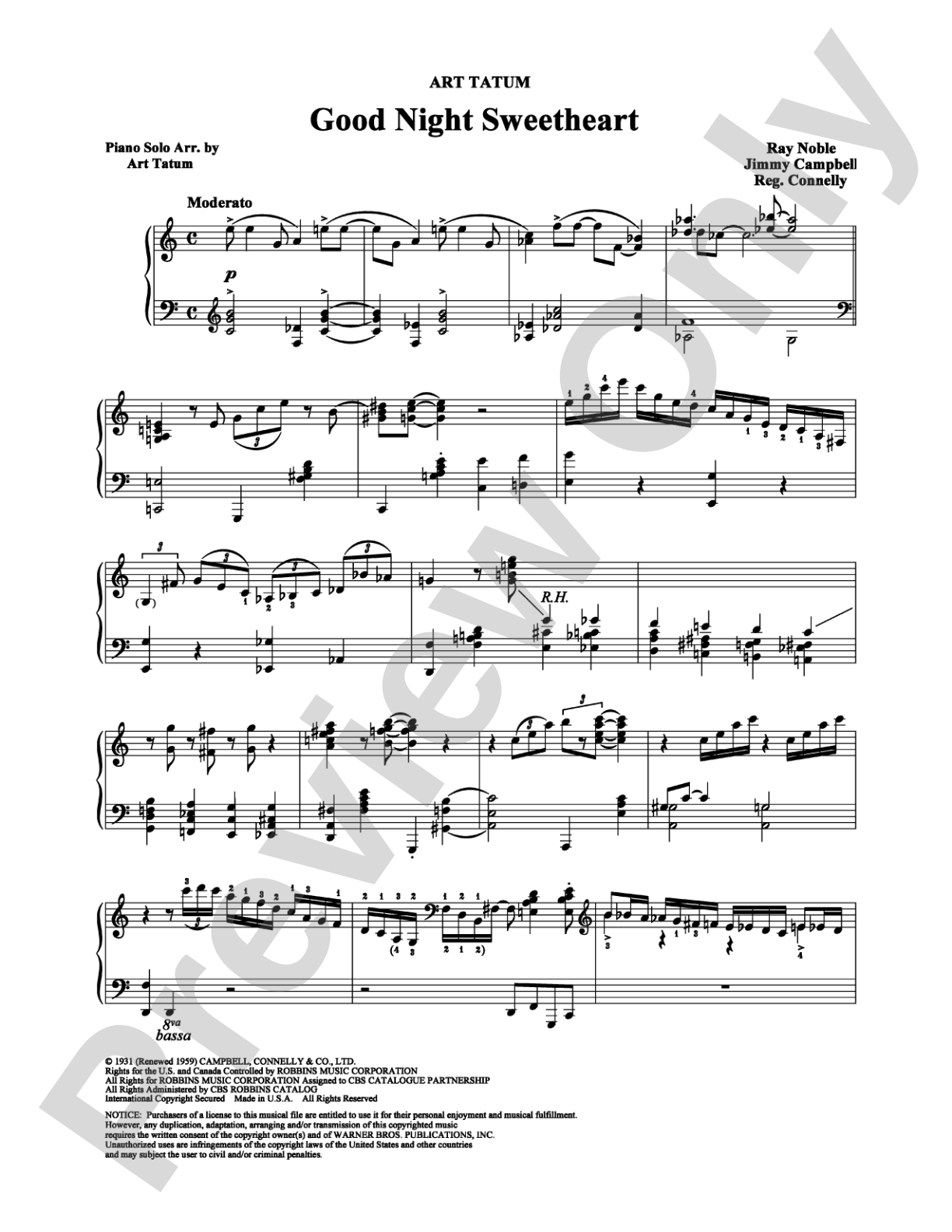
Ray Noble, Jimmy Campbell, Reg Connelly, Art Tatum

Item: 00-PS-0007310

Digital Download
$3.99
Description

Good Night Sweetheart: Piano Digital Sheet Music isn't in MakeMusic Cloud just yet...but it could be. Let us know you'd like to see it, and you'll help shape what comes next. In the meantime, start a free trial and dive into thousands of interactive titles your students can play along with today.

Sample Audio
No sample audio found.
Sample Video
Additional Details
SKU: 00-PS-0007310

More about this title

About the Artist: Art Tatum

Art Tatum (1909-1956) was a pianist whose technical mastery and harmonic sophistication fundamentally changed what was possible on the jazz piano. Largely self-taught, he developed an approach to improvisation that combined stride piano foundations with chromatic reharmonization, rapid runs, and a harmonic language far ahead of his contemporaries. His recordings remain essential listening for anyone studying jazz piano, and his interpretations of popular standards set the template that generations of jazz pianists followed.

Why we love this

This is Tatum's arrangement of a standard that showcases his signature approach to melody and harmony: reharmonization that respects the song's bones while reimagining every chord. Studying how he handles this familiar tune teaches pianists how to honor a melody while building sophisticated accompaniment textures underneath it.

What to expect

Warm and conversational, like Tatum is playing a familiar tune just for you and making small discoveries in the harmony as he goes. The arrangement moves between moments of delicate melody and passages of brilliant technical display, never losing the song's inherent sweetness.

Who it's for

Intermediate to advanced jazz pianists ready to tackle sophisticated reharmonization and stride technique. This arrangement rewards pianists who have foundational jazz vocabulary and want to study how a master improviser reconstructs a standard.

How to get the most out of it

  • Work the left hand stride pattern separately until it becomes automatic; Tatum's right-hand freedom depends on a rock-solid foundation in the bass.
  • Map out the harmonic movement before you tackle the runs; understanding the chord progression underneath the fast passagework makes the technique meaningful rather than just notes.
  • Listen to Tatum's recorded version multiple times and sing the melody aloud to internalize his phrasing and where he breathes.
  • Practice the reharmonized sections at half tempo to hear the harmonic colors clearly before accelerating to performance speed.

How to use it

Pair this with other jazz standards or early swing era pieces for a concert segment that highlights jazz piano as a serious compositional and interpretive art. It also works as a study piece in a jazz history curriculum, allowing students to hear and play from an original source rather than a secondary analysis.

Skills your students will build

  • Stride piano technique and left-hand independence
  • Reading and executing reharmonized chord progressions
  • Interpreting rubato and phrasing in jazz piano
  • Translating improvised performance into reproducible arrangement

You May Also Like