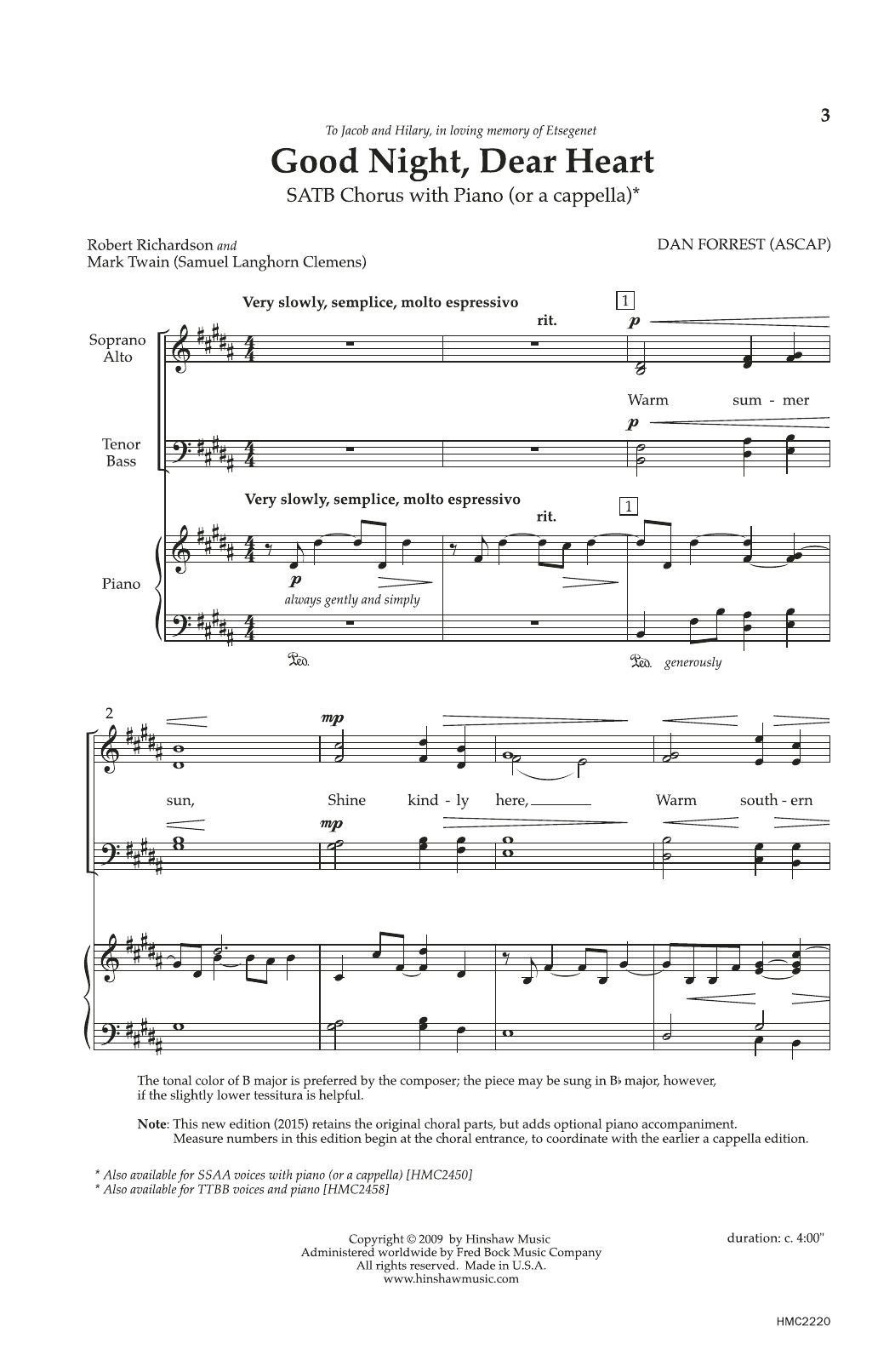
Good Night, Dear Heart: SATB Choral Octavo

By Mark Twain / By Robert Richardson / Arranged by Dan Forrest

Item: 35-DS00726219

Digital Download
$3.30
Description

Good Night, Dear Heart: SATB Choral Octavo isn't in MakeMusic Cloud just yet...but it could be. Let us know you'd like to see it, and you'll help shape what comes next. In the meantime, start a free trial and dive into thousands of interactive titles your students can play along with today.

Sample Audio
No sample audio found.
Sample Video
Additional Details
Publisher: Hal Leonard
Page Count: 7
SKU: 35-DS00726219

More about this title

About the Authors

Mark Twain

Robert Richardson

Why we love this

Dan Forrest's arrangement brings a reflective warmth to this Twain text that feels both intimate and substantial for a secular concert program. The a cappella writing sits comfortably for mixed voices without demanding extreme ranges, making it accessible for high school and community choirs while maintaining musical sophistication. It's the kind of piece that anchors a program; audiences remember it.

What to expect

There's a gentleness here that never tips into sentimentality. The harmonic language feels grounded and honest, supporting text that speaks to saying goodbye with grace and affection. Performing it leaves singers and listeners in a quieter, more reflective place.

Who it's for

High school and college choirs seeking substantial a cappella repertoire for concert settings will find this piece both musically rewarding and emotionally resonant. Directors programming secular works that still carry weight and thoughtfulness will appreciate what Forrest has crafted from Twain's text.

How to get the most out of it

  • Pay attention to vowel unification across the ensemble, especially in the sustained passages where blend matters most. Twain's sentimental text deserves clarity without sacrificing cohesion.
  • Shape the phrase endings with intention rather than simply releasing on the final consonant. A gentle taper often communicates more sincerity than an abrupt cutoff.
  • Balance the harmonies carefully during chord transitions so that inner voices don't disappear. This arrangement rewards listeners who hear all four parts working in conversation.

How to use it

This works beautifully as a program closer or as part of a thematic set exploring farewells and human connection. Its modest length and emotional maturity make it an excellent choice for concert finales where you want to send audiences out thoughtfully rather than energetically.

Skills your students will build

  • Blending vowels across sustained chords in a cappella textures
  • Shaping musical phrases with dynamic nuance and intention
  • Balancing four-part harmony to preserve clarity in all voices
  • Interpreting literary text through musical expression

You May Also Like