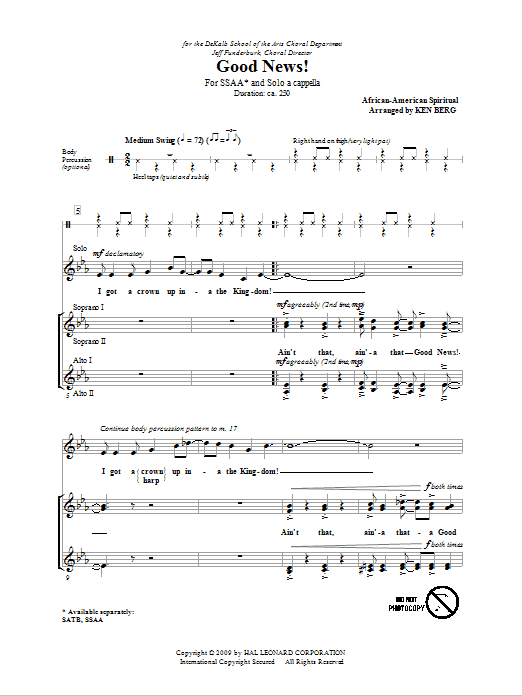
African-American spirituals emerged from enslaved communities in the American South, blending African musical traditions with Christian hymn texts and Protestant worship practices. These songs served multiple purposes: they were expressions of faith, coded messages of resistance and hope, and vehicles for preserving cultural identity under oppressive conditions. Spirituals became foundational to American musical culture and remain central to choral repertoire today, offering singers direct access to a uniquely American sacred tradition rooted in resilience and spiritual depth.
Why we love this
Ken Berg's SSA setting of this spiritual gives your choir immediate access to the emotional power and musical authenticity of the form without requiring extensive arrangement work. The six-page octavo sits comfortably in a concert or festival program and works equally well in a spirituals unit or as a standalone sacred offering that connects your singers to a tradition they should know deeply.
What to expect
The piece carries the particular gravity and hope embedded in the spiritual tradition itself. Despite its challenges and sorrows, the melodic and harmonic language speaks to transcendence and faith that feels earned rather than sentimental.
Who it's for
SSA and SSAA choirs looking for authentic sacred repertoire that connects singers to African-American musical heritage. This setting works for high school and college ensembles at festival or concert performance levels.
How to get the most out of it
Honor the text by allowing space for the meaning of each phrase to land; resist rushing through the syllables even as the melodic line moves.
Shape the overall arc across all six pages rather than treating each section as separate; this keeps the narrative momentum alive for listeners.
Balance blend against clarity in the SSA voicing; the three parts need to lock rhythmically while each line remains audible in the acoustic.
Explore the spiritual's call-and-response roots by experimenting with how sections might breathe or shift weight between the top line and harmonic support.
How to use it
Pair this with other spirituals from different eras or arrangements to create a thematic concert section that traces the form's evolution. It also stands alone effectively as a reflective moment in a mixed sacred program, offering audiences a grounded and authentic choral sound.
Skills your students will build
Interpreting text with historical and cultural awareness
Balancing three-part voicing with harmonic independence
Sustaining tone and phrasing across longer phrase structures
Understanding call-and-response as both a musical and structural principle
You May Also Like
Scan to Complete Your Purchase
Use your phone's camera to scan the code below
You'll log in on your phone and the order will be added to your account