
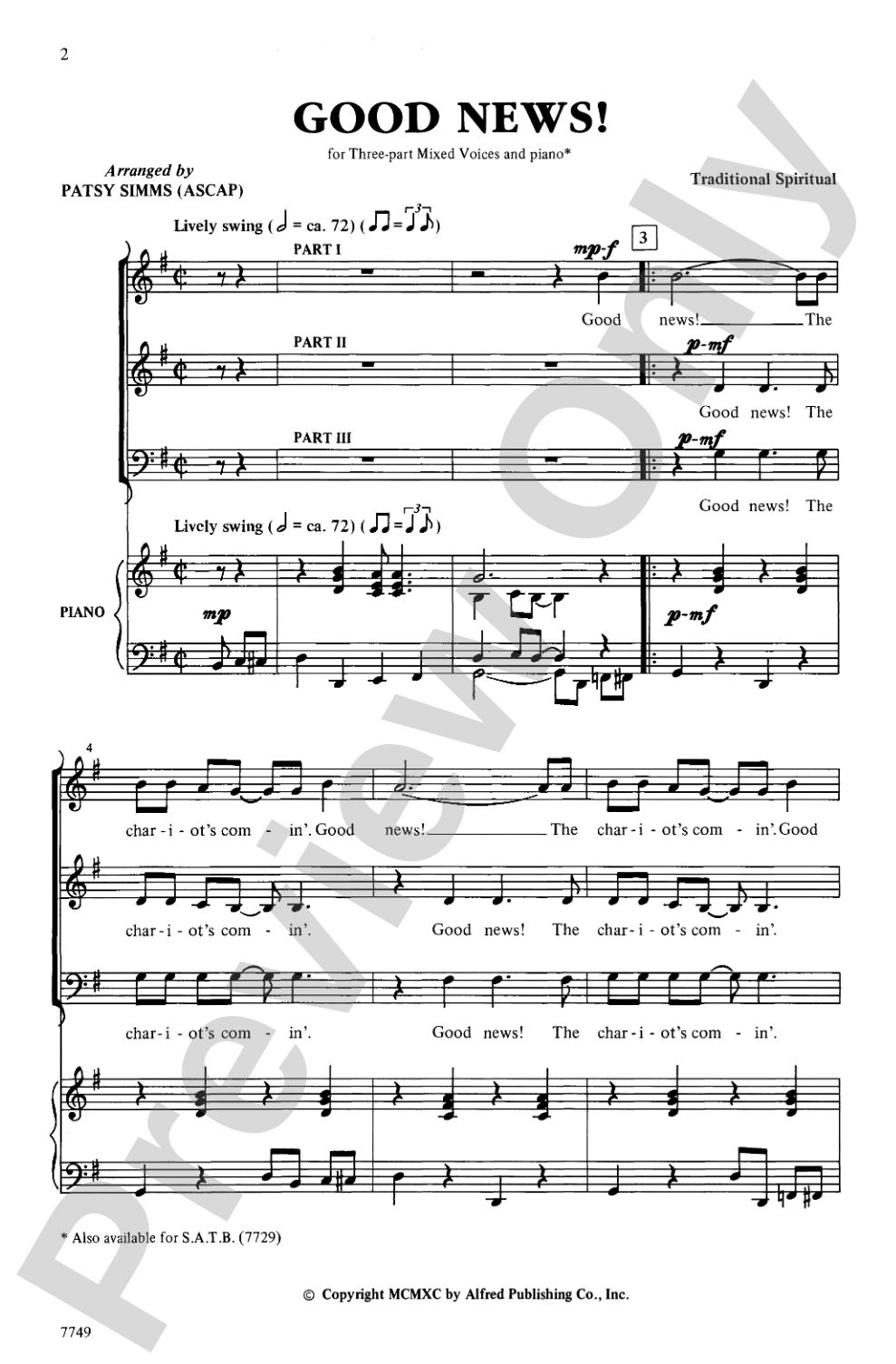
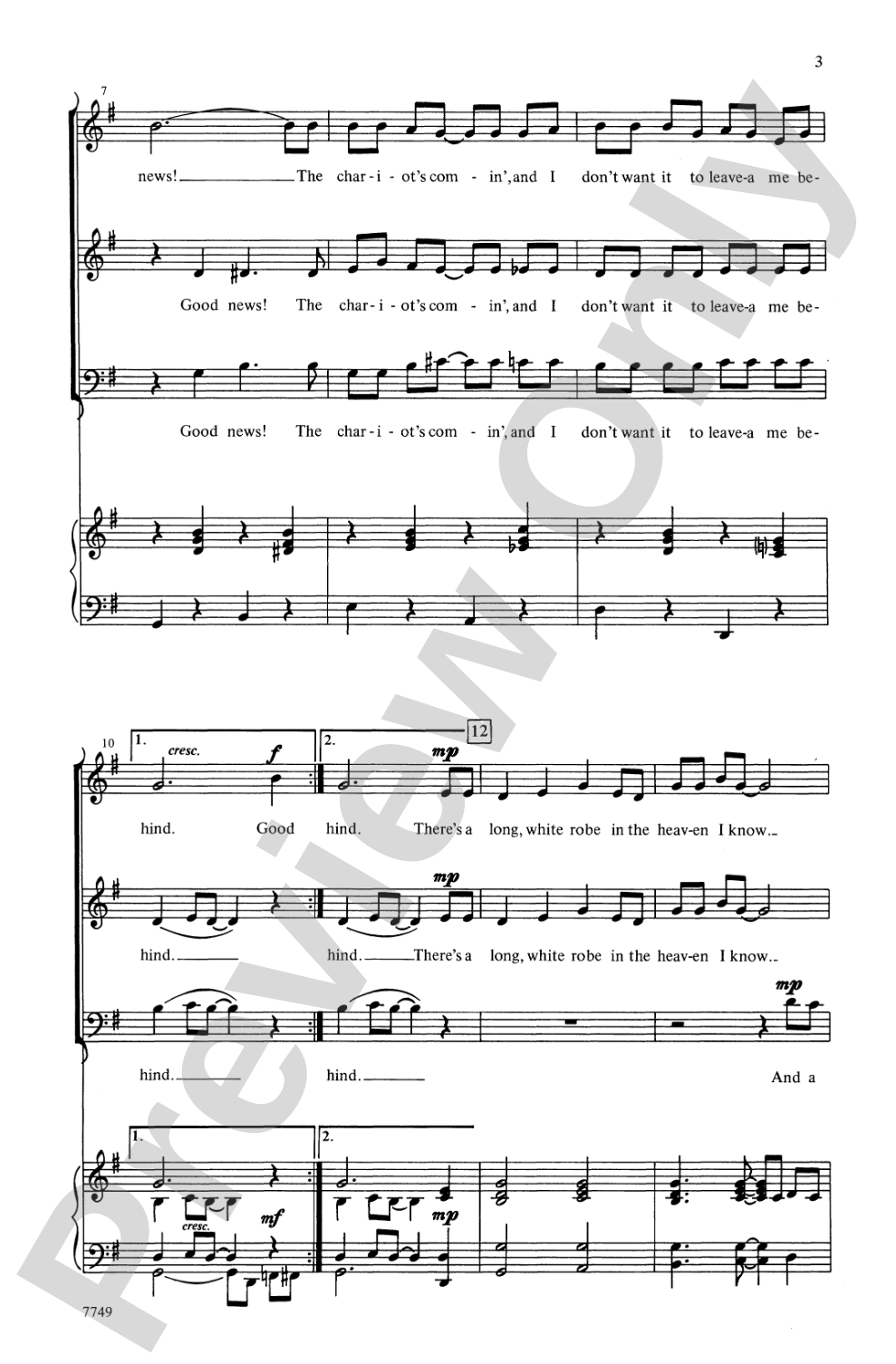

Good News!: 3-Part Mixed Choral Octavo
Arr. Patsy Ford Simms
Item: 00-PO-0004575
$2.25
Minimum order quantity: 20 copies
Pickup currently not available
Description
If you're having trouble finding a good, singable spiritual, look no further! Patsy Simms' arrangement of the traditional Good News is your choice. Features a rollicking piano accompaniment, some handclapping and a swinging descant on the final chorus.


Good News!: 3-Part Mixed Choral Octavo isn't in MakeMusic Cloud just yet...but it could be. Let us know you'd like to see it, and you'll help shape what comes next. In the meantime, start a free trial and dive into thousands of interactive titles your students can play along with today.
Request This Title
Tell us you want it.
Start Your Free Trial
Explore everything that's ready to play right now.
Sample Audio
No sample audio found.
Sample Video
No sample videos found.
Additional Details
Series:
Alfred Archive Edition: Alfred Choral Designs
Publisher:
Alfred Music
Page Count:
8
SKU:
00-PO-0004575
More about this title
About the Arranger: Patsy Ford Simms
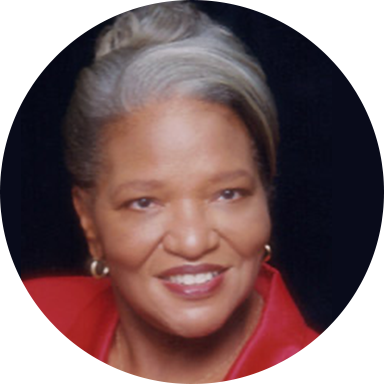
Patsy Ford Simms began her publishing career in 1981 and has since created over 300 compositions and arrangements for educational and church music programs across multiple major publishers, including Shawnee Press. Her work emerged from a direct classroom need: during her early years teaching, she found few quality choral octavos written for junior high and middle school voices, so she began writing them herself.
Simms holds a Bachelor of Science in Music Education from Knoxville College, a Master of Education from the University of Louisville, and a doctorate in Music Education from Columbia Pacific University. After 30 years in K-12 classrooms and at the Youth Performing Arts School, she transitioned to a broader role as an internationally recognized arranger, composer, and clinician. Her work has taken her to Italy and Africa as a presenter, and she has composed commissioned pieces and musicals centered on African American history. Two of her compositions were selected for MENC World's Largest Concerts, and she has received multiple ASCAP Special Music Awards.
Why we love this
Simms understands the SAB range intimately because she spent decades writing specifically for middle school voices. This arrangement swings with genuine rhythmic ease, the piano part drives without overwhelming young singers, and the handclapping and final-chorus descant give students real reasons to engage with the style. It's the kind of spiritual that actually works in rehearsal, not just in theory.
What to expect
Good News radiates optimism from the opening measure. The piano bounces beneath bright harmonies, the rhythm propels forward with natural joy, and the handclapping threads through like a conversation between the ensemble and the accompaniment. By the final chorus, the descant soars above everything, creating a moment of lift and celebration.
Who it's for
This arrangement fits SAB choirs in middle school and early high school settings, or any community or church choir seeking an energetic spiritual with accessible ranges and parts that stay singable under the demands of the style. If your group has limited time for a festival or concert but wants a piece with genuine character and swinging energy, this is a reliable choice.
How to get the most out of it
- Lock the swing feel between your rhythm section and singers early; the piano's rollicking accompaniment sets the groove, so singers should follow its pulse rather than pushing ahead.
- Bring out the handclapping as a textural element, not a distraction. It works best when the choir is confident enough to clap while singing cleanly.
- Balance the descant carefully on the final chorus. It should shine without pulling focus from the main melody; consider light dynamic shaping in the upper voices to let it land naturally.
- Encourage percussive articulation on consonants throughout. Spirituals thrive on rhythmic precision and character in the text, especially with a style this buoyant.
How to use it
This works beautifully as a festival selection or concert finale where you want the audience to leave energized. It also pairs well in a concert section pairing spirituals across different styles and voicings, or as a contrast to slower, more reflective repertoire. The piece is substantial enough for a full program slot but accessible enough that rehearsal time can focus on style and character rather than note-learning.
Skills your students will build
- Swing rhythm and syncopated phrasing in the spiritual idiom
- Balancing harmonic independence in three-part mixed voicing
- Ensemble integration with rhythmic accompaniment
- Stylistically appropriate articulation and text clarity
- Descant negotiation and blend in a polyphonic context