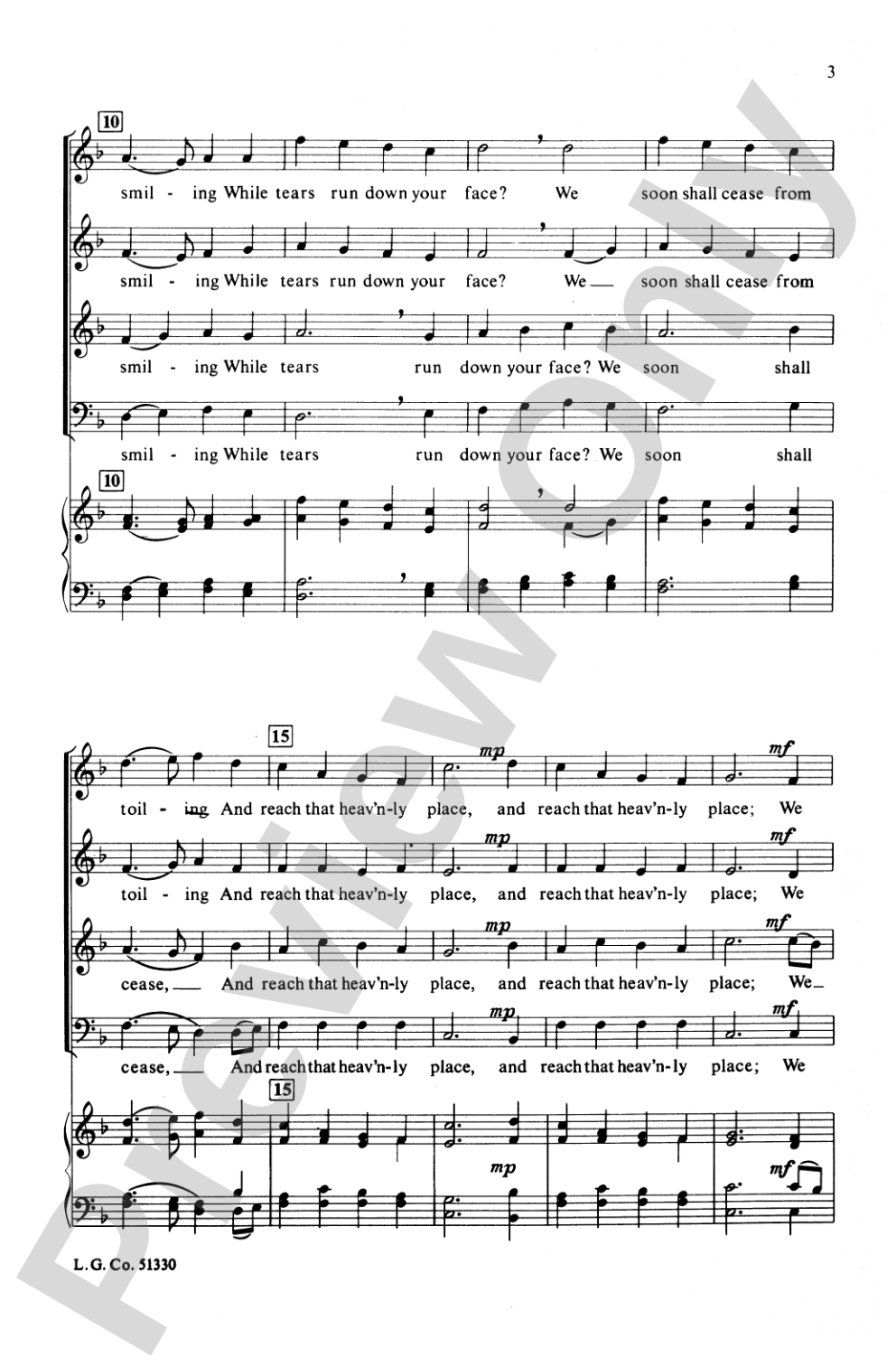
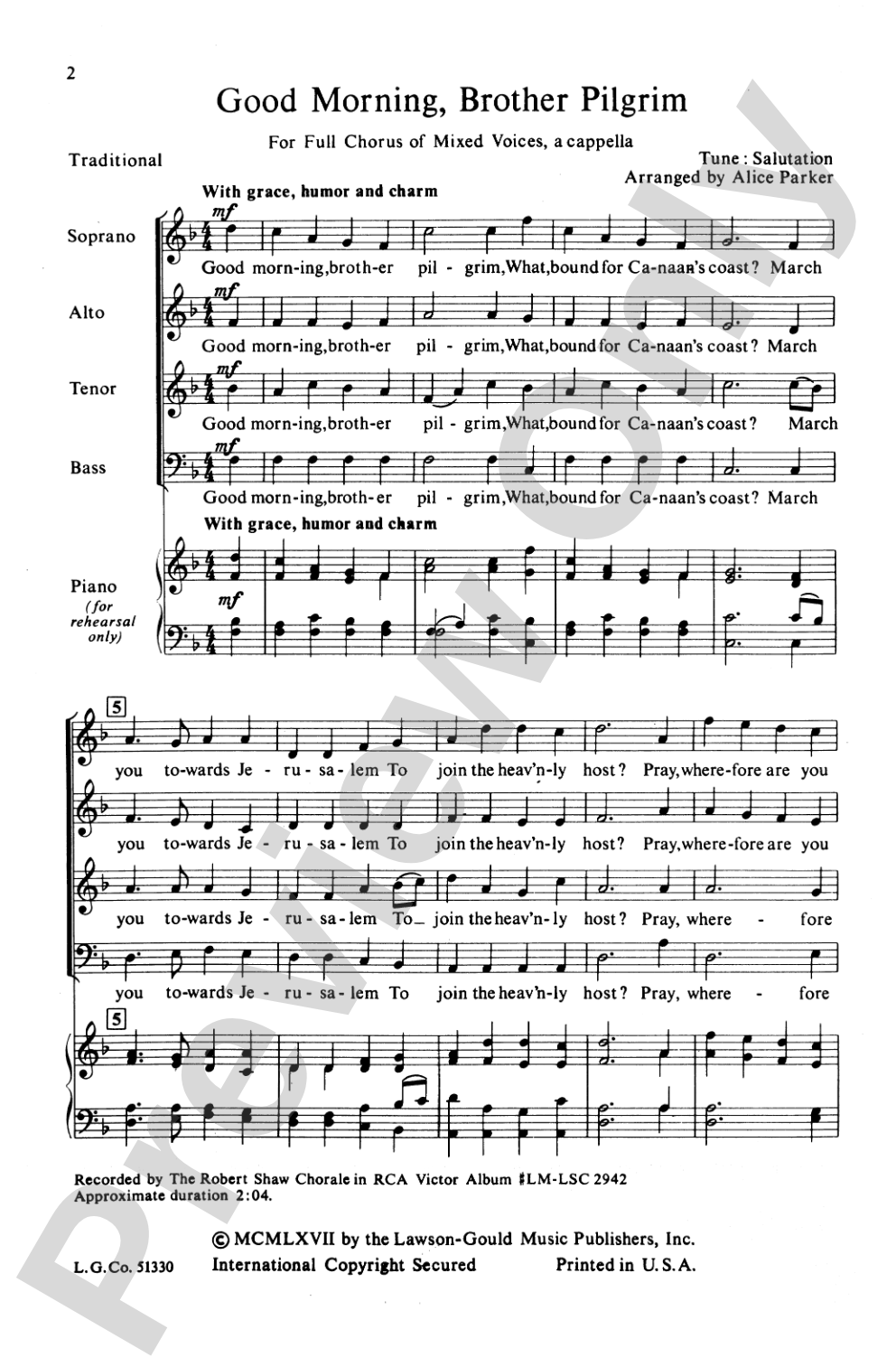
Good Morning, Brother Pilgrim Sheet Music Preview

Good Morning, Brother Pilgrim: SATB Choral Octavo

Arr. Alice Parker

Item: 00-PO-0004992

Digital Download
$2.25

Minimum order quantity: 20 copies

Description

Good Morning, Brother Pilgrim: SATB Choral Octavo isn't in MakeMusic Cloud just yet...but it could be. Let us know you'd like to see it, and you'll help shape what comes next. In the meantime, start a free trial and dive into thousands of interactive titles your students can play along with today.

Sample Audio
No sample audio found.
Sample Video
Additional Details
Series: Alfred Archive Edition: Robert Shaw Choral Series
Publisher: Alfred Music
Page Count: 8
SKU: 00-PO-0004992

More about this title

About the Arranger: Alice Parker

Alice Parker

Alice Parker brought together two distinct worlds in her career: she was a classically trained composer and conductor (studied at Smith College and Juilliard) and a passionate advocate for American vocal traditions. Her partnership with Robert Shaw yielded hundreds of choral arrangements of folk hymns and spirituals that remain central to the American choral repertoire. In 1985, Parker founded Melodious Accord, an organization dedicated to exploring melody as the heart of vocal music, and went on to publish influential texts on song leading, choral improvisation, and congregational singing.

Among her many honors, Parker received the Robert Shaw Award from the American Choral Directors Association, the Harvard Glee Club Foundation Medal, and six honorary doctorates. She served as the first Director Laureate of Chorus America and was named Distinguished Composer of the Year by the American Guild of Organists. Her legacy spans over five hundred published works, from operas and cantatas to individual anthems, all rooted in her conviction that strong melody and authentic folk expression matter deeply in choral music.

Why we love this

Parker's gift for setting American folk material lies in her ability to honor the melody while creating engaging inner voices that reward preparation. This particular arrangement appears in the Robert Shaw Choral Series, which means it carries the mark of Shaw's exacting standards for intonation, blend, and expressive authenticity. Directors return to Parker/Shaw settings because singers genuinely enjoy singing them and audiences immediately connect with the familiar tune dressed in fresh harmonic clothing.

What to expect

Warm, grounded, and deeply human. The piece carries the earnest quality of a hymn or spiritual greeting, with harmonies that feel both traditional and fresh. There's a congregational quality to it, as though the choir is inviting the audience to remember a tune they already know in their bones.

Who it's for

SATB choirs at community, educational, and sacred music levels who sing folk-based repertoire and spirituals. The accessibility of the melody makes it suitable for singers with varying levels of experience, while Parker's voice writing offers enough sophistication to engage advanced ensembles.

How to get the most out of it

  • Establish the melody clearly in soprano parts during the opening section; this folk tune depends on its recognizability, and any obscuring of the tune line will lose the audience immediately.
  • Balance the lower voices carefully in passages where alto, tenor, and bass move in contrary motion to the soprano line. Parker often writes independent material below, and it should support rather than compete.
  • Shape the piece phrase by phrase rather than treating it as a through-composed work. Folk songs breathe in natural units, and respecting those breathing points will enhance diction and musicality.

How to use it

This works beautifully in services of worship, memorial concerts, or programs celebrating American musical traditions. Its eight pages fit comfortably into a longer choral concert without requiring excessive rehearsal time, making it ideal for mid-season programming when you need something substantial but not demanding.

Skills your students will build

  • Balancing melody with supporting harmonies in folk-song contexts
  • Shaping phrase lines that follow natural speech and melodic contour
  • Singing with accuracy in mixed-voice textures while maintaining ensemble cohesion
  • Approaching folk material with authenticity and expression rather than over-arrangement

You May Also Like