Good Morning Blues: Piano/Vocal/Chords Digital Sheet Music

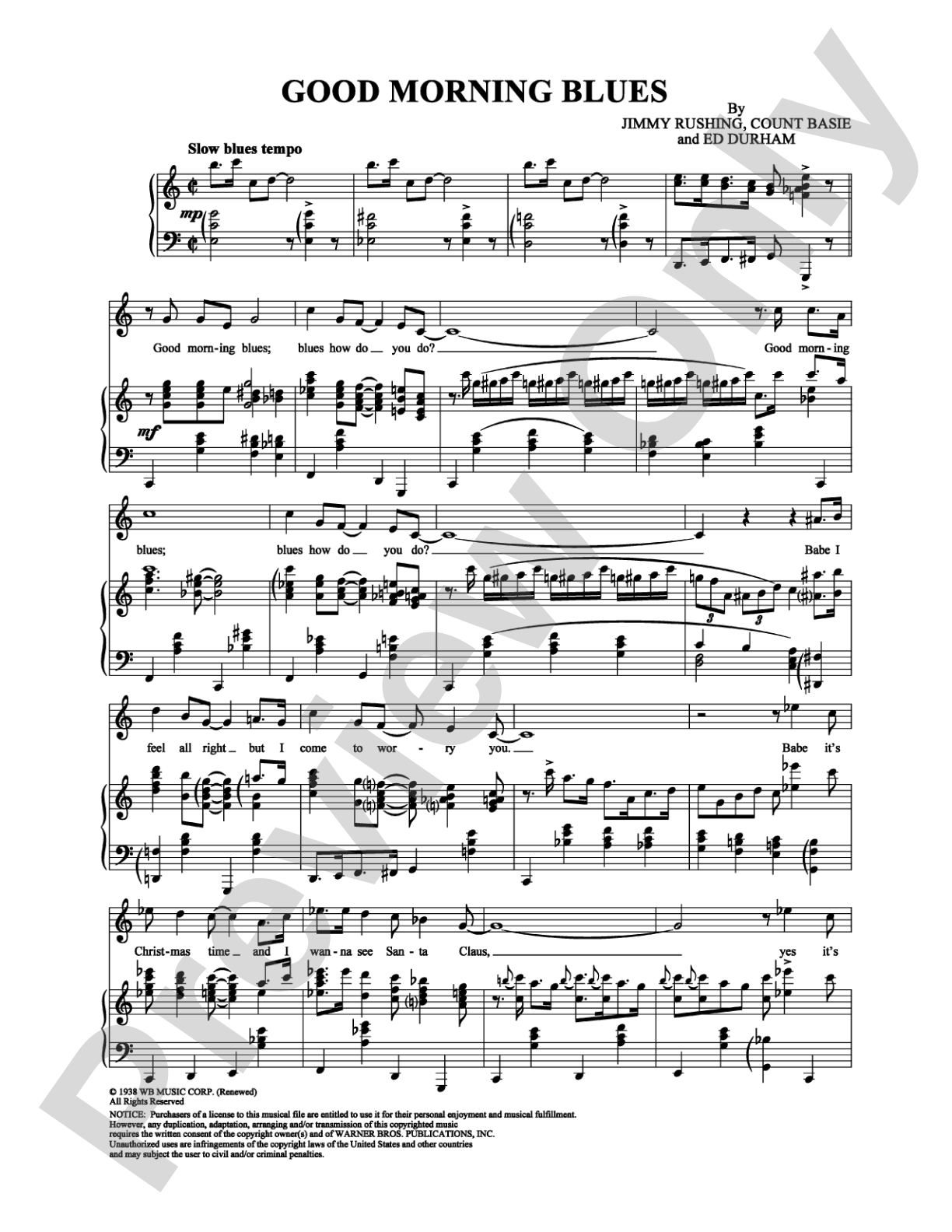
Good Morning Blues: Piano/Vocal/Chords Digital Sheet Music

Count Basie, Jimmy Rushing, Ed Durham

Item: 00-PS-0009046

Digital Download
$3.99
Description

Good Morning Blues: Piano/Vocal/Chords Digital Sheet Music isn't in MakeMusic Cloud just yet...but it could be. Let us know you'd like to see it, and you'll help shape what comes next. In the meantime, start a free trial and dive into thousands of interactive titles your students can play along with today.

Sample Audio
No sample audio found.
Sample Video
Additional Details
SKU: 00-PS-0009046

More about this title

About the Artist: Count Basie

Count Basie (1904, 1984) was a pianist and bandleader whose orchestra became one of the most influential ensembles in jazz history. His rhythmic approach to comping and his ability to drive a band with minimal but perfectly timed gestures revolutionized how pianists accompany musicians. Basie's compositions and arrangements, many written with collaborator Eddie Durham, became standards that defined the swing era and continue to define what it means to play with pocket and precision.

As an educator's reference point, Basie's style teaches students the power of restraint, pocket playing, and listening. His bands swung hard because every member understood space and timing, not because of technical complexity. His music remains essential for any student learning to accompany singers or develop a strong sense of groove.

Why we love this

Good Morning Blues captures the blues sensibility that grounded Basie's entire musical philosophy. The tune's straightforward form and strong melodic character make it accessible for singers and pianists learning to navigate jazz phrasing and harmony without sacrificing authenticity. It's a genuine teaching piece from someone who lived the idiom.

What to expect

The tune settles into the warm, grounded simplicity of a classic twelve-bar blues with the kind of unhurried sophistication Basie's band perfected. There's melancholy beneath the surface, but nothing ponderous; the melody lands easy and the harmonic motion feels inevitable rather than complicated.

Who it's for

Pianists and singers working together in jazz combos, vocal studios, or jazz ensembles benefit from this straightforward blues vehicle. Intermediate to advanced players can use it to develop swing feel and vocal accompanying skills without heavy technical demands.

How to get the most out of it

  • Listen to recordings of Basie's original arrangement to absorb the rhythmic pocket and understand where the piano sits behind the vocal line.
  • Shape the melody with swing eighth notes rather than straight rhythms; let the chord changes breathe naturally rather than hitting every harmonic change with equal weight.
  • Use the chords as a guide for comping, not a cage; leave space for the vocalist to land phrases and respond with minimal accompaniment during vocal passages.

How to use it

Pair this with other blues standards in a jazz-focused recital or concert to show depth within a single form. It works equally well as a solo vehicle in a student jazz combo performance or as part of a Basie-era retrospective.

Skills your students will build

  • Swing feel and phrasing over a twelve-bar blues form
  • Piano comping and accompaniment in jazz style
  • Reading chord changes and improvising extensions
  • Vocal jazz interpretation and lyrical phrasing
  • Developing taste and restraint in arrangement

You May Also Like